Showing posts with label 1948. Show all posts

Friday, April 19, 2024

#287 Bobby Adams - Baltimore Orioles


Robert Henry Adams
Baltimore Orioles
Second Base-Third Base

Bats:  Right  Throws:  Right  Height:  5'10"  Weight:  160
Born:  December 14, 1921, Tuolumne, CA
Signed:  Signed by the Cincinnati Reds as an amateur free agent before 1939 season
Major League Teams:  Cincinnati Reds 1946-1952; Cincinnati Redlegs 1953-1955; Chicago White Sox 1955; Baltimore Orioles 1956; Chicago Cubs 1957-1959
Died:  February 13, 1997, Gig Harbor, WA (age 75)

Bobby Adams spent a decade of his 14-year major league career with the Reds/Redlegs, enjoying his best seasons in the early 1950s with the club.  Adams assumed regular second baseman duties as a rookie with the Reds in 1946.  He'd back up Benny Zientara in 1947 and 1948, although he was the club's opening day second baseman for both those seasons.  Adams regained a starting job in 1951, moving over to third base, and his career year came in 1952 when he batted .283 while leading the National League with 637 at-bats.  He'd have another fine season in 1953, batting .275 and leading all National League third baseman in assists for the second year in a row.  Sold to the White Sox in July 1955, Adams would spend the rest of his career as a reserve infielder with the White Sox, Orioles and Cubs.

He batted .269 overall with 1,082 hits, 37 home runs and 303 RBIs.  Adams stayed with the Cubs after retiring as a player, and was a member of their College of Coaches between 1961 and 1965.  He'd manage the Triple-A Tacoma Cubs between 1966 and 1971, returning as a major league coach for the Cubs in 1973.

January 19, 2003 - NFC Championship Game at The Vet
Building the Set

January 18, 2003 in Plymouth Meeting, PA - Card #241
In January 2003, I added seven cards to our set, purchased at a baseball card show held inside the Plymouth Meeting Mall.  I paid $45 for the seven cards, which included this Adams card.  My Topps set building had stalled out somewhat in 2003 as I had switched over to become primarily a Phillies collector, and I was also spending my disposable income trying to put together the early Topps Heritage sets.  This was the first of only 18 cards we added to our set in 2003, but we did cross the threshold of needing less than 100 cards to complete the set late in the year.

The Card / Orioles Team Set
This is one of only two "2d base-3d base" position combinations in the set, along with Gil McDougald (#225), although Topps used "2nd-3rd base" for McDougald's card.  The action shot could feature Adams as a member of the White Sox looking to see where the ball went after it apparently got by him.  Adams wore #25 during his brief time with the White Sox, and that could be the number on the back of the fielder.  The head shot is the same used for Adams' 1955 Topps card, and Topps swapped out a Reds hat for an Orioles hat.

The cartoons on the back of the card highlight Adams' hustling play, his move to third base from second base and his move to the American League for the 1955 season.

1956 Season
Adams was traded by the White Sox to the Orioles on October 18, 1955 for outfielder Cal Abrams.  The Orioles' opening day third baseman, Adams struggled mightily at the plate over the season's first two months, and the club released him on May 28th.  The Orioles apparently realized they had made a  mistake, as they brought Adams back on June 4th, only for him to be released again on July 17th.  It looks as if he landed with the Orioles' Double-A team after that, as Adams appeared in 46 games for the San Antonio Missions, batting .310.  In his 41 games with the Orioles between April and July, Adams batted .225.

1948-49 Leaf #54
1952 Topps #249
1953 Bowman Color #108
1955 Topps #178
1959 Topps #249

Other Notable Baseball Cards

First Mainstream Card:  1948-49 Leaf #54
Topps Flagship Set Appearances (7):  1952-1956, 1958-1959
Most Recent Mainstream Card:  1994 Topps Archives 1954 #123

32 - Adams non-parallel baseball cards in the Beckett online database as of 4/6/24.

Sources:  
Baseball Reference
Beckett Database

Friday, January 12, 2024

#273 Walker Cooper - St. Louis Cardinals


William Walker Cooper
St. Louis Cardinals
Catcher

Bats:  Right  Throws:  Right  Height:  6'3"  Weight:  210
Born:  January 8, 1915, Atherton, MO
Signed:  Signed by the St. Louis Cardinals as an amateur free agent before 1935 season
Major League Teams:  St. Louis Cardinals 1940-1945; New York Giants 1946-1949; Cincinnati Reds 1949-1950; Boston Braves 1950-1952; Milwaukee Braves 1953; Pittsburgh Pirates 1954; Chicago Cubs 1954-1955; St. Louis Cardinals 1956-1957
Died:  April 11, 1991, Scottsdale, AZ (age 76)

Until composing this post, I had no idea Walker Cooper was a veteran of 18 major league seasons, an eight-time All-Star and a two-time World Champion with the Cardinals in the early 1940s.  Cooper was behind the plate for the Cardinals' World Series wins in 1942 and 1944, batting .300 overall in 16 World Series games, including the 1943 series in which the Cardinals lost to the Yankees.  In that 1943 season, Cooper batted .318 with 81 RBIs, finishing as runner-up to teammate Stan Musial for National League MVP honors.  He was the starting catcher for the National League All-Stars in six of the nine All-Star Games played in the 1940s.  Cooper missed most of the 1945 season while serving in the U.S. Navy during World War II, and was sold to the Giants in 1946 following a salary dispute.  With the Giants in 1947, he reached career highs in both home runs (35) and RBIs (122).

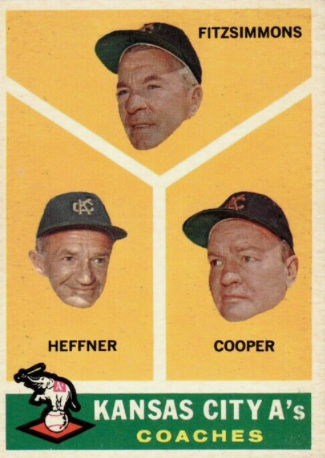
Cooper would play for six different teams, all in the National League, and would finish his big league career as a back-up catcher and pinch-hitter for the Cardinals in 1956 and 1957.  One of the strongest players in the game, Cooper also earned respect for his defense and ability to call a great game behind the plate.  In 1,473 games played, Cooper batted .285 with 1,341 hits, 173 home runs and 812 RBIs.  At the time of his retirement, he was among the top five all-time National League catchers in average, slugging percentage, home runs and RBIs.  Cooper managed in the minor leagues for three seasons and was a coach for the Kansas City Athletics in 1960.

Building the Set
Summer of 1983 or 1984 in Millville, NJ - Card #37
This Cooper card was one of the Original 44 and the last time I told the full story of the Original 44 was almost a year ago within the Walt Dropo (#238) post, so I'll repeat it again here.

June 1983 - Ocean City Baseball Card Show
Technically speaking, my Dad and I actually began collecting the set in the summer of 1987, but this card (along with the other Original 44) first entered my collection three or four years before that.

I think it was either the summer of 1983 or 1984 when a shoebox of vintage baseball cards, football cards and a few non-sports cards arrived into my world.  The box contained about a hundred cards dating between 1950 and 1956, and for the most part, they were all in excellent shape.  A friend of the family was in the process of cleaning up and moving into her new house when she found the old shoebox and she wondered if the only kid she knew who collected baseball cards (me) would be interested in looking through it – maybe even taking the box off her hands.

She dropped the box off to my parents and asked them to have me look through the box and take what I was interested in. Turns out, I was interested in everything.  Up to that point, the oldest cards in my collection were cards from the early '70s I had obtained through trades or cards that my Dad had picked up for me at yard sales or small baseball card shows.  (My Dad had given me a few dog-earred and rough Topps cards – Juan Pizzaro and Jim Busby – a few years prior, and I completely forget how or why he had purchased these cards for me.)

My parents asked me to pick out a few cards from the box, and then we’d return the rest to the family friend.  Problem was, I wanted them all.  I really wanted them all.  I diligently and meticulously went through one of my price guides and determined the “value” of the treasure chest. I probably used my Sport Americana Baseball Card Price Guide No. 4, edited by Dr. James Beckett, and I had no way to value the football or non-sports cards.  My memory is fuzzy, and I can't find the original tally, but I think I came up with the box being worth somewhere in the neighborhood of $300 to $400, which I knew my parents definitely did not have in their discretionary spending budget.  But they could tell how much I wanted those cards, as I lovingly studied each and every one and handled each as if it were some long-lost artifact.

I don’t know the exact details, but I believe my Dad went back to the friend and told her we’d take the whole box, but only if she let him give her some money for it.  I believe she was genuinely shocked that the box of old cardboard pictures had some value, and that someone was willing to give her cash for it.  My Dad shared the list I had created showing the “book value” of the cards and he mentioned how it was going to be close to impossible to get me to pick and choose which ones I wanted.  When all was said and done, the family friend, who had absolutely no intention of making money on this endeavor, walked away with (I think) something in the neighborhood of $100 for the whole lot.

Within the spoils were 44 cards from the 1956 Topps set – by far the most cards from any one set.  I studied them, I sorted them, and I pretty much memorized every detail of those 44 cards.  

And so a few years later, in the summer of 1987 while on a family vacation, I was giddy with excitement when we came across a few ’56 Topps cards in the Walker Gallery on the main drag in Cooperstown, New York.  My Dad and I studied the cards for sale and he casually asked me the question, “Why don’t we try to put together the whole set?” We bought four cards that day for $9.25.  Those cards, along with the 44 from the magic shoebox, became the basis for our 1956 Topps set.

The Card / Cardinals Team Set
This marks Cooper's first mainstream baseball card in a few years, as he had last appeared in the 1953 Bowman Black & White set.  It would seem as if the runner is safe in the action shot?  The three cartoon panels on the back cover all the right highlights, including his return to the Cardinals for the 1956 season, his reputation as a slugger and his fantastic 1947 season with the Giants.

1956 Season
In his penultimate season, and at the age of 41, Cooper re-signed with his original team, the Cardinals, to serve as the back-up catchers Bill Sarni (#247) and Hal Smith (#283).  Cooper started only 12 games all season, appearing in 40 games overall, mostly as a pinch-hitter.  He batted .265 with a pair of home runs and 14 RBIs.

1943 M.P. & Co. (R302-1)
1948 Bowman #9
1952 Topps #294
1957 Topps #380
1960 Topps #462

Other Notable Baseball Cards

First Mainstream Card:  1943 M.P. & Co. (R302-1)
Topps Flagship Set Appearances (4):  1952, 1956-1957, 1960
Most Recent Mainstream Card:  1992 Conlon Collection TSN #633

48 - Cooper non-parallel baseball cards in the Beckett online database as of 12/21/23.

Sources:  
Baseball Reference
Beckett Database

Friday, October 14, 2022

#222 Dave Philley - Baltimore Orioles


David Earl Philley
Baltimore Orioles
Outfield


Bats:  Both  Throws:  Right  Height:  6'0"  Weight:  188
Born:  May 16, 1920, Paris, TX
Acquired:  Purchased by the Chicago White Sox from the Shreveport Sports of the Texas League, July 18, 1941
Major League Teams:  Chicago White Sox 1941, 1946-1951; Philadelphia Athletics 1951-1953; Cleveland Indians 1954-1955; Baltimore Orioles 1955-1956; Chicago White Sox 1957; Detroit Tigers 1957; Philadelphia Phillies 1958-1960; San Francisco Giants 1960; Baltimore Orioles 1960-1961; Boston Red Sox 1962
Died:  March 15, 2012, Paris, TX (age 91)

Journeyman outfielder Dave Philley spent part of 18 seasons in the majors with eight different teams, and that's after having missed three full years while serving during World War II.  With a strong outfield arm, Philley led all outfielders in assists three times (1948, 1949, 1953).  His best seasons came in the early 1950s as he reached career highs in home runs (14) and RBIs (80) with the White Sox in 1950, and strung together seven consecutive seasons between 1947 and 1953 with at least 20 doubles.  With the Athletics in 1953, he reached career highs in batting average (.303), hits (188) and doubles (30).  Philley's sole postseason appearance came in the 1954 World Series with the Indians, where he was used mostly as a late inning defensive replacement.  With the Orioles in 1955, Philley won the team's batting title with a .299 mark and was named the club's MVP.

1958 Hires #12
Philley continued to move around during the final phase of his career, playing for seven different teams between 1956 and 1962, including second stints with the White Sox and Orioles.  He developed into an excellent pinch-hitter, collecting 18 pinch-hits for the Phillies in 1958, including eight in a row at the end of the season.  Philley earned a lifetime average of .300 as a pinch-hitter, collecting 92 pinch-hits in 307 at-bats.  He retired following the 1962 season with a .270 average in 1,904 games, exactly 1,700 hits and 101 stolen bases.  Philley briefly managed in the Houston system following his retirement, and also spent time with the Red Sox as a scout.

Building the Set
Summer of 1983 or 1984 in Millville, NJ - Card #27
This was one of the Original 44, and I re-told the story of how my Dad and I started collecting this set with the Early Wynn (#187) post, back in January.  Seven of the Original 44 came from series one, with 11 coming from series two, and this Philley card is the ninth of 16 from series three.

The Card / Orioles Team Set
Philley appeared in both Bowman and Topps sets in 1954, and then was completely left out of both sets in 1955.  He's shown here swinging a bat in Yankee Stadium, and it's possible he's wearing an Indians uniform that had been updated by a Topps artist to look like an Orioles uniform.  On the back, his team-leading average from 1955 is highlighted, and Topps is incorrect in their prediction that the frequently moving Philley was in Baltimore to stay.  By the time collectors were finding this card in packs, he was most likely already back with the White Sox.

1956 Season
Philley began the year with the Orioles and was their opening day right fielder.  He'd play in just 32 games for Baltimore before the team swapped him to the White Sox with Jim Wilson (#171) for Mike Fornieles, Connie Johnson (#326), George Kell (#195) and Bob Nieman (#267).  In his second stint with Chicago, Philley appeared in 86 games overall, seeing time at first base, right field and left field.  He batted .265 with four home runs and 47 RBIs for the White Sox as the team finished in third place in the American League.

Phillies Career
On December 11, 1957, the Tigers sold Philley to the Phillies, finally bringing together the player and the team that bore the same name.  He was acquired specifically to be a veteran bat off the bench, although he did make 17 starts at first base and 24 starts in right field, occasionally backing up Ed Bouchee or Wally Post (#158).  He broke his nose on May 17th after diving into the stands while playing first base and trying to catch a foul ball.  He spent all of 1959 with the club in the same pinch-hitting and back-up role, and returned for 14 games in 1960 before being sold to the Giants on May 12, 1960.  In 1959, his average as a pinch-hitter was an incredible .395 (15 for 38) and he drove in 11 runs.

With the Phillies, Philley appeared in 204 games overall, batting .300 with 10 home runs and 72 RBIs.  He collected 37 pinch-hits and his 18 pinch-hits from the 1958 season are the fourth most in a season by a Phillies player behind Greg Dobbs (22 in 2008), Doc Miller (20 in 1913) and Greg Gross (19 in 1982).

1948-49 Leaf #85
1952 Topps #226
1954 Topps #159
1959 Topps #92
1962 Topps #542

Other Notable Baseball Cards

First Mainstream Card:  1948-49 Leaf #85
Topps Flagship Set Appearances (10):  1952-1954, 1956-1962
Most Recent Mainstream Card:  1994 Topps Archives 1954 #159

61 - Philley non-parallel baseball cards in the Beckett online database as of 10/11/22.

Sources:  
Baseball Reference
Beckett Database

Monday, October 3, 2022

#220 Del Ennis - Philadelphia Phillies


Delmer Ennis
Philadelphia Phillies
Outfield


Bats:  Right  Throws:  Right  Height:  6'0"  Weight:  195
Born:  June 8, 1925, Philadelphia, PA
Signed:  Signed by the Philadelphia Phillies as an amateur free agent before 1943 season
Major League Teams:  Philadelphia Phillies 1946-1956; St. Louis Cardinals 1957-1958; Cincinnati Reds 1959; Chicago White Sox 1959
Died:  February 8, 1996, Huntingdon Valley, PA (age 70)

Slugger Del Ennis was one of the bright spots for the Phillies in the 1950s, helping to lead the Whiz Kids to the 1950 National League pennant, and earning a spot on three All-Star teams.  A popular player, especially for a kid growing up in Millville, New Jersey (see below), Ennis hit for power, ran the bases with speed and provided steady defense in the outfield, aided by a strong throwing arm.  Ennis was at his peak between 1948 and 1950, driving in 95, 110 and a league leading 126 runs in each of those three years, and clubbing a career-high 31 home runs in 1950.  He collected MVP votes in eight different season, finishing fourth in 1950.  His last great season with the Phillies came in 1955 when he was named to his final All-Star team, and he finished the season with a .295 average.  Ennis drove in at least 100 runs in seven different seasons, and hit at least 20 home runs in nine different seasons.

2006 Toyota Phillies Wall of Fame Postcards
Dealt to the Cardinals following in late 1956, Ennis would play two and half more seasons before retiring.  In 1,903 career games, he batted .284 with 288 home runs and 1,284 RBIs.  He operated a bowling alley in Huntingdon Valley, Pennsylvania following his retirement, and the Phillies inducted him into their Wall of Fame in 1982.  Ennis was named as an outfielder on the Phillies' Centennial Team in 1983, and he was a frequent autograph signer at area baseball card shows throughout the 1980s.

Building the Set
December 25, 1996 from Deptford Mall Baseball Card Show - Card #148
It's appropriate this card would have been considered a major Christmas present in 1996, as Del Ennis was one of my Dad's favorite players growing up, along with Ennis' former Phillies teammate Dick Sisler.  The baseball card show held inside the Deptford Mall most likely took place that November or December, and my Dad stashed this card away to be revealed on Christmas morning.  He must have told me how much it cost as I have in my notes the card cost a whopping $9.

1996 was a transitional year for my Dad and me.  He required open heart surgery earlier in the year, and I was set to graduate college.  Although nerve-wracking, his surgery was a success and I opted to stay one more year in school to complete my Masters degree.  My best friends from my first four years of college were preparing to move on, and I was preparing to stick around, albeit with a new group of friends and in somewhat unfamiliar territory.  This Ennis card would have showed up as I was making the transition from student to adult, and it would have seen a confused kid making questionable decisions and looking for any port in the storm.

The Card / Phillies Team Set
I've always loved this card.  This is Ennis' first Topps card since 1952, as he had been under exclusive contract with Bowman between 1953 and 1955.  The back of the card highlights his impressive consistency with his yearly home run and RBI totals.  The final cartoon panel shows Ennis on the way to his big league debut in 1946.  He might have been up sooner if not for a two and half year stint in the U.S. Navy, which began in 1943 and ended on April 5, 1946, just a few short weeks before his first action with the Phillies.

Phillies Career / 1956 Season
Ennis made his debut with the Phillies on April 28, 1946, and became the first rookie in team history to make the All-Star team.  As mentioned above, he was a member of the storied Whiz Kids team that won the National League pennant in 1950, becoming the first Phillies team in the postseason since 1915.  The team was swept by the Yankees in the World Series, but much like the 1993 Phillies team, the legacy of that club and the good memories from that season endure among many lifelong Phillies fans.  He passed Chuck Klein in 1956 as the team's all-time home run leader, and he held that spot until passed by Mike Schmidt in 1980.  He also broke the games played record in 1956, held by Ed Delahanty who had appeared in 1,544 games with the Phillies.  He's currently third on the Phillies all-time home run leader board with 259, behind Schmidt and Ryan Howard.  Ennis now ranks sixth in games played (1,630), fifth in hits (1,812), third in RBIs (1,124) and eighth in doubles (310).

In 1956, his final season with the Phillies, Ennis was again the team's opening day left fielder and he'd start all but one of the team's 154 games at the position.  He batted .260 with 26 home runs and 95 RBIs, as the Phillies finished in fifth place.  On November 19th, the Phillies traded Ennis to the Cardinals for Bobby Morgan (#337) and Rip Repulski (#201).

1948-49 Leaf #49
1950 Bowman #31
1952 Topps #223
1953 Bowman Color #103
1959 Topps #255

Other Notable Baseball Cards

First Mainstream Card:  1949 Leaf #49
Topps Flagship Set Appearances (5):  1951-1952, 1956-1959
Most Recent Mainstream Card:  1994 Upper Deck All-Time Heroes #32

68 - Ennis non-parallel baseball cards in the Beckett online database as of 10/3/22.

Sources:  
Baseball Reference
Beckett Database

Friday, June 3, 2022

#205 "Whitey" Lockman - New York Giants


Carroll Walter Lockman
New York Giants
Outfield

Bats:  Left  Throws:  Right  Height:  6'1"  Weight:  175
Born:  July 25, 1926, Lowell, NC
Signed:  Signed by the New York Giants as an amateur free agent before 1943 season
Major League Teams:  New York Giants 1945, 1947-1956; St. Louis Cardinals 1956; New York Giants 1957; San Francisco Giants 1958; Baltimore Orioles 1959; Cincinnati Reds 1959-1960
As a Manager:  Chicago Cubs 1972-1974
Died:  March 17, 2009, Scottsdale, AZ (age 82)

All but two of Whitey Lockman's 15 seasons in the major leagues were spent playing for the Giants.  He came up as a rookie with the Giants in 1945, a few weeks shy of his 19th birthday.  Lockman enjoyed his best seasons in the late 1940s, hitting a career-high 18 home runs in 1948 as the Giants' regular center fielder.  He batted a career-high .301 in 1949.  On October 3, 1951, Lockman doubled home Al Dark (#148) in the bottom of the ninth inning during the three-game divisional playoff series against the Dodgers.  He'd then score when Bobby Thomson (#257) hit his famous "Shot Heard 'Round the World" to send the Giants to the World Series.  Lockman led off and played first base for the National League All-Stars in 1952, but went 0 for 3 in the game.  He was a member of the World Champion Giants in 1954, playing as their every day first baseman.  He'd briefly play for the Cardinals in 1956 before returning to the Giants for their final season in New York in 1957.  Lockman served as a bat off the bench in 1958, the team's first year in San Francisco, and he'd spend the last two seasons of his playing career primarily as a pinch-hitter for the Orioles and Reds.  In 1,666 career games, Lockman batted .279 with 114 home runs and 563 RBIs.

Lockman joined the Reds' coaching staff in 1960, moving back to the Giants in 1961 as the third base coach for manager Dark.  Following the 1964 season, Lockman moved to the Cubs as a minor league manager (1965, 1967-1970) and big league coach (1966).  He managed the Cubs between 1972 and 1974 to a 157-162 record.  Following his stint as Cubs manager, Lockman worked as a scout and in the front office of the Cubs, Expos and Marlins.


Building the Set
May 21, 2000 in Raleigh, NC - Card #202
I was mostly miserable during the years I lived in Raleigh, following my graduation from college, but I remember looking forward to the monthly baseball card shows held at the North Carolina State Fairgrounds.  While so much during that time was confusing to me, the familiarity of a baseball card show, along with the sights and sounds of the activity within the show building would have provided some comfort.   I attended the May 2000 show on a Sunday, and I don't remember seeing autograph guest Bob Feller (#200) there at all.  According to my records, this was the only card added to our 1956 Topps set, purchased for $6.  The bulk of my collecting budget went towards a growing 1972 Topps set, and my hand-written list shows I purchased 21 cards for that set for $51.  I'm guessing I had allotted $60 for the show in total, with $2 for admission, $6 for this Lockman card and $51 for the 1972 Topps lot.  Maybe the remaining $1 went towards a hot dog.  My big purchase was the 1972 Topps Brooks Robinson card for $15.

I would have called my Dad after this show to tell him to update his list back in New Jersey for the new Lockman card added, and the next cards added to the set wouldn't come until August.

The Card / Giants Team Set
I had always assumed Lockman was the runner in the action photo, but in researching this post, I now realize he never wore #3, and he's the first baseman partially obscured by the runner.  Assuming the Topps artist colored the photo correctly, and the number on the runner's back is supposed to be black, that could be the Pirates' George Freese being forced out.  Freese played in nine games against the Giants in 1955.

This is Lockman's first Topps set appearance since his card in the 1951 Topps Red Backs set.  The first cartoon on the back of the card highlights Lockman hitting a home run in his first big league at-bat on July 5, 1945 off Cardinals' pitcher George Dockins.  The final cartoon panel points out Lockman was a fine fielder both in the outfield and at first base.

1956 Season
Lockman began the season on the Giants' bench, occasionally starting in place of Gail Harris (#91) at first base or Dusty Rhodes (#50) in left field.  After 48 games with the Giants, he was traded to the Cardinals on June 14th with Dark, Ray Katt, Don Liddle (#325) and cash for Jackie Brandt, Dick Littlefield, Bill Sarni (#247), Red Schoendienst (#165), Bob Stephenson and Gordon Jones.  Lockman started 46 games in the outfield for the Cardinals, at all three outfield positions, and in 70 games overall he batted .249 with 10 RBIs.  During spring training in 1957, the Cardinals sent him back to the Giants in exchange for future Hall of Famer Hoyt Wilhelm (#307).

1948 Bowman #30
1951 Bowman #37
1954 Bowman #153
1960 Topps #535
1974 Topps #354

Other Notable Baseball Cards

First Mainstream Card:  1948 Bowman #30
Topps Flagship Set Appearances (7):  1951, 1956-1960, 1973-1974
Most Recent Mainstream Card:  2009 Topps Heritage Real One Autographs #ROA-WL

71 - Lockman non-parallel baseball cards in the Beckett online database as of 5/30/22.

Sources:  
Baseball Reference
Beckett Database