Showing posts with label Red-Orange. Show all posts

Friday, September 24, 2021

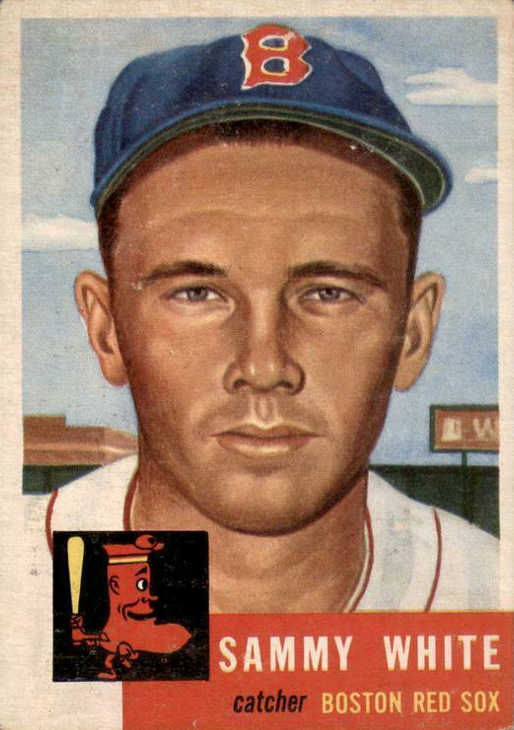
#168 Sammy White - Boston Red Sox


Sammy Charles White
Boston Red Sox
Catcher


Bats:  Right  Throws:  Right  Height:  6'3"  Weight:  195
Born:  July 7, 1927, Wenatchee, WA
Acquired:  Traded by Seattle (PCL) to the Boston Red Sox for 3 players to be named later and optional assignment of Windy McCall and John Hoffman, May 16, 1949
Major League Teams:  Boston Red Sox 1951-1959; Milwaukee Braves 1961; Philadelphia Phillies 1962
Died:  August 4, 1991, Princeville, HI (age 64)

An all-around athlete, Sammy White could have signed to play professional basketball with the Minneapolis Lakers, but was forbidden to do so by the team holding his baseball contract - the Red Sox.  With the Red Sox, White was the club's regular catcher and a fan favorite between 1952 and 1959, enjoying an All-Star season in 1953.  His best season came in 1954 when he batted .282 with career highs in both home runs (14) and RBIs (75).  White was known as a good fielding catcher with a strong arm.  He led all American League catchers with baserunners caught stealing in 1955 and 1956.  After nine seasons with the Red Sox, White was traded to the Indians on March 16, 1960, but he refused to report, opting to retire instead, and the three-player trade was voided.  White sat out the 1960 season, returning after a year off to play parts of the next two seasons as a back-up with the Braves and Phillies.

In 1,043 major league games, White batted .262 with 916 hits, 66 home runs and 421 RBIs.  His caught stealing percentage of 47.2% is currently 57th all-time.  White would go on to become a professional bowler and then a professional golfer, spending the last years of his life living in Hawaii close to his friend and former teammate Frank Sullivan (#71).

Building the Set
Summer of 1983 or 1984 in Millville, NJ - Card #18
This was one of the Original 44, and I recently re-told the story of how my Dad and I started collecting this set with the Ed Mathews (#107) post.  There were a lot of these Original 44 cards bunched together, meaning the original owner must have opened a few Series Two packs.  Seven of the Original 44 came from Series One, with 11 coming from Series Two.  This is the last of those 11, and first ten covered were Mathews, Yogi Berra (#110), Jim Brady (#126), Eddie Yost (#128), Willie Mays (#130), the Cardinals team card (#134), Johnny Logan (#136), Johnny Antonelli (#138), Harvey Kuenn (#155) and Red Schoendienst (#165).

The Card / Red Sox Team Set
At first, I assumed the catcher in the action shot was White but it appears to be yet another cameo by Yankees catcher Berra and White is the runner doing the face plant at home plate.  This card marks White's return to Topps sets after a two-year absence and exclusive appearances with Bowman in 1954 and 1955.  The cartoon panels on the back highlight his collegiate basketball career and his strong throwing arm.  The middle panel shows White scoring three times in one inning - a feat he accomplished on June 18, 1953, when the Red Sox scored 17 runs in the seventh inning at Fenway Park against the Tigers, and they'd go on to a 23-3 win.

If you're keeping score at home, this is the fifth card in the set with the red-orange color bar combination on the front.  Preceding White were Hal Smith (#62), Babe Birrer (#84), Jim Davis (#102) and Jake Martin (#129).

1956 Season
White was the Red Sox' opening day catcher, and he'd make 112 starts behind the plate during the season.  He batted .245 with five home runs and 44 RBIs, and he caught the no-hitter thrown by Mel Parnell on July 14th.

I first wrote about White's appearance in the Norman Rockwell painting The Rookie, back when I posted Sullivan's card.  On an off-day during the 1956 season, White, Sullivan and Jackie Jensen (#115) were told to take a drive to meet with who they were told was a photographer.  The photographer, who was actually famous painter Norman Rockwell, used the photographs he took that day as the basis of his painting, The Rookie, which appeared on the cover of The Saturday Evening Post in March 1957.  Sullivan, who actually wore #18 at the time, is the player with the #8 peaking through on his back and White is shown to the far left holding a catcher's mitt.  In 2014, the original Rockwell painting sold for $22.5 million.

Phillies Career
White and Sullivan reunited briefly with the Phillies during the 1962 season.  White was signed prior to the season to serve as a veteran back-up to Clay Dalrymple.  White made 31 starts at catcher, and would ultimately lose additional playing time to Bob Oldis who served as Dalrymple's back-up during the final months of the season.  In 41 games, White batted .216 and appeared in his final big league game on August 23, 1962.  He was released by the Phillies following the season.

1952 Topps #345
1953 Topps #139
1954 Bowman #34
1957 Topps #163
1962 Topps #494

Other Notable Baseball Cards

First Mainstream Card:  1952 Topps #345
Topps Flagship Set Appearances (8):  1952-1953, 1956-1960, 1962
Most Recent Mainstream Card:  1991 Topps Archives 1953 #139

34 - White non-parallel baseball cards in the Beckett online database as of 9/19/21.

Sources:  
Baseball Reference
Beckett Database
The Phillies Room
SABR
The Trading Card Database

Friday, December 25, 2020

#129 "Jake" Martin - Pittsburgh Pirates


Paul Charles Martin
Pittsburgh Pirates
Pitcher

Bats:  Right  Throws:  Right  Height:  6'6"  Weight:  235
Born:  March 9, 1932, Brownstown, PA
Signed:  Signed by the Pittsburgh Pirates as an amateur free agent, June 28, 1955
Major League Teams:  Pittsburgh Pirates 1955
Died:  October 11, 2011, San Diego, CA (age 79)

Paul "Jake" Martin was a big right-handed pitcher singed as a bonus baby in 1955.  He appeared in only seven games for the Pirates in 1955 before suffering a career-ending arm injury.  Martin made his big league debut on July 2, 1955 against the future World Champion Brooklyn Dodgers.  He pitched two shutout innings, striking out three batters - Don Zimmer (#99) and Jackie Robinson (#30) twice.  Martin's next six outings all resulted in at least one run scored with his final appearance on August 16th leading to five runs scored by the Phillies in two innings of work.  His career line was 0-1 with a 14.14 ERA with 3 strikeouts and 17 walks.  Martin was released by the Pirates on April 27, 1956.

Building the Set

October 3, 1988 in Millville, NJ - Card #67
This was one of three 1956 Topps cards my parents gave me for my 15th birthday, the others being Ray Moore (#43) and Dean Stone (#87).  I'm 95% certain my Dad purchased these cards at a baseball card show held at our local YMCA in August and then gave them to me a few months later.  I have in my records that this card cost him $3.  I was more focused on building our 1973 Topps set in the summer of '88, as those cards were more readily available and much cheaper.  My allowance from mowing lawns only went so far.

We didn't get autographs from either of the show's guests, Spook Jacobs or Chris Short and I included the front and back of the show's flyer in previous posts.  I'm kicking myself now, over 30 years later, for not spending the $2 it would have cost me for an autograph and a picture with Short.  

I worked at the Millville YMCA in the summer of 1990 before it closed its doors for good that August.  In 1997, the building was repurposed as an apartment complex with the pool and gym renovated and updated and it's now operated as The Holly City Family Center.

The Card / Pirates Team Set
This is the one and only baseball card issued for Martin during his playing days, given his professional career lasted 7 games.  The card was reprinted for Martin to sign as part of the 2005 Topps Heritage Real One Autographs insert set.  Topps had to act quickly to get pictures of the big righty, as he was only active between early July and mid-August.  This is the first full on profile photo used in the set and Martin's nickname "Jake" is present in his signature.

Flipping to the back, the first two cartoon panels tell the story of Martin's arrival and big league debut against the Dodgers.  The third panel shows Martin's goal of becoming a minister.  I found his obituary, where it mentions he did attend Nyack Theological Seminary in New York and he served as a minister for a short time.  His true calling was has a long-time chiropractor in San Diego, where he lived for nearly 50 years.  As a respected chiropractor, he apparently traded his "Jake" nickname for "Doc."

1956 Season
There's nothing to report here.  Martin was released by the Pirates in April and would never again play professional baseball.  He's the third player to have a card in the set who had already appeared in his final game, joining Nelson Burbrink (#27) and Karl Spooner (#83).

Other Notable Baseball Cards
First Mainstream Card:  1956 Topps #129
Topps Flagship Set Appearances (1):  1956
Most Recent Mainstream Card:  1956 Topps #129

4 - Martin non-parallel baseball cards in the Beckett online database as of 11/27/20.

Sources:  
Baseball Reference
Beckett Database
The Trading Card Database

Friday, June 19, 2020

#102 Jim Davis - Chicago Cubs


James Bennett Davis
Chicago Cubs
Pitcher

Bats:  Both  Throws:  Left  Height:  6'0"  Weight:  180
Born:  September 15, 1924, Red Bluff, CA
Signed:  Signed by the Boston Red Sox as an amateur free agent before 1946 season
Major League Teams:  Chicago Cubs 1954-1956; St. Louis Cardinals 1957; New York Giants 1957
Died:  November 30, 1995, San Mateo, CA (age 71)

Used primarily as a reliever, Jim Davis appeared in 154 games in parts of four seasons with the Cubs, Cardinals and Giants.  Relying on his screwball and a knuckleball, he owned a lifetime record of 24-26 with a 4.01 ERA and 8 saves.  His first season was also his best as he went 11-7 with the Cubs in 1954 with a career low 3.52 ERA.  He finished in tenth place in the N.L. for appearances in 1954 and 1956, pitching in 46 games in both those seasons.

Davis pitched for 12 seasons in the minor leagues between 1946 and 1959, having a record of 102-73 and a 3.36 ERA over 361 games.

Building the Set
February 9, 2002 in Cooperstown, NY - Card #231
This is one of only four cards I purchased in 2002, which was one of the tougher years for me personally.  I made a solo unscheduled and unplanned trip to Cooperstown in early 2002 in an attempt to clear my mind one weekend.  It was an escape.  Thinking back on that time now 18 years later, I realize Cooperstown was a logical choice for me to make my escape as I could leave my present worries behind and live in the past for a few days.  I spent a lot of time walking around the Hall of Fame, taking my time and actually relaxing.

I didn't have a lot of money for this trip, but I visited Baseball Nostalgia that Saturday afternoon and purchased four cards for our 1956 Topps set, including this Davis card.  The other three cards purchased were Don Kaiser (#124), Joe Frazier (#141) and Tom Gorman (#246) and the four cards together cost me $18.50.  That's a fairly low price to pay for some much needed baseball card therapy.

I'm happy to see Baseball Nostalgia is still open, although as I'm writing this it's currently closed due to the coronavirus pandemic.  My wife and I have discussed taking a trip back to Cooperstown when everything gets back to normal as neither of our boys have ever visited before.  Whenever that trip happens, I'll be sure to pay a visit to Baseball Nostalgia.

The Card
Davis appeared on three Topps flagship cards, with his 1955 and 1956 cards using the same photo.  The cartoonist on the back did a wonderful job highlighting Davis' knuckle ball and his role as one of the Cubs' top relievers in 1955.

Cubs Team Set

1956 Season
Davis spent the entire season with the Cubs and along with Turk Lown was one of the team's most heavily relied upon relievers.  He appeared in 46 games, making 11 starts, and went 5-7 with a 3.66 ERA.  On May 27th against the Cardinals, Davis struck out four batters in the sixth inning, tying a long-time record and becoming the first pitcher to perform the feat in 40 years.  He struck out Hal Smith (#283), Jackie Brandt and Lindy McDaniel, but McDaniel reached first on an error by catcher Hobie Landrith (#314).  Davis struck out the next batter, Don Blasingame (#309), looking to end the inning.  According to the Baseball Almanac, Davis was the fourth National League pitcher and the sixth pitcher overall to tie this record.

On August 12th, again against the Cardinals in Chicago, Davis threw a complete game shutout in a game that ended in a 0-0 tie.  Herm Wehmeier (#78) was on the other end of the rare, dual complete game shutout for St. Louis.  I'm not exactly sure why the game didn't go into extra innings, but Baseball Reference indicates this was the second game of a double header and my assumption here is that Wrigley Field simply got too dark to continue play.

1955 Topps #68
1957 Topps #273
Other Notable Baseball Cards
First Mainstream Card:  1955 Topps #68
Topps Flagship Set Appearances (3):  1955-1957
Most Recent Mainstream Card:  1957 Topps #273

10 - Davis non-parallel baseball cards in the Beckett online database as of 4/15/20.

Sources:  
Baseball Reference
Beckett Database
The Trading Card Database
Wikipedia

In some cases, the first and last cards listed above are subjective and chosen by me if multiple cards were released within the same year.  Most recent mainstream card may also be subjective and does not include extremely low serial numbered cards, buybacks or cut autograph cards.

Friday, February 14, 2020

#84 "Babe" Birrer - Detroit Tigers


Werner Joseph Birrer
Detroit Tigers
Pitcher

Bats:  Right  Throws:  Right  Height:  6'0"  Weight:  195
Born:  July 4, 1929, Buffalo, NY
Signed:  Signed by the Detroit Tigers as an amateur free agent before 1947 season
Major League Teams:  Detroit Tigers 1955; Baltimore Orioles 1956; Los Angeles Dodgers 1958
Died:  November 19, 2013, Clarence, NY (age 84)

Babe Birrer pitched in 56 games over parts of three seasons for the Tigers, Orioles and Dodgers, but it was his performance on July 19, 1955 that he'll most be remembered for.  Birrer relieved Frank Lary (#191) in the sixth inning and pitched four shutout innings to earn the save.  But at the plate, Birrer hit two, three-run home runs to stun the Orioles along with pitchers George Zuverink (#276) and Art Schallock.

Birrer's career record was 4-3 with a 4.36 ERA and four saves.  Most of his success came in the minor leagues, where he pitched for 18 seasons and compiled a lifetime record of 131-127 in 518 games.  He threw a no-hitter in 1957 while pitching for the Los Angeles Angels, the Dodgers' top farm team.

Building the Set
October 10, 1998 in Winston-Salem, NC - Card #163
In what had to have been a post-birthday purchase, I spent $52 in the Season Ticket baseball card store in Winston-Salem for 10 1956 Topps cards.  This Birrer card cost me $4.  I say it had to have been a post-birthday purchase as I didn't have a lot of disposable income back then, but I made sure that any birthday money from my parents went towards something fun and not towards something practical.

I spent 5 years living in Winston-Salem, but I still managed to get lost driving around in those pre-GPS days quite frequently.  Season Ticket was one of the few locations in the city that I memorized and I could drive to without having to ask someone to remind me of the directions.  I mean no disrespect to the former owners, but the place was a glorious dump.  Baseball cards were stacked precariously and haphazardly throughout the store, there was hardly any flat surface without something piled on it, nothing was ever in order and if you asked for something specific the owners may or may not remember the generally direction of where they had last seen it.

And I loved it in there.  I took my Dad a few times when my parents visited me, and he couldn't wait to get out of the store and back into some fresh air.

The Card
This is the third card so far in the set to represent a player's first and last Topps card, along with Nelson Burbrink (#27) and Jose Santiago (#59).  Birrer's facsimile autograph on the front features his real name, Werner.  Topps made Birrer a year older than he actually was, giving him a birth date in 1928.

Tigers Team Set

1956 Season
On April 5th, Birrer was selected off waivers by the Orioles, and he'd appear in only four games for the club from mid-April to mid-May.  He had a 6.75 ERA for the Orioles over 5 1/3 innings, allowing four earned runs on nine hits.  Most of his season was spent with the San Antonio Missions, and he led that team with 13 wins.  Birrer went 13-8 for the Missions with a 3.75 ERA and 15 complete games.

1961 Buffalo Bisons team photo
Phillies Connection
His Baseball Reference page doesn't provide any details of how he came to the organization, but Birrer pitched for the Phillies' top farm team in Buffalo for parts of three seasons between 1960 and 1962.  With the Bisons, Birrer appeared in 74 games, going 19-18.

Other Notable Baseball Cards
First Mainstream Card:  1956 Topps #84
Topps Flagship Set Appearances (1):  1956
Most Recent Mainstream Card:  1956 Topps #84

8 - Birrer non-parallel baseball cards in the Beckett online database as of 1/1/20.

Sources:  
https://www.baseball-reference.com/players/b/birreba01.shtmlBaseball Reference
Beckett Database
The Trading Card Database
Wikipedia

In some cases, the first and last cards listed above are subjective and chosen by me if multiple cards were released within the same year.  Most recent mainstream card may also be subjective and does not include extremely low serial numbered cards, buybacks or cut autograph cards.

Friday, September 13, 2019

#62 Hal Smith - Baltimore Orioles


Harold Wayne Smith
Baltimore Orioles
Catcher

Bats:  Right  Throws:  Right  Height:  6'0"  Weight:  195
Born:  December 7, 1930, West Frankfort, IL
Signed:  Signed by the New York Yankees as an amateur free agent before 1949 season
Major League Teams:  Baltimore Orioles 1955-1956; Kansas City Athletics 1956-1959; Pittsburgh Pirates 1960-1961; Houston Colt .45s 1962-1963; Cincinnati Reds 1964

Hal Smith spent 10 seasons in the Majors catching for the Orioles, Athletics, Pirates, Colt .45s and Reds, and he holds the distinction of being the first catcher in Houston Colt .45s/Astros history.

Smith deserves credit for making Bill Mazeroski's game-winning home run in Game 7 of the 1960 World Series against the Yankees possible.  Smith had entered the game in the eighth, after starting catcher Smoky Burgess (#192) had been pinch-run for the previous inning.  With the Pirates trailing 7-6, Smith hit a three-run home off pitcher Jim Coates to give the Pirates a 9-7 lead.  The Yankees would tie the game in the top of the ninth, but then Mazeroski hit his famous shot off Ralph Terry to give the Pirates the title.

Smith came to the Orioles in November 1954 in the 17-player trade I discussed with the Bob Turley (#40) post.  In 879 career games, he hit .267 with 58 home runs and 323 RBIs.

Building the Set
August 19, 2000 in Raleigh, NC - Card #203
This Hal Smith shouldn't be confused with the other Hal Smith (#283) also in the 1956 Topps set.  Both were catchers, complicating things somewhat, but this Hal Smith is commonly shown as Hal W. Smith in checklists while the other Hal Smith shows up as Hal R. Smith.  I don't think I realized there were two Hal Smiths in the set until I alphabetized our checklist, which made it easier to check if we needed a card when a dealer's boxes were out of order.

1956 Topps #283
Something that's perhaps only amusing to me is that I purchased both Hal Smith cards needed for our set at the same time from the same dealer at the Sports Card Show in Raleigh.  I decided I wanted to purchase both cards together, and if I found one in decent shape I waited until I had found the second in decent shape as well.  Having found both Hal Smith cards in an out-of-order box of 1956 Topps commons, I approached the dealer and asked him for a price for the pair.  He did somewhat of a double take when he realized both cards bore the name Hal Smith and he looked at me quizzically.

Without missing a beat, and without cracking a smile, I told him, "I collect only Hal Smith cards."  He continued his stare for a few more seconds and then said, "$15 for both of them."  And with that, both Hal Smith cards entered our 1956 Topps set.

The Card
As I'm tracking the color combinations used for the name and team boxes, this is the first red-orange color combination to be found in the set.  It works well for the Orioles.

The third panel on the back reference Smith's "great pegs," but he finished fourth in the A.L. in 1955 in runners caught stealing with 23 and he led the league in passed balls with 14.  He'd lead the league again in passed balls in 1957.  I'm questioning his "great pegs" distinction even more once I saw the league leaders for stolen bases allowed in 1956 (see below).

1956 Season
Smith started the season with the Orioles but then was traded to the Athletics on August 17th for Joe Ginsberg, in a swap of catchers.  In total, he appeared in 114 games, hitting .267 with five home runs and 42 RBIs.  Despite his challenges with passed balls in 1955 and 1957 mentioned above, Smith actually was second in the A.L. among catchers with a .991 fielding percentage.  However, he led the league in stolen bases allowed with 43, with no other catcher even close.  Yogi Berra (#110) finished a distant second in that category with 26 stolen bases allowed.

1955 Topps #8
1959 Topps #227
1961 Topps #242
1963 Topps #153
1964 Topps #233
Other Notable Baseball Cards
First Mainstream Card:  1955 Topps #8
First Topps Card:  1955 Topps #8
Last Topps Card:  1964 Topps #233
Most Recent Mainstream Card:  1980 TCMA 1960 Pittsburgh Pirates #37
Topps Flagship Set Appearances (10):  1955-1964

Smith appeared in Topps flagship sets between 1955 and 1964, but Topps only added the "W" middle initial to his 1961 card.

52 - Smith non-parallel baseball cards in the Beckett online database as of 8/20/19.

Sources:  
Baseball Reference
Beckett Database
SABR
The Trading Card Database

In some cases, the first and last cards listed above are subjective and chosen by me if multiple cards were released within the same year.  Most recent mainstream card may also be subjective and does not include extremely low serial numbered cards, buybacks or cut autograph cards.