Showing posts with label St. Louis Cardinals. Show all posts

Friday, June 6, 2025

#336 Ellis Kinder - St. Louis Cardinals


Ellis Raymond Kinder
St. Louis Cardinals
Pitcher

Bats:  Right  Throws:  Right  Height:  6'0"  Weight:  195
Born:  July 26, 1914, Atkins, AR
Acquired:  Obtained by the St. Louis Browns from the Memphis Chickasaws (Southern Association) as part of a minor league working agreement, before 1944 season
Major League Teams:  St. Louis Browns 1946-47; Boston Red Sox 1948-55; St. Louis Cardinals 1956; Chicago White Sox 1956-57
Died:  October 16, 1968, Jackson, TN (age 54)

One of the most underrated pitchers of his era, Ellis Kinder pitched professionally for 17 seasons, making his big league debut at the age of 31 with the Browns.  Given the nickname "Old Folks," Kinder first appeared with the Browns in 1946, enjoying mild success as a swingman for the second division club.  He was dealt to the Red Sox in November 1947, beginning an eight-year stretch as one of the best pitchers in the American League.  Kinder won 23 games in 1949, and had a 3.36 ERA in 43 games, including 30 starts.  He threw a career-high 252 innings that season, finishing fifth in MVP voting and earning The Sporting News Pitcher of the Year honors.  Converted to a full-time reliever in 1951, Kinder became one of the game's first closers, saving a league-leading 16 games in 1951 and a career-high and league-leading 27 games in 1953 while appearing in a then record-setting 69 games.  He'd depart Boston following the 1955 season, spending two more years with the Cardinals and White Sox before retiring.

In 484 big league games, Kinder was 102-71 with a 3.43 ERA in 1,479 2/3 innings pitched.  He threw 56 complete games, 10 shutouts and had 104 career saves.  Kinder was posthumously inducted into the Boston Red Sox Hall of Fame in 2006.

Building the Set
January 27, 2001 from Moorestown Mall Baseball Card Show - Card #227
For Father's Day in 2021, we attended my youngest son's piano recital and then travelled to the Moorestown Mall (in nearby Moorestown, NJ) for a baseball card show.  I don't spend a lot of time in malls, but I thought this one looked vaguely familiar.  As it turns out, I was at the very same mall 20 years earlier with my Dad for his 57th birthday.  We paid $60 for four cards for our 1956 Topps set, with the biggest purchase being the Harmon Killebrew card (#164) that set us back $38.  Based on my checklist at the time, we got a good deal on this card as I had the Killebrew card listed as one of the more valuable cards we still needed at a range of $60 to $100.  The other three cards added were this Kinder card, Carl Erskine (#233) and Frank Malzone (#304).

The Card / Cardinals Team Set
Topps did a good job transferring Kinder from a Red Sox uniform to a Cardinals uniform, but the unmistakable Yankee Stadium facade is still visible in the background.  The same main photo is used on Kinder's 1955 Topps card.  The cartoons on the back highlight Kinder's record-setting 69 appearances in 1953, and his successful 1949 campaign.  Topps' math is a little off in the final cartoon panel.  While he did start pitching professionally in 1939, he missed two full seasons in 1943 and 1945.  Kinder retired briefly in 1943, going to work as a pipe-fitter with the Illinois Central Railroad, and he missed all of 1945, serving a year in the U.S. Navy.

1956 Season
Kinder was sold by the Red Sox to the Cardinals on December 4, 1955, prompting a memorable going away party in Boston for the popular pitcher.  He began the season in the back-end of the Cardinals' bullpen, earning six saves but blowing two saves in the first two months of the year.  Despite the Cardinals decent record and Kinder pitching fairly well, he had his contract sold to the White Sox on July 11th.  The 41-year-old appeared in 29 games for the White Sox, going 3-1 with a 2.73 ERA and three saves.  For the season, he was 5-1 with a 3.09 ERA in 51 relief appearances with nine saves.

1950 Bowman #152
1952 Topps #78
1953 Topps #44
1955 Topps #115
1957 Topps #352

Other Notable Baseball Cards

First Mainstream Card:  1950 Bowman #152
Topps Flagship Set Appearances (6):  1952-57
Most Recent Mainstream Card:  1994 Topps Archives 1954 #47

29 - Kinder non-parallel baseball cards in the Beckett online database as of 5/31/25.

Sources:  
Baseball Reference
Beckett Database

Friday, March 7, 2025

#323 Willard Schmidt - St. Louis Cardinals


Willard Raymond Schmidt
St. Louis Cardinals
Pitcher

Bats:  Right  Throws:  Right  Height:  6'1"  Weight:  187
Born:  May 29, 1928, Hays, KS
Signed:  Signed by the St. Louis Cardinals as an amateur free agent before 1949 season
Major League Teams:  St. Louis Cardinals 1952-53, 1955-57; Cincinnati Redlegs 1958; Cincinnati Reds 1959
Died:  March 22, 2007, Newcastle, OK (age 78)

Willard Schmidt spent parts of seven seasons in the majors, mostly as a Cardinals' reliever.  After brief stints with the club in 1952 and 1953, and an entire season back in the minors in 1954, Schmidt was promoted to the Cardinals in July 1955 and he'd soon settle in as the club's fifth starter.  The 20 games in which he appeared with the Cardinals in the second half of the 1955 season was to be the best stretch of his career, as he went 7-6 with a 2.78 ERA, making 15 starts and throwing eight complete games, including one shutout.  He had another solid season with the Cardinals in 1956, going 6-8 with a 3.84 ERA while throwing a career-high 147 2/3 innings.

On December 5, 1957, Schmidt, Marty Kutyna and Ted Wieand were traded to the Redlegs in exchange for Curt Flood and Joe Taylor.  In 1959, his final season in the majors, Schmidt earned the distinction of being hit by a pitch twice in the same inning in a game against the Braves.  On April 26, 1959, Schmidt was hit by Lew Burdette (#219) at the start of the bottom of the third, and then by Bob Rush (#214) at the end of the frame.  In the top of the fourth, now on the mound, Schmidt was drilled by a line drive off the bat of Johnny Logan (#136) and had to leave the game.  He'd spend three more seasons in the minor leagues before retiring in 1962.  In 194 games, including 55 starts, Schmidt was 31-29 with a 3.93 ERA in 586 1/3 innings pitched.

Building the Set
Summer of 1983 or 1984 in Millville, NJ - Card #43
This Schmidt card was one of the Original 44 and the last time I told the full story of the Original 44 was a year ago with the Walker Cooper (#273) post, so I'll repeat it again here.  Seven of the Original 44 came from series one, with 11 coming from series two, and 16 from series three.   This is the ninth of ten cards to come from the final series four, and I'll likely copy and paste this entry one last time when I get to the card for Mickey McDermott (#340).

June 1983 - Ocean City Baseball Card Show
Technically speaking, my Dad and I actually began collecting the set in the summer of 1987, but this card (along with the other Original 44) first entered my collection three or four years before that.

I think it was either the summer of 1983 or 1984 when a shoebox of vintage baseball cards, football cards and a few non-sports cards arrived into my world.  The box contained about a hundred cards dating between 1950 and 1956, and for the most part, they were all in excellent shape.  A friend of the family was in the process of cleaning up and moving into her new house when she found the old shoebox and she wondered if the only kid she knew who collected baseball cards (me) would be interested in looking through it – maybe even taking the box off her hands.

She dropped the box off to my parents and asked them to have me look through the box and take what I was interested in. Turns out, I was interested in everything.  Up to that point, the oldest cards in my collection were cards from the early '70s I had obtained through trades or cards that my Dad had picked up for me at yard sales or small baseball card shows.  (My Dad had given me a few dog-earred and rough Topps cards – Juan Pizzaro and Jim Busby – a few years prior, and I completely forget how or why he had purchased these cards for me.)

My parents asked me to pick out a few cards from the box, and then we’d return the rest to the family friend.  Problem was, I wanted them all.  I really wanted them all.  I diligently and meticulously went through one of my price guides and determined the “value” of the treasure chest. I probably used my Sport Americana Baseball Card Price Guide No. 4, edited by Dr. James Beckett, and I had no way to value the football or non-sports cards.  My memory is fuzzy, and I can't find the original tally, but I think I came up with the box being worth somewhere in the neighborhood of $300 to $400, which I knew my parents definitely did not have in their discretionary spending budget.  But they could tell how much I wanted those cards, as I lovingly studied each and every one and handled each as if it were some long-lost artifact.

I don’t know the exact details, but I believe my Dad went back to the friend and told her we’d take the whole box, but only if she let him give her some money for it.  I believe she was genuinely shocked that the box of old cardboard pictures had some value, and that someone was willing to give her cash for it.  My Dad shared the list I had created showing the “book value” of the cards and he mentioned how it was going to be close to impossible to get me to pick and choose which ones I wanted.  When all was said and done, the family friend, who had absolutely no intention of making money on this endeavor, walked away with (I think) something in the neighborhood of $100 for the whole lot.

Within the spoils were 44 cards from the 1956 Topps set – by far the most cards from any one set.  I studied them, I sorted them, and I pretty much memorized every detail of those 44 cards.  

And so a few years later, in the summer of 1987 while on a family vacation, I was giddy with excitement when we came across a few ’56 Topps cards in the Walker Gallery on the main drag in Cooperstown, New York.  My Dad and I studied the cards for sale and he casually asked me the question, “Why don’t we try to put together the whole set?” We bought four cards that day for $9.25.  Those cards, along with the 44 from the magic shoebox, became the basis for our 1956 Topps set.

The Card / Cardinals Team Set
Schmidt's rookie card can be found in the 1953 Topps set, and this marks his first appearance back in the flagship set after a two-year absence.  The back of the card highlights his minor league accomplishments and notes his "strikeout power."  In parts of 10 minor league seasons, Schmidt struck out 1,194 batters in 1,615 innings pitched.

1956 Season
This was Schmidt's first full season without any time in the minor leagues.  He was the fifth most-used starter by the Cardinals, behind Vinegar Bend Mizell (#193), Tom Poholsky (#196), Murry Dickson (#211) and Herm Wehmeier (#78) in the rotation.  Schmidt threw a pair of complete games and earned a save with three innings of shutout relief on July 4th.

Phillies Connection
Schmidt spent part of the 1962 season with the Dallas-Fort Worth Rangers, a shared American Association team of the Phillies and Angels at the time.  It was to be his last action in professional baseball.  With the Rangers, Schmidt was 5-9 with a 4.55 ERA in 19 games and 14 starts.

1953 Topps #168
1957 Topps #206
1958 Topps #214
1959 Topps #171

Other Notable Baseball Cards

First Mainstream Card:  1953 Topps #168
Topps Flagship Set Appearances (5):  1953, 1956-59
Most Recent Mainstream Card:  1991 Topps Archives 1953 #168

17 - Schmidt non-parallel baseball cards in the Beckett online database as of 2/28/25.

Sources:  
Baseball Reference
Beckett Database

Monday, September 30, 2024

#309 Don Blasingame - St. Louis Cardinals


Don Lee Blasingame
St. Louis Cardinals
Shortstop

Bats:  Left  Throws:  Right  Height:  5'10"  Weight:  160
Born:  March 16, 1932, Corinth, MS
Signed:  Signed by the St. Louis Cardinals as an amateur free agent before 1953 season
Major League Teams:  St. Louis Cardinals 1955-59; San Francisco Giants 1960-61; Cincinnati Reds 1961-63; Washington Senators 1963-66; Kansas City Athletics 1966
Died:  April 13, 2005, Fountain Hills, AZ (age 73)

Don Blasingame played 17 years of professional baseball, with 12 seasons in the major leagues and 3 more seasons in Japan in the late 1960s.  He found the most success early in his career as the every day second baseman for the Cardinals between 1956 and 1959, taking that position over from future Hall of Famer Red Schoendienst (#165).  He earned MVP votes in 1957 when he hit .271 with career highs in home runs (8), RBIs (58), runs scored (108) and stolen bases (21).  Blasingame was an All-Star in 1958.  In 1960, Blasingame married Sara Cooper, the daughter of Walker Cooper (#273), a teammate of Blasingame's with the Cardinals in 1956 and 1957.  

After a brief stint with the Giants, Blasingame became the regular second baseman for the Reds, playing in the 1961 World Series against the Yankees, before Pete Rose took his starting job in 1963.  He played two and a half seasons with the Senators and 12 games with the Athletics before heading to Japan.  Blasingame played for the Nankai Hawks between 1967 and 1969, and later served as a coach in Japan between 1970 and 1978.  He'd go on to manage the Hanshin Tigers (1979-80) and the Hawks (1981-82) before returning to the U.S.

January 28, 2006 - Celebrating Dad's 62nd birthday
Building the Set
December 3, 2005 in Ft. Washington, PA - Card #277
This was a relatively late edition to our set and one of eight cards we purchased at the 93rd Philadelphia Sports Card Show held at the convention center in Ft. Washington.  My notes say we purchased this Blasingame card for a little less than $6.  With the Ocean City baseball card shows long gone by now, our only options for local baseball card shows were the "Philly Shows" held in Ft. Washington or the occasional mall baseball card show. 

My Dad didn't like the drive to Ft. Washington, and this would have been one of only a few shows we attended together in this location.  Looking at my records of when and where we purchased our cards, a full year would go by before we'd add any more cards to the set.

The year-long hiatus in collecting the set came at a time my wife and I were expecting our first son and as we moved into our first real house.

The Card / Cardinals Team Set
This is Blasingame's rookie card, and he'd go on to appear in nine more Topps flagship sets.  Looking at the card more closely, I wonder if a Topps artist artificially extended the green background behind the action shot of Blasingame, covering over additional fans or whatever else was next to or behind Blasingame in the original photo.  The cartoons on the back of the card highlight his speed on the base paths, his success in the minors in 1955, and he strong defensive skills.

1956 Season
Blasingame appeared in five games with the Cardinals in 1955 as a September call-up, and he officially replaced Schoendienst as the club's regular second baseman in 1956.  Blasingame started the season at shortstop, making 49 starts at the position, before sliding over to second base in mid-June and making 96 starts there.  In 150 games, he batted .261 with 22 doubles and 27 RBIs.

1957 Topps #47
1958 Topps #199
1961 Topps #294
1962 Topps #103
1965 Topps #21

Other Notable Baseball Cards

First Mainstream Card:  1956 Topps #309
Topps Flagship Set Appearances (10):  1956-65
Most Recent Mainstream Card:  1978 TCMA The 1960s I #84

58 - Blasingame non-parallel baseball cards in the Beckett online database as of 9/30/24.

Sources:  
Baseball Reference
Beckett Database

Friday, May 31, 2024

#293 Stu Miller - St. Louis Cardinals


Stuart Leonard Miller
St. Louis Cardinals
Pitcher


Bats:  Right  Throws:  Right  Height:  5'11"  Weight:  165
Born:  December 26, 1927, Northampton, MA
Signed:  Signed by the St. Louis Cardinals as an amateur free agent before 1949 season
Major League Teams:  St. Louis Cardinals 1952-1954, 1956; Philadelphia Phillies 1956; New York Giants 1957; San Francisco Giants 1958-1962; Baltimore Orioles 1963-1967; Atlanta Braves 1968
Died:  January 4, 2015, Cameron Park, CA (age 87)

Primarily a reliever throughout his 16-year major league career, Stu Miller won the National League ERA title in 1958, was an All-Star in 1961 and led the league in saves twice.  He'd rely on a slow curveball and a deceptive delivery to become one of the most effective relievers of his era.  Miller began his career with the Cardinals, where he pitched in parts of four seasons, and he spent a brief time with the Phillies before his career took off with the Giants in 1958.  His 2.47 ERA over 182 innings pitched was tops in the league that season and he earned a place in the All-Star Game a few years later in 1961.  Miller is the pitcher who was memorably "blown" off the mound during the Mid-Summer Classic at Candlestick Park that year, resulting in a balk.  He'd ultimately win the game, recording four strikeouts.  As the Giants' closer in 1962, Miller helped the team win the National League pennant.  He recorded over 20 saves in three different seasons, leading the league in 1961 with the Giants and in 1963 with his new club, the Orioles.

Miller found late career success with the Orioles, earning MVP votes for his relief work in 1963, 1965 and 1966.  On April 30, 1967, Miller and starting pitcher Steve Barber combined to throw a no-hitter in a losing effort for the Orioles.  Miller surrendered Mickey Mantle's (#135) 500th career home run on May 14, 1967.  He retired from baseball in 1968 with a career record of 105-103 and a 3.24 ERA in 704 appearances.  At the time of his retirement, Miller's 153 career saves ranked third all-time behind Hoyt Wilhelm (#307) and Roy Face (#13).  Miller is a member of the San Francisco Giants Wall of Fame and the Baltimore Orioles Hall of Fame.

Some text for this post originally appeared on my 1965 Topps blog.

Building the Set
Summer of 1983 or 1984 in Millville, NJ - Card #40
This was one of the Original 44, and I re-told the story of how my Dad and I started collecting this set with the Walker Cooper (#273) post in January.  Seven of the Original 44 came from series one, with 11 coming from series two, and 16 from series three.   This is the sixth of ten cards to come from the final series four.

The Card / Cardinals Team Set
Miller appeared in both 1954 Bowman and Topps sets, and was omitted from both sets in 1955.  The back of the card summarizes his promotion to the Cardinals, his heavy workload and his "honey" of a fastball.  Given Miller's short time with the Phillies (see below) he never appeared on a Phillies baseball card.  May years ago, I updated his 1956 Topps card (see above) to mark his season with the Phils.

1956 Season / Phillies Career
Miller came to the Phillies from the Cardinals on May 11th with Ben Flowers and Harvey Haddix (#77) in exchange for Murry Dickson (#211) and Herm Wehmeier (#78).  He was used by manager Mayo Smith (#60) as a swing-man throughout the rest of the season, making 24 appearances overall, including 15 starts.  

Miller was 5-8 with a 4.47 ERA in 106 2/3 innings pitched, striking out 55.  His Phillies' tenure was short-lived as he was traded again soon after the season ended, going to the Giants on October 11th for pitcher Jim Hearn (#202).  In 27 games combined with the Cardinals and Phillies, Miller was 5-9 with a 4.50 ERA in 114 innings pitched.

1953 Topps #183
1958 Topps #111
1961 Topps #72
1964 Topps #565
1967 Topps #345

Other Notable Baseball Cards

First Mainstream Card:  1953 Topps #183
Topps Flagship Set Appearances (13):  1953-1954, 1956, 1958-1967
Most Recent Mainstream Card:  1994 Topps Archives 1954 #164

62 - Miller non-parallel baseball cards in the Beckett online database as of 5/20/24.

Sources:  
1965 Topps Blog

Friday, March 22, 2024

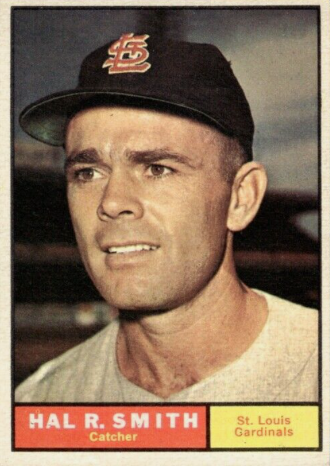
#283 Hal Smith - St. Louis Cardinals


Harold Raymond Smith
St. Louis Cardinals
Catcher

Bats:  Right  Throws:  Right  Height:  5'10"  Weight:  186
Born:  June 1, 1931, Barling, AR
Signed:  Signed by the St. Louis Cardinals as an amateur free agent before 1949 season
Major League Teams:  St. Louis Cardinals 1956-1961; Pittsburgh Pirates 1965
Died:  April 12, 2014, Fort Smith, AR (age 82)

Hal Smith was a three-time All-Star catcher for the Cardinals before a heart ailment prematurely ended his playing career.  Smith took over regular catching duties for the Cardinals in 1957, making his first All-Star team in the process.  He'd be named to both National League All-Star teams in 1959, which would prove to be his career year.  Smith appeared in a career-high 142 games that season, starting 128 games behind the plate.  He batted .270 with career bests in home runs (13) and RBIs (50).  Known most for his defense and strong throwing arm, Smith led all catchers in runners caught stealing in 1959 and 1960.  In June 1961 he was diagnosed with a coronary artery condition, immediately ending his big league career at the age of 30.  The Cardinals added him to their coaching staff, where he'd continue to mentor his eventual replacement, Tim McCarver.

Smith would make a brief return as a player in 1965.  Serving as the bullpen coach for the Pirates, Smith was activated and made emergency appearances in four games as the Pirates had lost all their catching depth to various injuries.  He'd coach in the majors with the Cardinals (1962), Pirates (1965-1967), Reds (1968-1969) and Brewers (1976-1977).  In 570 major league games, Smith batted .258 with 437 hits, 23 home runs and 172 RBIs.

Building the Set

August 19, 2000 in Raleigh, NC - Card #204
This Hal Smith shouldn't be confused with the other Hal Smith (#62) also in the 1956 Topps set.  Both were catchers, complicating things somewhat, but this Hal Smith is commonly shown as Hal R. Smith in checklists while the other Hal Smith shows up as Hal W. Smith.  I don't think I realized there were two Hal Smiths in the set until I alphabetized our checklist, which made it easier to check if we needed a card when a dealer's boxes were out of order.

Something that's perhaps only amusing to me is that I purchased both Hal Smith cards needed for our set at the same time from the same dealer at the Sports Card Show in Raleigh.  I decided I wanted to purchase both cards together, and if I found one in decent shape I waited until I had found the second in decent shape as well.  Having found both Hal Smith cards in an out-of-order box of 1956 Topps commons, I approached the dealer and asked him for a price for the pair.  He did somewhat of a double take when he realized both cards bore the name Hal Smith and he looked at me quizzically.

Without missing a beat, and without cracking a smile, I told him, "I collect only Hal Smith cards."  He continued his stare for a few more seconds and then said, "$15 for both of them."  And with that, both Hal Smith cards entered our 1956 Topps set.

The Card / Cardinals Team Set
This is Smith's rookie card, and given he didn't make his debut until 1956 (see below) I'm assuming that's not Smith donning the catching gear in the action shot.  Smith would wear #18 with the Cardinals in his first three seasons with the team.  Outfielder Rip Repulski (#201) wore #8 with the Cardinals, so there's also an excellent chance the catcher shown is from an entirely different team.

Adding confusion to the multiple catching Hal Smith situation, Topps used the wrong Smith's facsimile autograph on the front of this card.  This is the same autograph that appears on the other Smith's card earlier in the set.

1956 Season
Smith earned a spot on the Cardinals' opening day roster and made his major league debut on May 2nd against the Pirates at Busch Stadium.  He pinch-hit for pitcher Lindy McDaniel in the fifth inning, connecting for an RBI double to left that scored Repulski.  A few batters later, Stan Musial would hit a grand slam, and Smith scored his first major league run.  On June 14th, regular catcher Bill Sarni (#247) was part of a massive ten-player deal with the Giants and Smith became the Cardinals' every day catcher.

He'd start 58 games overall behind the plate, and batted .282 in his rookie season with five home runs and 23 RBIs.

1957 Topps #111
1958 Topps #273
1959 Topps #497
1960 Topps #84
1961 Topps #549

Other Notable Baseball Cards

First Mainstream Card:  1956 Topps #283
Topps Flagship Set Appearances (6):  1956-1961
Most Recent Mainstream Card:  1961 Topps #549

32 - Smith non-parallel baseball cards in the Beckett online database as of 2/23/24.

Sources:  
Baseball Reference
Beckett Database

Friday, January 12, 2024

#273 Walker Cooper - St. Louis Cardinals


William Walker Cooper
St. Louis Cardinals
Catcher

Bats:  Right  Throws:  Right  Height:  6'3"  Weight:  210
Born:  January 8, 1915, Atherton, MO
Signed:  Signed by the St. Louis Cardinals as an amateur free agent before 1935 season
Major League Teams:  St. Louis Cardinals 1940-1945; New York Giants 1946-1949; Cincinnati Reds 1949-1950; Boston Braves 1950-1952; Milwaukee Braves 1953; Pittsburgh Pirates 1954; Chicago Cubs 1954-1955; St. Louis Cardinals 1956-1957
Died:  April 11, 1991, Scottsdale, AZ (age 76)

Until composing this post, I had no idea Walker Cooper was a veteran of 18 major league seasons, an eight-time All-Star and a two-time World Champion with the Cardinals in the early 1940s.  Cooper was behind the plate for the Cardinals' World Series wins in 1942 and 1944, batting .300 overall in 16 World Series games, including the 1943 series in which the Cardinals lost to the Yankees.  In that 1943 season, Cooper batted .318 with 81 RBIs, finishing as runner-up to teammate Stan Musial for National League MVP honors.  He was the starting catcher for the National League All-Stars in six of the nine All-Star Games played in the 1940s.  Cooper missed most of the 1945 season while serving in the U.S. Navy during World War II, and was sold to the Giants in 1946 following a salary dispute.  With the Giants in 1947, he reached career highs in both home runs (35) and RBIs (122).

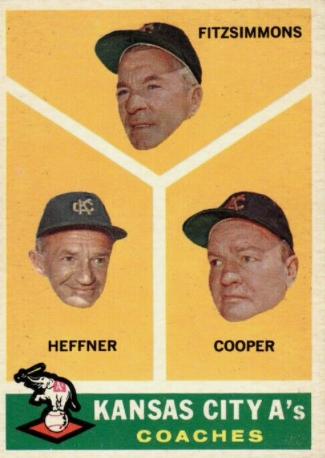
Cooper would play for six different teams, all in the National League, and would finish his big league career as a back-up catcher and pinch-hitter for the Cardinals in 1956 and 1957.  One of the strongest players in the game, Cooper also earned respect for his defense and ability to call a great game behind the plate.  In 1,473 games played, Cooper batted .285 with 1,341 hits, 173 home runs and 812 RBIs.  At the time of his retirement, he was among the top five all-time National League catchers in average, slugging percentage, home runs and RBIs.  Cooper managed in the minor leagues for three seasons and was a coach for the Kansas City Athletics in 1960.

Building the Set
Summer of 1983 or 1984 in Millville, NJ - Card #37
This Cooper card was one of the Original 44 and the last time I told the full story of the Original 44 was almost a year ago within the Walt Dropo (#238) post, so I'll repeat it again here.

June 1983 - Ocean City Baseball Card Show
Technically speaking, my Dad and I actually began collecting the set in the summer of 1987, but this card (along with the other Original 44) first entered my collection three or four years before that.

I think it was either the summer of 1983 or 1984 when a shoebox of vintage baseball cards, football cards and a few non-sports cards arrived into my world.  The box contained about a hundred cards dating between 1950 and 1956, and for the most part, they were all in excellent shape.  A friend of the family was in the process of cleaning up and moving into her new house when she found the old shoebox and she wondered if the only kid she knew who collected baseball cards (me) would be interested in looking through it – maybe even taking the box off her hands.

She dropped the box off to my parents and asked them to have me look through the box and take what I was interested in. Turns out, I was interested in everything.  Up to that point, the oldest cards in my collection were cards from the early '70s I had obtained through trades or cards that my Dad had picked up for me at yard sales or small baseball card shows.  (My Dad had given me a few dog-earred and rough Topps cards – Juan Pizzaro and Jim Busby – a few years prior, and I completely forget how or why he had purchased these cards for me.)

My parents asked me to pick out a few cards from the box, and then we’d return the rest to the family friend.  Problem was, I wanted them all.  I really wanted them all.  I diligently and meticulously went through one of my price guides and determined the “value” of the treasure chest. I probably used my Sport Americana Baseball Card Price Guide No. 4, edited by Dr. James Beckett, and I had no way to value the football or non-sports cards.  My memory is fuzzy, and I can't find the original tally, but I think I came up with the box being worth somewhere in the neighborhood of $300 to $400, which I knew my parents definitely did not have in their discretionary spending budget.  But they could tell how much I wanted those cards, as I lovingly studied each and every one and handled each as if it were some long-lost artifact.

I don’t know the exact details, but I believe my Dad went back to the friend and told her we’d take the whole box, but only if she let him give her some money for it.  I believe she was genuinely shocked that the box of old cardboard pictures had some value, and that someone was willing to give her cash for it.  My Dad shared the list I had created showing the “book value” of the cards and he mentioned how it was going to be close to impossible to get me to pick and choose which ones I wanted.  When all was said and done, the family friend, who had absolutely no intention of making money on this endeavor, walked away with (I think) something in the neighborhood of $100 for the whole lot.

Within the spoils were 44 cards from the 1956 Topps set – by far the most cards from any one set.  I studied them, I sorted them, and I pretty much memorized every detail of those 44 cards.  

And so a few years later, in the summer of 1987 while on a family vacation, I was giddy with excitement when we came across a few ’56 Topps cards in the Walker Gallery on the main drag in Cooperstown, New York.  My Dad and I studied the cards for sale and he casually asked me the question, “Why don’t we try to put together the whole set?” We bought four cards that day for $9.25.  Those cards, along with the 44 from the magic shoebox, became the basis for our 1956 Topps set.

The Card / Cardinals Team Set
This marks Cooper's first mainstream baseball card in a few years, as he had last appeared in the 1953 Bowman Black & White set.  It would seem as if the runner is safe in the action shot?  The three cartoon panels on the back cover all the right highlights, including his return to the Cardinals for the 1956 season, his reputation as a slugger and his fantastic 1947 season with the Giants.

1956 Season
In his penultimate season, and at the age of 41, Cooper re-signed with his original team, the Cardinals, to serve as the back-up catchers Bill Sarni (#247) and Hal Smith (#283).  Cooper started only 12 games all season, appearing in 40 games overall, mostly as a pinch-hitter.  He batted .265 with a pair of home runs and 14 RBIs.

1943 M.P. & Co. (R302-1)
1948 Bowman #9
1952 Topps #294
1957 Topps #380
1960 Topps #462

Other Notable Baseball Cards

First Mainstream Card:  1943 M.P. & Co. (R302-1)
Topps Flagship Set Appearances (4):  1952, 1956-1957, 1960
Most Recent Mainstream Card:  1992 Conlon Collection TSN #633

48 - Cooper non-parallel baseball cards in the Beckett online database as of 12/21/23.

Sources:  
Baseball Reference
Beckett Database