Showing posts with label 1969. Show all posts

Monday, July 1, 2024

#297 Bob Skinner - Pittsburgh Pirates


Robert Ralph Skinner
Pittsburgh Pirates
Outfield


Bats:  Left  Throws:  Right  Height:  6'4"  Weight:  190
Born:  October 3, 1931, La Jolla, CA
Signed:  Signed by the Pittsburgh Pirates as an amateur free agent before 1951 season
Major League Teams:  Pittsburgh Pirates 1954, 1956-1963; Cincinnati Reds 1963-1964; St. Louis Cardinals 1964-1966
As a Manager:  Philadelphia Phillies 1968-1969; San Diego Padres 1977

Bob Skinner spent over 50 years in baseball as a player, manager, coach and scout.  Most of his playing career was spent with the Pirates where he was an All-Star in 1958 and for both games in 1960.  As the regular left fielder for the Pirates, Skinner had his best season in 1958 when he batted .321 with 13 home runs and 70 RBIs, finishing in the top ten in the National League in most major offensive categories and earning MVP votes.  In 1960, Skinner was second on the club with 86 RBIs, behind only Roberto Clemente (#33) for the team lead, helping the Pirates clinch the pennant and eventually win the World Series in seven games over the Yankees.  After a few seasons with the Reds, Skinner ended his playing career as a pinch-hitter and back-up outfielder for the Cardinals.  He had four pinch-hitting appearances in the 1964 World Series, going 2 for 3 as St. Louis prevailed over the Yankees.  In 1,381 career games, Skinner batted .277 with 103 home runs and 531 RBIs.

Skinner began his managerial career in 1967 with the San Diego Padres, then the top minor league affiliate for the Phillies.  He won Minor League Manager of the Year honors after leading the Padres to an 85-63 record and winning the 1967 Pacific Coast League Championship.  On June 16, 1968, Skinner was named as the new manager of the Phillies after Gene Mauch was fired.  Skinner's time as manager of the Phillies would last a little over a year before he'd resign from the position.  Skinner would coach in the majors with the Padres (1970-1973, 1977), Pirates (1974-1976, 1979-1985), Angels (1978) and Braves (1986-1988), and he earned his third World Series ring as the hitting coach for the Pirates in 1979.  He'd work in the Astros organization as a special assignment scout until 2009.  Skinner's son Joel played nine seasons in the majors with the White Sox, Yankees and Indians.  Joel Skinner briefly managed the Indians in the second half of the 2002 season.

Some text for this post originally appeared on my 1965 Topps blog.

Building the Set

December 25, 2003 from San Diego, CA (Kit Young Cards) - Card #250
My Dad/Santa brought me nine cards for our set for Christmas in 2003, with all but one of the cards coming from his dealer of choice, Kit Young Cards in San Diego.  The Brooklyn Dodgers team card (#166) was the lone non-Kit Young Cards addition, as that card came from TemDee in Turnersville, New Jersey.  It was a strange mix of commons from Kit Young Cards, with no semi-star or star card to balance out the lot.  We were admittedly in a lull collecting the set, with only 18 cards added during all of 2003 and only six cards added, as Christmas presents, in 2004.

Pictures from the Christmas of 2003 show us opening gifts at my Mom's house on December 26th, which has since become a tradition for us.  So while the official set records indicate these nine cards were added on December 25th, it was most likely a day later I opened the cards while in Millville.

The Card / Pirates Team Set
Skinner's rookie card can be found in the 1955 Topps set, and this card reuses the main head shot photo from that card.  The action shot features an excellent play at the plate, and it would look as if Skinner is out.  But thanks to the magic of the internet, I found the source photo showing the home plate umpire signaling Skinner as safe.  In a play that happened in the first inning of the Pirates-Giants game on April 20, 1954, Skinner slid under the tag of Giants' catcher Ray Katt as the on-deck batter, Jack Shepard, wearing #10, looks on.  It looks as if Topps decided to move Skinner's head in the photo used for the card.

On the back, Topps imagines playing in New Orleans as a non-stop Mardi Gras celebration, complete with a parade and marching band.

1956 Season
Still a few years away from his break-out season of 1958, Skinner spent all of 1955 in the minor leagues and made the Pirates' opening day roster in 1956.  He spent the season learning to play the outfield, and served as a utility player for the club, making starts in left field (21), first base (19) and right field (9).  In 113 games overall, Skinner batted .202 with five home runs and 29 RBIs.

Phillies Career
Skinner's managerial career with the Phillies did not go well, which was somewhat surprising at the time given his success with the Triple-A Padres.  In 1968, Skinner inherited a team from Mauch in fifth place, but only 5 1/2 games out of first place.  The 1968 Phillies finished the season with 86 losses overall and 21 games out of first place.  In 1969, Skinner continued to clash with star Dick Allen.  When Allen skipped a double header in New York on June 24th, he was suspended and missed the next 26 games.  With the Phillies front office seemingly negotiating with Allen behind Skinner's back, the manager abruptly resigned in early August.  The story from the Phillies was that Skinner resigned because the team wouldn't extend his contract beyond the 1969 season, but Skinner maintained the reason for his departure was the constant clashing with Allen.  Third base coach George Myatt managed the team for the remainder of the season.  Skinner was 92-123 overall for the Phillies, in a managerial tenure that lasted a little over one year.

1955 Topps #88
1958 Topps #94
1961 Topps #204
1969 Topps #369
1985 Topps #139

Other Notable Baseball Cards

First Mainstream Card:  1955 Topps #88
Topps Flagship Set Appearances (16):  1955-1966, 1969, 1973-1974, 1985
Most Recent Mainstream Card:  1992 Fleer ProCards #503

98 - Skinner non-parallel baseball cards in the Beckett online database as of 7/1/24.

Sources:  
1965 Topps Blog

Friday, November 26, 2021

#177 Hank Bauer - New York Yankees


Henry Albert Bauer
New York Yankees
Outfield

Bats:  Right  Throws:  Right  Height:  6'0"  Weight:  192
Born:  July 31, 1922, St. Louis, IL
Signed:  Signed by the New York Yankees as an amateur free agent before 1946 season
Major League Teams:  New York Yankees 1948-1959; Kansas City Athletics 1960-1961
As a Manager:  Kansas City Athletics 1961-1962; Baltimore Orioles 1964-1968; Oakland Athletics 1969
Died:  February 9, 2007, Lenexa, KS (age 84)

Hank Bauer was a hero during World War II before joining the Yankees and winning seven World Series rings with the club as their regular right fielder.  Bauer was consistently dependable throughout his Yankees tenure, and between 1950 and 1959 he batted .279 with an average of 15 home runs and 60 RBIs per season.  Bauer owned a 17-game World Series hitting streak, still a record today as tied by Derek Jeter, and contributed a three-run triple in the decisive Game 6 fo the 1951 World Series.  He slugged four home runs in the 1958 World Series, his final postseason action as a player.  Bauer was a three-time All-Star between 1952 and 1954, and earned MVP votes each year between 1952 and 1956.  He was dealt to the Athletics in December 1959 as part of the deal that brought Roger Maris to the Bronx.  While Maris went on to set the single-season home run record, Bauer played in parts of two seasons with the Athletics, becoming their player-manager in June 1961, before retiring as a player and focusing on his managing career.  Bauer retired with 1,424 hits, 164 home runs, 703 RBIs and a .277 career average.

His first managerial stint with the Athletics lasted only through the 1962 season.  He joined the Orioles as a first base coach in 1963, and was promoted to their manager following the season.  Bauer guided the Orioles to their first ever World Series title in 1966, sweeping the heavily favored Dodgers in four games.  His success with the Orioles waned after a few years and he was fired on July 10, 1968, to be replaced by Orioles' first base coach Earl Weaver.  Bauer managed one last time, returning to the Athletics, now in Oakland, for the 1969 season.  His lifetime managerial record was 594-544-1.  Bauer managed the Mets' top farm team in Tidewater in 1971 and 1972, before leaving the dugout for good.  He was inducted into the Baltimore Orioles Hall of Fame in 1990.

March 4, 2007 - Dad and Doug
Building the Set
February 7, 2007 in Voorhees, NJ - Card #292
This is one of six cards I purchased at the Echelon Mall Baseball Card show in February 2007, spending $70 total, including $12.50 on this Bauer card.  At the time, Doug was a few days away from turning two months old and we had just celebrated my Dad's 63rd birthday a few weeks earlier.  I also realized as I was composing this post that Bauer passed away just two days after we had added his card to our set.

I think Jenna had been out shopping on this day when she texted (or called) me to let me know there was a baseball card show being held at what used to be the Echelon Mall.  The former mall has since been converted as part of the Voorhees Town Center. 

The Card / Yankees Team Set
Bauer is one of only eight players featured in the set's second series who were also in the 1954 and 1955 Topps sets, and who appeared with the exact same photos.  This is a sharp drop from the 32 players appearing in the set's first series for whom their photo was the same used in 1954 and 1955.  The majority of players in the set's second series were those who had been exclusive to Bowman over the past few years, so Topps had to come up with new photos for those players.

I'm calling Bauer safe on the play at the plate.  If the photo is from 1955, the only two American League catchers who were #9 that season were the Senators' Bob Oldis and the Tigers' Jay Porter.  Porter didn't catch in any games against the Yankees that season, but Oldis caught in two games against the Yankees in April 1955.  My best guess is the action photo is from April 13, 1955 when the Yankees destroyed the Senators, 19-1.  In the seventh inning, with Oldis catching, Bauer was the last of three runners to cross the plate on a bases-clearing triple from Bob Cerv (#288).

1956 Season
Bauer was again the opening day right fielder for the Yankees, with Mickey Mantle (#135) in center and Elston Howard (#208) in left, and it was the fourth straight season in which he earned that honor.  He'd start three more opening days for the Yankees before moving on to the Athletics in 1960.  Bauer hit career highs with his power numbers, slugging 26 home runs and driving in 84 runs, but his average slipped to .241.  He appeared in 147 games overall, making 128 starts in right and seven starts in left.  When the Yankees reached the World Series for the second consecutive year, and the seventh time in Bauer's eight seasons so far with the club, he hit safely in all seven games against the Dodgers, beginning his then record 17-game World Series hitting streak.

1950 Bowman #219
1954 Topps #130
1959 Topps #240
1967 Topps #1
1969 Topps #124

Other Notable Baseball Cards
First Mainstream Card:  1950 Bowman #219
Topps Flagship Set Appearances (18):  1951-1952, 1954-1962, 1964-1969
Most Recent Mainstream Card:  2010 Topps New York Yankees 27 World Series Championships #YC13

289 - Bauer non-parallel baseball cards in the Beckett online database as of 11/19/21.

Sources:  

Friday, October 29, 2021

#173 Johnny Podres - Brooklyn Dodgers


John Joseph Podres
Brooklyn Dodgers
Pitcher


Bats:  Left  Throws:  Left  Height:  5'11"  Weight:  170
Born:  September 30, 1932, Witherbee, NY
Signed:  Signed by the Brooklyn Dodgers as an amateur free agent before 1951 season
Major League Teams:  Brooklyn Dodgers 1953-1955, 1957; Los Angeles Dodgers 1958-1966; Detroit Tigers 1966-1967; San Diego Padres 1969
Died:  January 13, 2008, Glens Falls, NY (age 75)

Johnny Podres forever joined the ranks of Dodger greats when the lefty won 1955 World Series MVP honors for his two fantastic starts against the Yankees in the Fall Classic.  Podres started Game 3, pitching a complete game in the Dodgers' win, and then started the decisive Game 7, pitching a complete game shutout to give the team their first and only World Series title while in Brooklyn.  Podres settled in as a reliable starter for Brooklyn and then Los Angeles, winning at least 12 games over the next seven seasons and making four All-Star teams.  He led the league with six shutouts in 1957 while winning the ERA title with a 2.66 mark.  Podres attained a career-high 18 wins in 1961, and he'd win two more World Series rings with the Dodgers in 1959 and 1963.  He retired as a player following a half-season with the expansion Padres in 1969.  Podres was 148-116 over 440 career games, pitching 77 complete games and 24 shutouts.  He struck out 1,435 over his 15-year big league career, currently 249th on the all-time leader's list.  Podres' 136 career wins with the Dodgers currently ranks 10th all-time for the franchise.

Podres served as a long-time pitching coach in the majors, working for the Padres (1973), Red Sox (1980), Twins (1981-1985) and Phillies (1991-1996).

Building the Set
June 20, 1992 in Ocean City, NJ - Card #108
This is one of 11 cards (and the 10th I've covered on this blog) my Dad and I bought in June 1992 at the Ocean City baseball card show held on the boardwalk at the Music Pier.  We paid $60 for the lot of 11 cards, which at the time was most likely a steal.  Chronologically, I have this listed as the 108th card we added to the set.  Like the other cards in this lot, this card is gorgeous with four sharp corners.  I'd love to get into my time machine and buy whatever other 1956 Topps cards this dealer had for sale as they're some of the finest cards in our set.

It would seem as if we paid the full admission price of $6 as we didn't relinquish the postcard below to receive $0.50 off.  I still have a collection of these postcards and flyers dating back to the early 1980s from the various Ocean City baseball card shows.  My Dad wasn't much of a night owl, which explains why we wouldn't have waited around for an autograph from Del Ennis (#220) the Saturday of this show.  It's a shame too.  Ennis was one of my Dad's favorite players and it would have been an amazing keepsake if I had somehow gotten a picture of the two of them together.


The Card / Dodgers Team Set
The main photo on the card was also used on Podres' 1954 and 1955 Topps cards, and I found the source photo from April 1954 after a quick search of Getty Images.  The back of the card focuses on Podres' recent heroics on the 1955 World Series and mentions his extremely effective fastball in the final cartoon panel.  The card is reprinted as part of the 1995 Topps Archives Brooklyn Dodgers set.

1956 Season
Podres was drafted into military service shortly after Christmas 1955, and just a few months after the Dodgers' World Series victory.  He missed the entire 1956 season while serving in the U.S. Navy, although he did pitch for the teams formed at both Bainbridge Naval Station and Glenview Air Station.  He was discharged in October 1956, and returned to the Dodgers for spring training in 1957.

Phillies Career
Podres was hired as the Phillies pitching coach on October 31, 1990, after spending the prior five seasons as a minor league coach with the Dodgers.  He joined manager Nick Leyva's coaching staff as the replacement for Darold Knowles, who had departed after two seasons at the post.  Podres stuck around following Leyva's dismissal 13 games into the 1991 season, and he was a key member of new manager Jim Fregosi's coaching staff throughout the early 1990s.  Podres is credited with helping Curt Schilling, Tommy Greene, Ben Rivera, and other young Phillies pitchers find early success in their careers.  He went to his final World Series with the club in 1993, with the Phillies falling in six games to Joe Carter and the Blue Jays.  Podres left the team during the 1996 season to deal with health issues and was replaced on an interim basis by Jim Wright.  Following the 1996 season, and in connection with the hiring of new manager Terry Francona, Podres was replaced by Galen Cisco as the team's full-time pitching coach.

1953 Topps #263
1955 Topps #25
1959 Topps #495
1963 Topps #150
1969 Topps #659

Other Notable Baseball Cards

First Mainstream Card:  1953 Topps #263
Topps Flagship Set Appearances (17):  1953-1967, 1969, 1973
Most Recent Mainstream Card:  2015 Topps Stepping Up #SU-4

367 - Podres non-parallel baseball cards in the Beckett online database as of 10/22/21.

Sources:  
1991 Phillies Media Guide

Friday, August 27, 2021

#164 Harmon Killebrew - Washington Nationals


Harmon Clayton Killebrew
Washington Nationals
Infield


Bats:  Right  Throws:  Right  Height:  6'0"  Weight:  195
Born:  June 29, 1936, Payette, ID
Signed:  Signed by the Washington Senators as an amateur free agent, June 19, 1954
Major League Teams:  Washington Senators 1954-1960; Minnesota Twins 1961-1974; Kansas City Royals 1975
Hall of Fame Induction:  1984
Died:  May 17, 2011, Scottsdale, AZ (age 74)

Harmon Killebrew was one of the most prolific sluggers of his era, and upon his retirement he was fourth on the all-time home run list and second to Babe Ruth in the American League.  Killebrew led the league six times in home runs and three times in RBIs.  He was a 13-time All-Star and received MVP votes in 11 different seasons.  He helped lead the Twins to the their first pennant in 1965, and while he hit .286 in the World Series, the Dodgers prevailed in seven games.  In 1967, he hit the longest home run ever recorded at Minnesota's Metropolitan Stadium at 520 feet.  Killebrew attained career highs in home runs (49) and RBIs (140) in 1969 and won the league's MVP honors that season.  He wrapped up his 22-year big league career with a final season with the Royals, serving as the team's designated hitter.  When the Royals visited Minnesota in early May 1975, the Twins held a pre-game ceremony to retire Killebrew's #3.  He was inducted into baseball's Hall of Fame in 1984, and was in the inaugural class of the Minnesota Twins Hall of Fame in 2000.  In 2,435 games, Killebrew accumulated 2,086 hits while batting .256.  He hit 573 career home runs to go along with 1,584 RBIs.

After retiring as a player, Killebrew served as a broadcaster for the Twins, Athletics and Angels between 1976 and 1988.  He also briefly served as a hitting instructor with the Athletics.  Nicknamed "Killer" on the field, by all accounts Killebrew was one of the kindest and most well-respected men to ever play the game.

Building the Set
January 27, 2001 from Moorestown Mall Baseball Card Show - Card #164
For Father's Day this year, we attended my youngest son's piano recital and then travelled to the Moorestown Mall (in nearby Moorestown, NJ) for a baseball card show.  I don't spend a lot of time in malls, but I thought this one looked vaguely familiar.  As it turns out, I was at the very same mall 20 years earlier with my Dad for his 57th birthday.  We paid $60 for four cards for our 1956 Topps set, including this Killebrew card that set us back $38.  Based on my checklist at the time, we got a good deal on this card as I had the Killebrew card listed as one of the more valuable cards we still needed at a range of $60 to $100.  The other three cards added were Carl Erskine (#233), Frank Malzone (#304) and Ellis Kinder (#336).

The Card / Nationals Team Set
This is one of only six cards in the set to use the "Infield" position designation.  Topps could have safely opted for "third base" as by the time this card came out, Killebrew had played in 47 games for the Senators - including 23 games at third and six games at second.  Killebrew's rookie card can be found in the 1955 Topps set, and this 1956 card uses the same main photo as his rookie card.  I'm not sure what's going on in the action shot here.  Either Killebrew is fielding a foul ball at the third base line, or a throw has gotten away from him and he's in the process of tracking it down.  The cartoon panels on the back of the card hint at what would come for Killebrew as the Senators were correctly predicting that the slugger would become a "big star."

The card was reprinted in the 2012 Topps Archives Reprints insert set, and an oversized reprint of the card was included in the 2015 Topps Cardboard Icons 5 x 7 Harmon Killebrew set.

1956 Season
Under the bonus baby rules of the day, Killebrew was required to remain on the Senators active roster for two years.  He began the season with the big club, and was used almost exclusively as a pinch-hitter in 24 games between opening day and June 21st.  When his bonus baby status expired, Killebrew was sent down to the single-A Charlotte Hornets where he'd receive regular playing time.  With the Hornets as their regular third baseman, and at just 20 years old, Killebrew played in 70 games and batted .325 with 15 home runs and 63 RBIs.  The Senators called him back up when rosters expanded in September, and for the last few weeks of the season he served as their every day third baseman.  In 44 total games with the Senators, Killebrew batted .222 with five home runs and 13 RBIs.

1955 Topps #124
1962 Topps #70
1965 Topps #400
1969 Topps #375
1975 Topps #640

Other Notable Baseball Cards

First Mainstream Card:  1955 Topps #124
Topps Flagship Set Appearances (20):  1955-1956, 1958-1975
Most Recent Mainstream Card:  2021 Topps Allen & Ginter #139

1,810 - Killebrew non-parallel baseball cards in the Beckett online database as of 8/23/21.

Sources:  
Baseball Reference
Beckett Database
National Baseball Hall of Fame
SABR
The Trading Card Database

Friday, April 16, 2021

#145 Gil Hodges - Brooklyn Dodgers


Gilbert Raymond Hodges
Brooklyn Dodgers
First Base

Bats:  Right  Throws:  Right  Height:  6'1"  Weight:  200
Born:  April 4, 1924, Princeton, IN
Signed:  Signed by the Brooklyn Dodgers as an amateur free agent, September 6, 1943
Major League Teams:  Brooklyn Dodgers 1943, 1947-1957; Los Angeles Dodgers 1958-1961; New York Mets 1962-1963
As a Manager:  Washington Senators 1963-1967; New York Mets 1968-1971
Died:  April 2, 1972, West Palm Beach, FL (age 47)
Hall of Fame Induction:  2022

Jackie Robinson (#30) called Gil Hodges, "The core of the Brooklyn Dodgers."  Originally a catcher, Hodges moved to first base for the Dodgers in the late 1940s where he'd be a mainstay for the club throughout the next decade and including their move west to Los Angeles.  Hodges had seven straight seasons of 100 RBIs or more between 1949 and 1955, and his bat helped lead the Dodgers to World Series titles in 1955 and 1959.  He never won an MVP, but the eight-time All-Star was a perennial MVP vote getter.  Considered one of the finest defensive first baseman of his era, he won three Gold Gloves.  His 361 career home runs are second on the Dodgers' all-time list behind Duke Snider's (#150) 389.  Hodges finished his playing career as a member of the expansion Mets and in 1,921 career games he hit .273 with 370 home runs and 1,274 RBIs.

Hodges retired as an active player when the Mets traded him to the Senators on May 23, 1963 for Jim Piersall (#143), and Hodges assumed managerial duties for the departed Mickey Vernon (#228).  His years with the Senators were fairly dismal as the team never finished above sixth place.  He took over at the helm for the Mets in 1968 and led the club to their first improbable World Championship title in 1969 with a miraculous victory over the heavily favored Orioles.  Hodges passed away unexpectedly during spring training 1972, felled by a heart attack after a round of golf with his Mets coaches.

Hodges is considered to be one of the best players from his era not currently in the Hall of Fame.  His #14 was retired by the Mets in 1973 and he was elected into the Mets Hall of Fame in 1982.

Postscript - Gil Hodges was elected into the Hall of Fame in December 2021 by the Golden Days Era Committee, and he'll be inducted posthumously in July 2022.

Some text for this post originally appeared on my 1965 Topps blog.

Building the Set

December 25, 1998 from San Diego, CA (Kit Young Cards) - Card #173
I'm not sure what inspired me to take the picture shown here back in November 1998, but it shows the view from my couch in my apartment in Raleigh, North Carolina at the time.  I had (and still have) way too many CDs, and my 1956 Topps binder is open to the page showing cards #41 to #48.  That's Art Fowler (#47) and Jim Hegan (#48) blurry on the bottom.

This Hodges card would have been missing from that binder at the time, as my parents gave me this card for Christmas in 1998.  It was my "big" present and my Dad let it slide that he had paid $50 for it from Kit Young Cards, his baseball card dealer of choice.  It was a lean year for building our 1956 Topps set, as we added just 14 new cards throughout all of 1998.

The Card / Dodgers Team Set
Unless Hodges' head is blocking the fielder holding the ball, I'd say the sliding Hodges is safe at third in the action photo.  Baseball card collectors had become familiar with the headshot of Hodges by now, as it had also appeared on his 1954 and 1955 Topps cards.  His power numbers are celebrated on the back.  Hodges drove in at least 100 runs for seven straight seasons between 1949 and 1955.  He'd dip down to 87 RBIs in 1956 and almost crack the 100-RBI plateau in 1957 with 98.  His 162-game average for his career, over 18 seasons, was an impressive even 100 RBIs with 29 home runs.  Hodges' four-home run game came on August 31, 1950 against the Braves at Ebbets Field against four different Braves pitchers - Normie Roy, Warren Spahn (#10), Bob Hall and Johnny Antonelli (#138).

This card was reprinted as part of the 1995 Topps Archives Brooklyn Dodgers set.

1956 Season
Hodges appeared in 153 games for the Dodgers as their regular first baseman.  He batted .265 with 32 home runs (second on the club behind Snider's 43) and 87 RBIs.  In the World Series, won by the Dodgers over the Yankees, Hodges played every inning in all seven games, batting .304 (7 for 23) with a home run and 8 RBIs.

1949 Bowman #100
1952 Topps #36
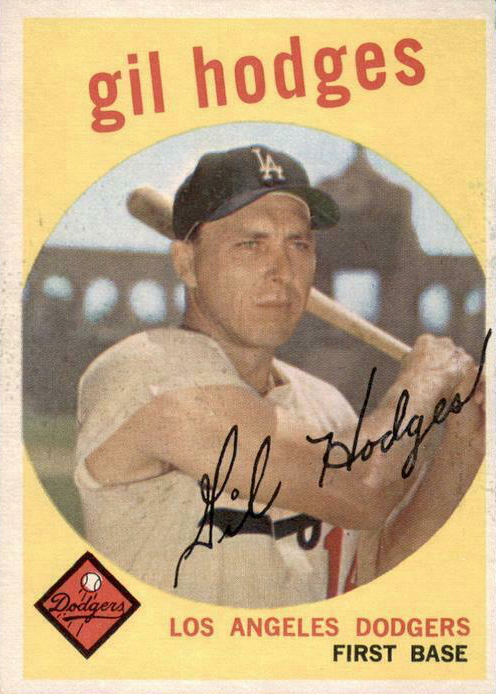
1959 Topps #270
1972 Topps #465
1989 Topps #664

Other Notable Baseball Cards

First Mainstream Card:  1949 Bowman #100
Topps Flagship Set Appearances (22):  1951-1952, 1954-1972, 1989
Most Recent Mainstream Card:  2020 Panini Absolute Legends #AL2

511 - Hodges non-parallel baseball cards in the Beckett online database as of 4/1/21.

Sources:  
1965 Topps Blog