Showing posts with label 1974. Show all posts

Friday, May 16, 2025

#333 Rube Walker - Brooklyn Dodgers


Albert Bluford Walker
Brooklyn Dodgers
Catcher

Bats:  Left  Throws:  Right  Height:  6'0"  Weight:  175
Born:  May 16, 1926, Lenoir, NC
Signed:  Signed by the Chicago Cubs as an amateur free agent before 1944 season
Major League Teams:  Chicago Cubs 1948-51; Brooklyn Dodgers 1951-57; Los Angeles Dodgers 1958
Died:  December 12, 1992, Morganton, NC (age 66)

Rube Walker was a back-up catcher for 11 big league seasons and then a long-time pitching coach for another 21 big league seasons.  Walker came up with the Cubs and the 79 games he played in as a rookie in 1948 were his career high.  He'd start 50 games behind the plate for the Cubs in 1950, again a high water mark.  Walker was included in a blockbuster eight-player deal with the Dodgers in June 1951, heading to Brooklyn along with Andy Pafko (#312) and Wayne Terwilliger (#73).  He'd serve as Roy Campanella's (#101) back-up from 1951 to 1957, and Walker was behind the plate in the 1951 National League tie-breaker series when Bobby Thomson (#257) hit his Shot Heard 'Round the World to send the rival Giants to the World Series.  The Dodgers went to four World Series with Walker on the roster, but his only postseason action came as a pinch-hitter during the 1956 series against the Yankees.

Walker transitioned to a coaching role during his final season with the Dodgers in 1958.  In 608 games, he batted .227 with 35 home runs and 192 RBIs.  Walker was a minor league manager between 1959 and 1964, and then a long-time pitching coach for the Senators (1965-67), Mets (1968-81) and Braves (1982-84).  He won a World Series ring with the Mets in 1969, and was a trusted advisor to Hall of Famers Gil Hodges (#145), Casey Stengel, Yogi Berra (#110) and Joe Torre.

December 12, 2003 - My family at the Buena Tavern
Building the Set
December 25, 2003 from San Diego, CA (Kit Young Cards) - Card #251
My Dad/Santa brought me nine cards for our set for Christmas in 2003, with all but one of the cards coming from his dealer of choice, Kit Young Cards in San Diego.  The Brooklyn Dodgers team card (#166) was the lone non-Kit Young Cards addition, as that card came from TemDee in Turnersville, New Jersey.  It was a strange mix of commons from Kit Young Cards, with no semi-star or star card to balance out the lot.  We were admittedly in a lull collecting the set, with only 18 cards added during all of 2003 and only six cards added, as Christmas presents, in 2004.

Pictures from the Christmas of 2003 show us opening gifts at my Mom's house on December 26th, which has since become a tradition for us.  So while the official set records indicate these nine cards were added on December 25th, it was most likely a day later I opened the cards while in Millville.

The Card / Dodgers Team Set
Walker never appeared in a Bowman set and had an impressive run of Topps set appearances between 1952 and 1958.  The bigger photo is the same used on Walker's 1954 and 1955 Topps cards.  That's likely him sliding into a Giants' infielder, as Walker wore #10 with the Dodgers during his entire run with the club.  The back of the card highlights his minor league success and his strong throwing arm.  Topps reprinted the card in its 1995 Topps Archives Brooklyn Dodgers box set.

1956 Season
Walker's career was winding down at this point.  He appeared in 54 games overall, making 37 starts behind the plate to give Campanella days off.  Walker batted .212 with three home runs and 20 RBIs.

1952 Topps #319
1954 Topps #153
1957 Topps #147
1958 Topps #203
1974 Topps #179

Other Notable Baseball Cards

First Mainstream Card:  1952 Topps #319
Topps Flagship Set Appearances (9):  1952-58, 1973-74
Most Recent Mainstream Card:  2005 Topps Dem Bums #DB-RW

48 - Walker non-parallel baseball cards in the Beckett online database as of 5/13/25.

Sources:  
Baseball Reference
Beckett Database

Friday, April 25, 2025

#330 Jim Busby - Cleveland Indians


James Franklin Busby
Cleveland Indians
Outfield

Bats:  Right  Throws:  Right  Height:  6'1"  Weight:  175
Born:  January 8, 1927, Kenedy, TX
Signed:  Signed by the Chicago White Sox as an amateur free agent, June 7, 1948
Major League Teams:  Chicago White Sox 1950-52; Washington Nationals 1952-55; Chicago White Sox 1955; Cleveland Indians 1956-57; Baltimore Orioles 1957-58; Boston Red Sox 1959-60; Baltimore Orioles 1960-61; Houston Colt .45s 1962
Died:  July 8, 1996, Augusta, GA (age 69)

Jim Busby spent nearly three full decades in the major leagues as both a smooth-fielding center fielder and as a coach.  He spent 13 seasons as a player, and his earlier seasons were his best.  Busby was an All-Star with the White Sox in his rookie season of 1951, and he'd play a half inning in left field in the All-Star Game, replacing Ted Williams (#5).  Busby swiped a career-high 26 bases in 1951.  He'd have his best seasons as a member of the Nationals, batting .312 with career highs in doubles (28) and RBIs (82) in 1953.  Speed in the outfield helped him finish in the top 10 for putouts, fielding percentage and assists in most of the seasons throughout the 1950s.  Busby's production declined following his departure from Washington, and he spent the final eight seasons of his career playing for six different clubs, including a repeat stint with the White Sox and two different stints with the Orioles.

Busby is one of the more underrated players from the 1950s in my opinion.  In 1,352 games, he collected 1,113 hits, 162 doubles, 35 triples, 48 home runs and had 438 RBIs, while stealing 97 bases.  He was a player-coach with the Orioles in 1961 and with the inaugural Colt .45s team in 1962.  Busby's complete coaching career spanned 18 years with the Orioles (1961), Colt .45s/Astros (1962-67), Braves (1968-75), White Sox (1976) and Mariners (1977-78).


Building the Set
July 20, 1989 in Williamstown, NJ - Card #79
In the summer of 1989, I was between my freshman and sophomore years of high school, and I have nothing but pleasant memories of that time growing up in South Jersey.  There were maybe five or six baseball card stores in our area, although only a few of them were known to carry older baseball cards.  One of those stores was located in Williamstown, New Jersey, which ironically enough is where my wife and I would settle and start to raise our family some 14 years later.  I had to dig into my notes from our other set quests to find the store's name - Collector's Corner.  We had finished off our 1974 Topps set in February 1988 at Collector's Corner.   

1977 Topps #597
July 20th was a Thursday, and I guess my Dad would have been off work with a hankering for a new card for our relatively new 1956 Topps set quest.  We were also collecting the 1973 Topps set, and with our 1956 and 1973 checklists in hand, we made the half hour drive from Millville to Williamstown.  I don't know if we purchased any 1973 Topps cards that day, but we found this Busby card for $5 - not a bad deal.  As a current Williamstown resident, I'm not even sure where this store would have been located back in the day, as a lot of the ubiquitous strip malls all look pretty much the same to me.  But it was in a strip mall, I remember that much.

I'm not exactly sure why Busby was one of my Dad's favorite players, and I wish I had thought to ask him at some point.  I suspect it has something to do with the fact they both shared the same first name, and there weren't a lot of major leaguers with the first name of Jim during my Dad's years as a young baseball fan.  Busby holds a special place for me in my collecting journey, as my Dad brought home a 1959 Topps Busby card one day back in the early 1980s.  It was one of a trio of completely disconnected (and ancient) cards added to my collection after I had first discovered baseball cards, and these were the oldest cards in my collection for a few years until the Magic Shoebox entered my life, jumpstarting the journey of collecting the 1956 Topps set.

The Card / Indians Team Set
This is Busby's first Topps card since 1952, as he had been exclusive to Bowman.  It looks as if Busby is wearing a White Sox uniform in the action photo and Topps also decided to remove any infielders in the background who may have been in the vicinity of second base.  He could be wearing a White Sox or Nationals jersey in the head shot, and a Topps artist did a decent job adding the Indians logo to Busby's hat.  The back of the card highlights his speed and "great fielding ability."

On October 25, 1955, Busby was traded by the White Sox with Chico Carresquel (#230) to the Indians for Larry Toby (#250).  Topps updated the cap logos on Busby's and Carresquel's cards, but surprisingly decided to leave Doby's cap logo as is. 

1956 Season
Busby was the opening day center fielder for the Indians, and he'd start 122 games overall at the position.  In 135 total games, he batted .235 with 17 doubles, 12 home runs and 50 RBIs.  He was not able to replace Doby's output for the Indians, as had been hoped, but he did hit grand slams in back-to-back games on July 5th and 6th.

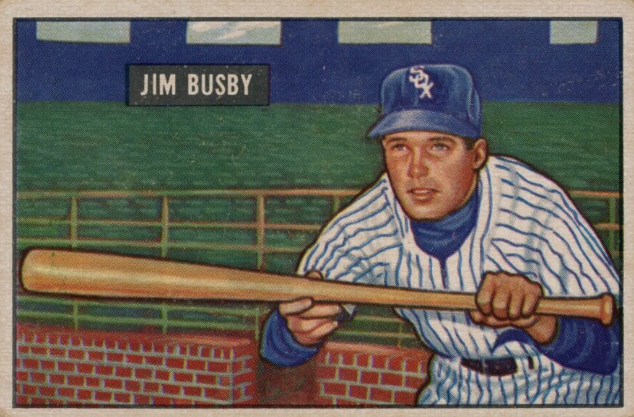
1951 Bowman #302
1952 Topps #309
1953 Bowman Color #15
1957 Topps #309
1974 Topps #634

Other Notable Baseball Cards

First Mainstream Card:  1951 Bowman #302
Topps Flagship Set Appearances (9):  1952, 1956-60, 1973-74, 1977
Most Recent Mainstream Card:  1983 Topps 1952 Reprint Series #309

55 - Busby non-parallel baseball cards in the Beckett online database as of 4/8/22.

Sources:  
Baseball Reference
Beckett Database

Friday, May 24, 2024

#292 Luis Aparicio - Chicago White Sox


Luis Ernesto Aparicio
Chicago White Sox
Shortstop


Bats:  Right  Throws:  Right  Height:  5'9"  Weight:  160
Born:  April 29, 1934, Maracaibo, Venezuela
Signed:  Signed by the Chicago White Sox as an amateur free agent before 1954 season
Major League Teams:  Chicago White Sox 1956-1962; Baltimore Orioles 1963-1967; Chicago White Sox 1968-1970; Boston Red Sox 1971-1973
Hall of Fame Induction:  1984

Known for his exceptional defense and base running skills, Luis Aparicio played for 18 seasons in the majors, primarily for the White Sox.  Ted Williams (#5) called him "the best shortstop he had ever seen."  Aparicio made his debut in 1956, winning the American League Rookie of the Year honors after batting .266 and leading the league with 21 stolen bases.  It was to be the first of nine straight years in which Aparicio led the league or tied for the league lead in stolen bases, and he eclipsed the 50 stolen base mark in four of those seasons.  Aparicio helped lead his "Go-Go" White Sox to the World Series in 1959, and he was American League MVP runner-up.  Dealt to the Orioles before the 1963 season, Aparicio's production declined slightly but his defensive skills didn't.  He reunited with the White Sox in 1968 and enjoyed a late career resurgence making three more All-Star teams in his late 30s with the White Sox and Red Sox.

Aparicio retired with 2,677 career hits, 506 stolen bases (currently 38th all-time) and a .262 lifetime average.  Upon his retirement, he was the all-time leader for hits, games played, assists and double plays by a shortstop, and his record nine Gold Gloves was matched by Omar Vizquel in 2001.  Derek Jeter broke his all-time hits record by a shortstop in 2009.  Aparicio was the first native Venezuelan inducted into the Hall of Fame in 1984, and his #11 was retired by the White Sox that same year.

Some text for this post originally appeared on my 1965 Topps blog.

Building the Set
December 25, 2000 from San Diego, CA (Kit Young Cards) - Card #292
Continuing a decade-long tradition, this was the "big" card under the tree on Christmas morning from Santa Claus, via my Dad by way of Kit Young Cards.  The early 2000s were a strange time for me, and looking back on pictures from this era I don't really recognize myself.  It's as if a majority of what happened from the late 1990s to the early 2000s is something I vaguely remember from a story I had read, and not something I actually lived through.  I have a few blurry and rushed photos from Christmas morning 2000, but nothing worth sharing and nothing that jogged my memory of having opened a present from my parents to find this Aparicio card.

The Card / White Sox Team Set
Kudos to Topps for rushing a card for Aparicio into the set's fourth and final series.  He had made his major league debut on April 17, 1956 and Topps must have been determined to get a card of the American League's best new rookie in its set.  The jumping action photo was seemingly a favorite pose for Topps photographers back in the day, especially for infielders.  The cartoons on the back of the card highlight Aparaicio's quick ascent to the White Sox starting line-up due mainly to his stellar defense and his speed.

Given this is a rookie card for a Hall of Famer, it's no surprise Topps has reprinted the card numerous times.  By my unofficial tally, there are eight different reprints available, including three with on-card autographs.

1956 Season
On October 25, 1955, the White Sox traded Chico Carrasquel (#230), a four-time American League All-Star shortstop, with Jim Busby (#330) to the Indians for outfielder Larry Toby (#250).  The White Sox knew Aparicio was ready for the majors, and their confidence in him was so high they made the shocking move of dealing away Carrasquel.  Aparicio did not disappoint.  He started 151 of the White Sox 154 games at shortstop, leading the league in assists, putouts, double plays, but also errors.  Aparicio received 22 of 24 first place votes in the postseason Rookie of the Year voting, with Rocky Colavito and Tito Francona receiving the remaining two votes.

1959 Topps #310
1962 Topps #325
1965 Topps #410
1970 Topps #315
1974 Topps #61

Other Notable Baseball Cards

First Mainstream Card:  1956 Topps #292
Topps Flagship Set Appearances (19):  1956-1974
Most Recent Mainstream Card:  2023 Topps Allen & Ginter #345

1,036 - Aparicio non-parallel baseball cards in the Beckett online database as of 5/20/24.

Sources:  
1965 Topps Blog

Friday, March 1, 2024

#280 Jim Gilliam - Brooklyn Dodgers


James William Gilliam
Brooklyn Dodgers
Outfield

Bats:  Both  Throws:  Right  Height:  5'10"  Weight:  175
Born:  October 17, 1928, Nashville, TN
Acquired:  Purchased with Joe Black (#178) by the Brooklyn Dodgers from the Baltimore Elite Giants (Negro League) for $11,000, before 1951 season
Major League Teams:  Baltimore Elite Giants (1946-1948); Brooklyn Dodgers 1953-1957; Los Angeles Dodgers 1958-1966
Died:  October 8, 1978, Inglewood, CA (age 49)

After his first three seasons in professional baseball with the Baltimore Elite Giants, Jim "Junior" Gilliam joined the Dodgers organization in 1951 and he'd serve as a player and popular coach with the club until his untimely death in 1978.  Gilliam made his debut with the Dodgers in 1953 as their opening day second baseman, sharing an infield with Gil Hodges (#145) at first base, Pee Wee Reese (#260) at shortstop and Jackie Robinson (#30) at third base.  He'd win Rookie of the Year honors that year, while batting .278 with 21 stolen bases and leading the league with 17 triples.  As a player, Gilliam was a member of seven pennant-winning Dodgers teams, with his club winning World Championships in 1955, 1959, 1963 and 1965.  He was a four-time All-Star.  Gilliam retired with a .265 average, 1,889 hits and 203 stolen bases.

He joined the Dodgers' coaching staff in 1965 while still an active player, switching over to a full-time coaching role in 1967.  With the Dodgers through the 1978 season, Gilliam was a part of three more pennant winning teams in 1974, 1977 and 1978.  He passed away at the end of the 1978 season following a massive brain hemorrhage and Gilliam's #19 was retired prior to Game 1 of the 1978 World Series.

Building the Set

August 16, 1987 from Cooperstown, NY - Card #48
This was one of the first four cards we purchased in the summer of 1987, officially marking the beginning of us collecting the 1956 Topps set.  As told now frequently in our set's origin story, and most recently with the post for the Walker Cooper (#273) card, I was essentially gifted with a shoebox of vintage Topps baseball cards in the summer of 1983 or 1984.  Within the spoils were 44 cards from the 1956 Topps set – by far the most cards from any one set.  I studied them, I sorted them, and I pretty much memorized every detail of those 44 cards.

A few years later, in the summer of 1987 while on a family vacation, I was giddy with excitement when we came across a few 1956 Topps cards in the Walker Gallery on the main drag in Cooperstown, New York.  It was our first trip to Cooperstown, and details from that family vacation still make up several of my most important core memories from my childhood.  My Dad and I studied the cards for sale and he casually asked me the question, “Why don’t we try to put together the whole set?” We bought four cards that day for $9.25, including this Gilliam card which was all of $3.25.  Those cards, along with the 44 from the magic shoebox, became the basis for our 1956 Topps set.

That small but incredibly meaningful purchase meant so much to me that I tacked a Walker Gallery business card to my bulletin board in my bedroom on 12th Street, where it hung for years.  I also felt compelled to clip the price tags from the rigid plastic sleeves in which each of these cards were originally purchased.  I knew then I wanted to remember everything about the purchase, and these are included at the back of our 1956 Topps binder, along with other ephemera from baseball card shows, stores and special occasions when cards were added to our set.

The Card / Dodgers Team Set
Gilliam is the rare example of a player appearing in all four Bowman and Topps sets from 1954 and 1955.  The head shot photo from his 1955 Topps card is reused here, and the action photo could very well be a Yankees baserunner sliding into second base during the 1953 or 1955 World Series.  The cartoons on the back focus on his career highlights to date.  Gilliam scored at least 100 runs each season between 1953 and 1956.  The second cartoon panel has an uncorrected error, as Gilliam starred in the 1953 World Series, and not 1952.

Topps reprinted the card as part of its 1995 Topps Archives Brooklyn Dodgers set.

1956 Season
This was Gilliam's best season statistically as he batted an even .300 over 153 games with 102 runs scored, 23 doubles, eight triples and 43 RBIs.  His 21 stolen bases were second in the league behind Willie Mays (#130), who had 40.  He walked 95 times and had a career-best OBP of .399.  Gilliam was one of the top offensive players on the team, trailing only center fielder Duke Snider (#150) in bWAR for the Dodgers.  As a testament to his versatility, Gilliam started 152 games - 98 at second base, 49 in left field and five in right field.

1953 Topps #258
1955 Topps #5
1959 Topps #306
1962 Topps #486
1974 Topps #144

Other Notable Baseball Cards

First Mainstream Card:  1953 Topps #258
Topps Flagship Set Appearances (14):  1953-1964, 1973-1974
Most Recent Mainstream Card:  2023 Donruss #208

152 - Gilliam non-parallel baseball cards in the Beckett online database as of 1/30/24.

Sources:  
Baseball Reference
Beckett Database

Sunday, May 14, 2023

#250 Larry Doby - Chicago White Sox


Lawrence Eugene Doby
Chicago White Sox
Outfield


Bats:  Left  Throws:  Right  Height:  6'1"  Weight:  180
Born:  December 13, 1923, Camden, SC
Signed:  Signed as a free agent with the Cleveland Indians, July 2, 1947
Major League Teams:  Newark Eagles 1942-1944, 1946-1947; Cleveland Indians 1947-1955; Chicago White Sox 1956-1957; Cleveland Indians 1958; Detroit Tigers 1959; Chicago White Sox 1959
As a Manager:  Chicago White Sox 1978
Hall of Fame Induction:  1998
Died:  June 18, 2003, Montclair, NJ (age 79)

Larry Doby was the first African-American player in the American League and the first Black player to go directly from the Negro Leagues to the Major Leagues.  A star with the Newark Eagles, he and teammate Monte Irvin (#194) helped that club with the Negro League World Series in 1946.  Upon joining the Indians in 1947, Doby spent eight and half seasons as the team's everyday centerfielder, helping Cleveland reach and win the World Series in 1948.  He was named to seven straight All-Star teams between 1949 and 1955, leading the league in RBIs with 126 in 1954, and in home runs twice in 1952 and 1954.  He was the league's MVP runner-up in 1954 behind Yogi Berra (#110), as his Indians once again reached the World Series.  Doby would finish out his career with the White Sox, a return trip to the Indians and the Tigers, making a brief comeback in 1962 with the Chunichi Dragons in Japan.

He retired with a .283 average in 1,533 games played, with 1,515 hits, 253 home runs and 970 RBIs.  Doby served as a coach with the Expos (1971-1973, 1976), Indians (1974) and White Sox (1977-1978), briefly taking over as manager of the White Sox when Bob Lemon (#255) was fired in June 1978.  He'd later work in the front office of the NBA's New Jersey Nets.  Doby had his #14 retired by the Indians in 1994, and the Veteran's Committee voted him into the Hall of Fame in 1998.

Building the Set
Summer of 1983 or 1984 in Millville, NJ - Card #31
This was one of the Original 44, and I re-told the story of how my Dad and I started collecting this set with the Walt Dropo (#238) post, back in February.  Seven of the Original 44 came from series one, with 11 coming from series two, and this Doby card is the 13th of 16 from series three.  Doby is one of eight Hall of Famers (or future Hall of Famers) from that Original 44 haul, along with Ed Mathews (#107), Berra, Willie Mays (#130), Red Schoendienst (#165), Early Wynn (#187) and Lemon.

The Card / White Sox Team Set
I'm a little stunned to find out, after owning this card for close to 40 years, that it's not an Indians card but a White Sox card.  Topps apparently updated the action photo of Doby to show him in a White Sox uniform, but they didn't update his hat in the portrait, which is the same photo used for his 1954 Topps card.  I've looked at this card hundreds of times and never registered the Chicago White Sox team designation on the front.  Crazy.

The back of the card highlights his trade to Chicago, his big years with Cleveland in 1952 and 1954, and his hitting for the cycle on June 4, 1952 against the Red Sox.

1956 Season
On October 25, 1955, the Indians traded Doby to the White Sox for Jim Busby (#330) and Chico Carrasquel (#230).  (Topps was able to update the hats on the Busby and Carrasquel cards to feature the Indians logo.)  Chicago acquired Doby in the hope of adding a power bat to their line-up, and Doby would hit 24 home runs and drive in 102 runs for the year.  Despite the combined offense of Doby in center field and Minnie Minoso (#125) in left, the White Sox still finished in third place, 12 games behind the Yankees.

1949 Bowman #233
1952 Topps #243
1954 Topps #70
1959 Topps #455
1974 Topps #531

Other Notable Baseball Cards

First Mainstream Card:  1949 Bowman #233
Topps Flagship Set Appearances (8):  1952, 1954, 1956-1959, 1973-1974
Most Recent Mainstream Card:  2022 Topps Archives #276

371 - Doby non-parallel baseball cards in the Beckett online database as of 5/12/23.

Sources:  
Baseball Reference
Beckett Database

Friday, June 3, 2022

#205 "Whitey" Lockman - New York Giants


Carroll Walter Lockman
New York Giants
Outfield

Bats:  Left  Throws:  Right  Height:  6'1"  Weight:  175
Born:  July 25, 1926, Lowell, NC
Signed:  Signed by the New York Giants as an amateur free agent before 1943 season
Major League Teams:  New York Giants 1945, 1947-1956; St. Louis Cardinals 1956; New York Giants 1957; San Francisco Giants 1958; Baltimore Orioles 1959; Cincinnati Reds 1959-1960
As a Manager:  Chicago Cubs 1972-1974
Died:  March 17, 2009, Scottsdale, AZ (age 82)

All but two of Whitey Lockman's 15 seasons in the major leagues were spent playing for the Giants.  He came up as a rookie with the Giants in 1945, a few weeks shy of his 19th birthday.  Lockman enjoyed his best seasons in the late 1940s, hitting a career-high 18 home runs in 1948 as the Giants' regular center fielder.  He batted a career-high .301 in 1949.  On October 3, 1951, Lockman doubled home Al Dark (#148) in the bottom of the ninth inning during the three-game divisional playoff series against the Dodgers.  He'd then score when Bobby Thomson (#257) hit his famous "Shot Heard 'Round the World" to send the Giants to the World Series.  Lockman led off and played first base for the National League All-Stars in 1952, but went 0 for 3 in the game.  He was a member of the World Champion Giants in 1954, playing as their every day first baseman.  He'd briefly play for the Cardinals in 1956 before returning to the Giants for their final season in New York in 1957.  Lockman served as a bat off the bench in 1958, the team's first year in San Francisco, and he'd spend the last two seasons of his playing career primarily as a pinch-hitter for the Orioles and Reds.  In 1,666 career games, Lockman batted .279 with 114 home runs and 563 RBIs.

Lockman joined the Reds' coaching staff in 1960, moving back to the Giants in 1961 as the third base coach for manager Dark.  Following the 1964 season, Lockman moved to the Cubs as a minor league manager (1965, 1967-1970) and big league coach (1966).  He managed the Cubs between 1972 and 1974 to a 157-162 record.  Following his stint as Cubs manager, Lockman worked as a scout and in the front office of the Cubs, Expos and Marlins.


Building the Set
May 21, 2000 in Raleigh, NC - Card #202
I was mostly miserable during the years I lived in Raleigh, following my graduation from college, but I remember looking forward to the monthly baseball card shows held at the North Carolina State Fairgrounds.  While so much during that time was confusing to me, the familiarity of a baseball card show, along with the sights and sounds of the activity within the show building would have provided some comfort.   I attended the May 2000 show on a Sunday, and I don't remember seeing autograph guest Bob Feller (#200) there at all.  According to my records, this was the only card added to our 1956 Topps set, purchased for $6.  The bulk of my collecting budget went towards a growing 1972 Topps set, and my hand-written list shows I purchased 21 cards for that set for $51.  I'm guessing I had allotted $60 for the show in total, with $2 for admission, $6 for this Lockman card and $51 for the 1972 Topps lot.  Maybe the remaining $1 went towards a hot dog.  My big purchase was the 1972 Topps Brooks Robinson card for $15.

I would have called my Dad after this show to tell him to update his list back in New Jersey for the new Lockman card added, and the next cards added to the set wouldn't come until August.

The Card / Giants Team Set
I had always assumed Lockman was the runner in the action photo, but in researching this post, I now realize he never wore #3, and he's the first baseman partially obscured by the runner.  Assuming the Topps artist colored the photo correctly, and the number on the runner's back is supposed to be black, that could be the Pirates' George Freese being forced out.  Freese played in nine games against the Giants in 1955.

This is Lockman's first Topps set appearance since his card in the 1951 Topps Red Backs set.  The first cartoon on the back of the card highlights Lockman hitting a home run in his first big league at-bat on July 5, 1945 off Cardinals' pitcher George Dockins.  The final cartoon panel points out Lockman was a fine fielder both in the outfield and at first base.

1956 Season
Lockman began the season on the Giants' bench, occasionally starting in place of Gail Harris (#91) at first base or Dusty Rhodes (#50) in left field.  After 48 games with the Giants, he was traded to the Cardinals on June 14th with Dark, Ray Katt, Don Liddle (#325) and cash for Jackie Brandt, Dick Littlefield, Bill Sarni (#247), Red Schoendienst (#165), Bob Stephenson and Gordon Jones.  Lockman started 46 games in the outfield for the Cardinals, at all three outfield positions, and in 70 games overall he batted .249 with 10 RBIs.  During spring training in 1957, the Cardinals sent him back to the Giants in exchange for future Hall of Famer Hoyt Wilhelm (#307).

1948 Bowman #30
1951 Bowman #37
1954 Bowman #153
1960 Topps #535
1974 Topps #354

Other Notable Baseball Cards

First Mainstream Card:  1948 Bowman #30
Topps Flagship Set Appearances (7):  1951, 1956-1960, 1973-1974
Most Recent Mainstream Card:  2009 Topps Heritage Real One Autographs #ROA-WL

71 - Lockman non-parallel baseball cards in the Beckett online database as of 5/30/22.

Sources:  
Baseball Reference
Beckett Database