Showing posts with label 1967. Show all posts

Friday, May 2, 2025

#331 Dick Hall - Pittsburgh Pirates


Richard Wallace Hall
Pittsburgh Pirates
Pitcher


Bats:  Right  Throws:  Right  Height:  6'6"  Weight:  200
Born:  September 27, 1930, St. Louis, MO
Signed:  Signed by the Pittsburgh Pirates as an amateur free agent, September 1951
Major League Teams:  Pittsburgh Pirates 1952-57, 1959; Kansas City Athletics 1960; Baltimore Orioles 1961-66; Philadelphia Phillies 1967-68; Baltimore Orioles 1970-71
Died:  June 18, 2023, Timonium, MD (age 92)

Signed out of college as an outfielder, Dick Hall converted to a pitcher full-time in 1957 and would gain fame as a reliever for the Orioles during their late 1960s/early 1970s dynasty.  Hall was a reserve outfielder for the Pirates beginning in 1952, appearing in a career-high 112 games with the club in 1954 and batting .239.  He'd begin his transition to pitching in 1955, going 12-5 with 16 complete games and a 2.24 ERA for the minor league Lincoln Chiefs.  Hall was dealt to the Orioles in April 1961, beginning the most successful stretch of his big league career.  In his first stint with the club, Hall's best seasons came between 1961 and 1964, when he went 27-17 with a 2.60 ERA in 164 appearances, saving 31 games.  After a brief stint with the Phillies, he was back with the Orioles in 1969, in time for their three-year run of postseason play.  In five postseason appearances, Hall was 2-1 with a 0.00 ERA in 8 2/3 innings pitched.  He won World Series rings with the Orioles in 1966 and 1970.  

He retired following the 1971 World Series, after two seasons of being the oldest player in the majors.  He was inducted into the Baltimore Orioles Hall of Fame in 1989.  In 495 games pitching over 16 seasons, Hall was 93-75 with a 3.32 ERA, 20 complete games, three shutouts and 71 saves.  He walked only 236 batters to 741 strikeouts over 1,259 2/3 innings pitched.  Over 19 seasons as a batter, Hall collected 150 hits, including four home runs, and had a lifetime .210 average.

From the 1968 Phillies Yearbook
Building the Set

August 13, 1989 in Bridgeton, NJ - Card #91
We went nuts at the Bridgeton Baseball Card Show in August 1989, buying 12 different cards for our 1956 Topps set, all at $1.50 a piece.  That's an impressive haul for $18!

I have no other information on the location of this show, other than it was held in the nearby city of Bridgeton, New Jersey.  What I do have however is the checklist I brought with us to the show.  I believe this is the second full checklist we carried around, having retired the prior version I created in 1988 and posted with the William Harridge (#1) card.

Just looking at this checklist (shown here) brings back fond memories of finding the cards, deciding to make a purchase, negotiating a price and then finding a flat surface so that we could cross off the newest additions.

The Card / Pirates Team Set
Hall's rookie card can be found in the 1955 Topps set, using the same photo as seen here.  Hall's position on his rookie card is listed as "3rd base-outfield."  The cartoon panels on the back justifiably highlight his move from the outfield to the pitcher's mound.

1956 Season
With the Pirates the entire season, Hall played in 33 games overall - 19 as a pitcher, 14 as a pinch-hitter and one as the starting first baseman on August 2nd.  As a pitcher, Hall was 0-7 with a 4.76 ERA in 10 relief appearances and nine starts.  He threw a complete game in his second start of the season on April 28th.  As a batter, Hall hit .345 (10 for 29) with an RBI.  His ten hits were all singles.

Phillies Career
Hall was a bright spot in the Phillies bullpen during his two years with the club during the lean years of 1967 and 1968.  On December 15, 1966, the Orioles traded Hall to the Phillies for a player to be named later, which ended up being lefty pitcher John Morris.  Hall and Turk Farrell were the club's top relievers in 1967, with Hall going 10-8 with a 2.20 ERA in 48 appearances and 86 innings pitched.  He saved nine games, second on the team behind Farrell's 12.  Hall slumped in 1968, going 4-1 with a 4.89 ERA in 32 appearances as one of the worst relievers in a surprisingly strong Phillies' bullpen.  He was released by the Phillies following the season, and the Orioles brought him back towards the end of spring training in 1969.

In 80 games (including one start) with the Phillies, Hall was 14-9 with a 3.14 ERA in 132 innings pitched.  His pinpoint control came with him to Philadelphia, as he struck out 80 and walked only 17.

1955 Topps #126
1957 Topps #308
1962 Topps #189
1967 Topps #508
1971 Topps #417

Other Notable Baseball Cards

First Mainstream Card:  1955 Topps #126
Topps Flagship Set Appearances (11):  1955-57, 1960-63, 1967-68, 1970-71
Most Recent Mainstream Card:  2022 Topps Archives Fan Favorites Autographs #93FF-DH

52 - Hall non-parallel baseball cards in the Beckett online database as of 4/26/25.

Sources:  
Baseball Reference
Beckett Database

Friday, February 14, 2025

#320 Joe Adcock - Milwaukee Braves


Joseph Wilbur Adcock
Milwaukee Braves
First Base

Bats:  Right  Throws:  Right  Height:  6'4"  Weight:  210
Born:  October 30, 1927, Coushatta, LA
Signed:  Signed by the Cincinnati Reds as an amateur free agent before 1947 season
Major League Teams:  Cincinnati Reds 1950-52; Milwaukee Braves 1953-62; Cleveland Indians 1963; Los Angeles Angels 1964; California Angels 1965-66
As a Manager:  Cleveland Indians 1967
Died:  May 3, 1999, Coushatta, LA (age 71)

Blocked at first base by slugger Ted Kluszewski (#25), the Reds tried moving Joe Adcock to left field for the first three seasons of his career.  Adcock was steady at the plate during those years, but wanting to play regularly at first base, he requested and was granted a trade to the Braves.  He'd play ten seasons in Milwaukee, helping the club to National League pennants in 1957 and 1958, and the World Series title in 1958.  Adcock's best season came in 1956 when he batted .291 while reaching career highs in home runs (38) and RBIs (103).  With Henry Aaron (#31) and Eddie Mathews (#107) in the line-up, Adcock was often overlooked, but in his decade with the Braves, he clubbed 239 home runs and drove in 760 runs, hitting at least 20 home runs in six seasons.  On July 31, 1954, he hit four home runs, off four different pitchers, in one game against the Dodgers at Ebbets Field.  Adcock was an All-Star in 1960.

Dealt to the Indians following the 1962 season, Adcock played four more years in the majors.  He'd have a late career resurgence with the early Angels teams, connecting for 18 home runs in his final season in 1966.  Adcock managed the Indians for one season in 1967, with the team finishing in eighth place with a 75-87 record.  In 1,959 games, Adcock batted .277 with 1,832 hits, 336 home runs and 1,122 RBIs.  He's still in the top 100 for many fielding categories for first basemen.  In 2022, Adcock was posthumously inducted into the Braves Hall of Fame.

Building the Set
Sometime in 1998, no record of purchase - Card #174
This is the fourth and final card in our set that appeared with no record of how or when we acquired it.  Adcock joins the quartet of Joe Astroth (#106), Robin Roberts (#180) and Max Surkont (#209) as the sadly undocumented additions to our collection.  Based on checklists from the time, it looks as if the card was added at some point in 1998, as checklists from 1998 show the card as being needed, while checklists from 1999 and later show the card crossed out.

I entered the work force in the fall of 1997, and 1998 would have been my first full year as a newly hired associate at the biggest accounting firm in the world, Arthur Andersen.  (Some would say the firm was too big to ever fail.)  I would have still been working in Philadelphia at that time, at least through the summer, and likely working anywhere from 50 to 80 hours a week, as was the expectation back then.  Still, it's a little frustrating to have no idea when or how we added this Adcock card to our set, especially as it's in such great shape.

The Card / Braves Team Set
This card marks Adcock's return to Topps sets, as he had appeared exclusively in Bowman sets since 1953.  He wore #9 with the Braves, so the action shot is definitely the slugger crossing home plate.  I was actually able to find the photo from Getty Images, and this is the original caption:  "Milwaukee's Joe Adcock, who got himself into the record books by hitting four homers in yesterday's game against the Dodgers, is shown scoring from second on Johnny Logan's (#136) pop single into left field in today's game at Ebbets Field. Adcock was carried off the field on a stretcher in the fourth inning after being hit in the head by a pitched ball thrown by Clem Labine (#295)."  A quick check of Baseball Reference shows this photo would have been from the Braves-Dodgers game on August 1, 1954.  Braves' pitcher Gene Conley (#17) would plunk Duke Snider (#150) in the fourth inning, and the Braves would have the last laugh, winning the game, 14-6.

The cartoons on the back summarize Adcock missing time in 1955 with a broken arm, and highlight his four home run game agains the Dodgers, along with the home run he hit into the bleachers at the Polo Grounds.  That Polo Grounds home run was his first with the Braves, on April 29, 1953.  Topps reprinted the card in its 2002 Topps Archives set.

1956 Season
As mentioned above, this was Adcock's best season in the majors.  He played in 137 games, making 129 starts at first base, batting second in the line-up for most games.  He finished second in the league in home runs, RBIs and slugging percentage with a .597 mark.  Adcock led all first baseman with a .995 fielding percentage, the first of four times in his career he'd lead the league in that category.

1951 Bowman #323
1952 Topps #347
1958 Topps #325
1962 Topps #265
1967 Topps #563

Other Notable Baseball Cards

First Mainstream Card:  1951 Bowman #323
Topps Flagship Set Appearances (10):  1952, 1956-63, 1967
Most Recent Mainstream Card:  2007 SP Legendary Cuts #42

133 - Adcock non-parallel baseball cards in the Beckett online database as of 2/8/25.

Sources:  
Baseball Reference
Beckett Database

Friday, May 31, 2024

#293 Stu Miller - St. Louis Cardinals


Stuart Leonard Miller
St. Louis Cardinals
Pitcher


Bats:  Right  Throws:  Right  Height:  5'11"  Weight:  165
Born:  December 26, 1927, Northampton, MA
Signed:  Signed by the St. Louis Cardinals as an amateur free agent before 1949 season
Major League Teams:  St. Louis Cardinals 1952-1954, 1956; Philadelphia Phillies 1956; New York Giants 1957; San Francisco Giants 1958-1962; Baltimore Orioles 1963-1967; Atlanta Braves 1968
Died:  January 4, 2015, Cameron Park, CA (age 87)

Primarily a reliever throughout his 16-year major league career, Stu Miller won the National League ERA title in 1958, was an All-Star in 1961 and led the league in saves twice.  He'd rely on a slow curveball and a deceptive delivery to become one of the most effective relievers of his era.  Miller began his career with the Cardinals, where he pitched in parts of four seasons, and he spent a brief time with the Phillies before his career took off with the Giants in 1958.  His 2.47 ERA over 182 innings pitched was tops in the league that season and he earned a place in the All-Star Game a few years later in 1961.  Miller is the pitcher who was memorably "blown" off the mound during the Mid-Summer Classic at Candlestick Park that year, resulting in a balk.  He'd ultimately win the game, recording four strikeouts.  As the Giants' closer in 1962, Miller helped the team win the National League pennant.  He recorded over 20 saves in three different seasons, leading the league in 1961 with the Giants and in 1963 with his new club, the Orioles.

Miller found late career success with the Orioles, earning MVP votes for his relief work in 1963, 1965 and 1966.  On April 30, 1967, Miller and starting pitcher Steve Barber combined to throw a no-hitter in a losing effort for the Orioles.  Miller surrendered Mickey Mantle's (#135) 500th career home run on May 14, 1967.  He retired from baseball in 1968 with a career record of 105-103 and a 3.24 ERA in 704 appearances.  At the time of his retirement, Miller's 153 career saves ranked third all-time behind Hoyt Wilhelm (#307) and Roy Face (#13).  Miller is a member of the San Francisco Giants Wall of Fame and the Baltimore Orioles Hall of Fame.

Some text for this post originally appeared on my 1965 Topps blog.

Building the Set
Summer of 1983 or 1984 in Millville, NJ - Card #40
This was one of the Original 44, and I re-told the story of how my Dad and I started collecting this set with the Walker Cooper (#273) post in January.  Seven of the Original 44 came from series one, with 11 coming from series two, and 16 from series three.   This is the sixth of ten cards to come from the final series four.

The Card / Cardinals Team Set
Miller appeared in both 1954 Bowman and Topps sets, and was omitted from both sets in 1955.  The back of the card summarizes his promotion to the Cardinals, his heavy workload and his "honey" of a fastball.  Given Miller's short time with the Phillies (see below) he never appeared on a Phillies baseball card.  May years ago, I updated his 1956 Topps card (see above) to mark his season with the Phils.

1956 Season / Phillies Career
Miller came to the Phillies from the Cardinals on May 11th with Ben Flowers and Harvey Haddix (#77) in exchange for Murry Dickson (#211) and Herm Wehmeier (#78).  He was used by manager Mayo Smith (#60) as a swing-man throughout the rest of the season, making 24 appearances overall, including 15 starts.  

Miller was 5-8 with a 4.47 ERA in 106 2/3 innings pitched, striking out 55.  His Phillies' tenure was short-lived as he was traded again soon after the season ended, going to the Giants on October 11th for pitcher Jim Hearn (#202).  In 27 games combined with the Cardinals and Phillies, Miller was 5-9 with a 4.50 ERA in 114 innings pitched.

1953 Topps #183
1958 Topps #111
1961 Topps #72
1964 Topps #565
1967 Topps #345

Other Notable Baseball Cards

First Mainstream Card:  1953 Topps #183
Topps Flagship Set Appearances (13):  1953-1954, 1956, 1958-1967
Most Recent Mainstream Card:  1994 Topps Archives 1954 #164

62 - Miller non-parallel baseball cards in the Beckett online database as of 5/20/24.

Sources:  
1965 Topps Blog

Friday, May 10, 2024

#290 Curt Simmons - Philadelphia Phillies


Curtis Thomas Simmons
Philadelphia Phillies
Pitcher


Bats:  Left  Throws:  Left  Height:  5'11"  Weight:  175
Born:  May 19, 1929, Egypt, PA
Signed:  Signed by the Philadelphia Phillies as an amateur free agent before 1947 season
Major League Teams:  Philadelphia Phillies 1947-1950, 1952-1960; St. Louis Cardinals 1960-1966; Chicago Cubs 1966-1967; California Angels 1967
Died:  December 13, 2022, Ambler, PA (age 93)

Curt Simmons will forever be associated with the beloved Whiz Kids, the 1950 Phillies club that made it to the World Series for the first time since 1915.  Simmons was a 17-game winner for the Phillies in 1950 and formed a solid one-two punch atop their starting pitching rotation with Robin Roberts (#180).  He missed the 1950 World Series against the Yankees after being drafted to serve in the Korean War.  Simmons was a three-time All-Star with the Phillies in 1952, 1953 and 1957.  He won at least 12 games with the club in six different seasons.  Released by the Phillies in May 1960, Simmons signed with the Cardinals where he enjoyed a career resurgence.  His best seasons actually came during his time in St. Louis as he went 15-9 in 1963 with a 2.48 ERA and was 18-9 for the team in 1964 when they upset the Phillies in the final week of the season to advance to the World Series.  Simmons pitched well in his Game 3 and Game 6 starts, and while he was the losing pitcher in Game 6, he compiled a 2.51 ERA over 14 1/3 innings.  The Cardinals would win the series in seven games over the Yankees.

A competent fielder as well, Simmons had errorless seasons in 1950, 1952, 1957 and 1963.  Simmons would finish up his 20-year big league career with a few seasons with the Cubs and Angels, retiring in 1967.  At the time, along with Smoky Burgess (#192), he was the last person to retire who had played in the majors in the 1940s.  Simmons had a lifetime record of 193-183 with a 3.54 ERA over 569 games pitched.  His career strikeout total of 1,697 is currently 149th on the all-time list.  Henry Aaron (#31) named Simmons as one of the toughest pitchers he faced during his career.

Some text for this post originally appeared on my 1965 Topps blog.

Building the Set

December 25, 1994 from San Diego, CA - Card #139
The Roy Campanella (#101) card was my "big" present from Santa for Christmas 1994.  With my Dad's help, Santa secured the Campanella card from Kit Young Cards in San Diego for what my notes say was $75.  That price seems steep, but there were six other cards from the 1956 Topps set under the Christmas tree that year from Kit Young Cards, including this Simmons card, with the other six cards costing a combined $20.  In December 1994, I would have been home from college for the winter break of my junior year.

This was the last Christmas my family and I spent in the house on 12th Street in my hometown where I grew up.  My parents were in the process of building a new house and we'd visit the construction site throughout that winter break.  I had a tough time leaving my childhood home behind and the 1994-1995 timeframe brought about quite a few major changes in my life.

The Card / Phillies Team Set
This card marks Simmons' first Topps card since 1952, as he appeared exclusively in Bowman sets in 1953, 1954 and 1955.  The action shot shows part of the #28 he wore between 1948 and 1960 with the Phillies.  The first and last cartoon panels explain his abbreviated season in 1955 (due to an arm injury) and his lively fastball.  The middle cartoon panel highlights a game from May 16, 1953, when Simmons came close to a perfect game.  He allowed a lead-off single to Bill Bruton (#185) in the bottom of the first inning, and then retired the next 26 Braves batters in order.

1956 Season
Once again Simmons and Roberts sat atop the Phillies rotation, with Harvey Haddix (#77) joining the duo for his first of two seasons in Philadelphia.  Simmons was 15-10 with a 3.36 ERA in 33 games overall and 27 starts.  He threw 14 complete games and just missed the 200 inning plateau with 198 innings pitched.

Phillies Career
The Phillies signed Simmons as a bonus baby in 1947 for $65,000, one of the highest amounts received to date by an amateur player.  He made his debut on September 28th that season and he'd be a fixture in the Phillies' starting pitching rotation for the next decade.  He was the National League's starting pitcher in the 1952 All-Star Game, hosted at Shibe Park, and he pitched three shutout innings while striking out three.  With the Phillies entering a rebuilding phase, Simmons was released by the club on May 17, 1960.  He'd return briefly to the franchise in 1970 as a member of the Phillies' minor league instructional staff.

With the Phillies, he was 115-110 with a 3.66 ERA in 325 games.  Simmons was inducted onto the Phillies Wall of Fame in 1993, and he was by far the best left-handed pitcher in franchise history until Steve Carlton, Chris Short and Cole Hamels all came along.  Simmons still ranks in the top ten among all Phillies pitchers in games started (263), shutouts (18), wins (115), innings pitched (1,939 2/3), and strikeouts (1,052).

1949 Bowman #14
1952 Topps #203
1957 Topps #158
1963 Topps #22
1967 Topps #39

Other Notable Baseball Cards

First Mainstream Card:  1949 Bowman #14
Topps Flagship Set Appearances (13):  1952, 1956-1967
Most Recent Mainstream Card:  2016 Topps Heritage Real One Autographs #ROA-CS

95 - Simmons non-parallel baseball cards in the Beckett online database as of 5/9/24.

Sources:  

Friday, May 26, 2023

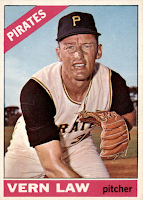
#252 Vernon Law - Pittsburgh Pirates


Vernon Sanders Law
Pittsburgh Pirates
Pitcher

Bats:  Right  Throws:  Right  Height:  6'2"  Weight:  195
Born:  March 12, 1930, Meridian, ID
Signed:  Signed by the Pittsburgh Pirates as an amateur free agent before 1948 season
Major League Teams:  Pittsburgh Pirates 1950-1951, 1954-1967

Vern Law spent his entire 16-year big league career with the Pirates and his dominating season in 1960 led to a World Series ring and the National League Cy Young Award.  Law made his debut in 1950 and pitched for two seasons as a swingman for the Pirates before missing two entire years while serving in the military.  He earned a spot back in the Pirates' starting pitching rotation in 1954.  Law won at least 10 games in nine different seasons and his 18-9 record in 1959 was a precursor to his career year in 1960.  He was 20-9 with a 3.08 ERA and a league leading 18 complete games that season, throwing 271 2/3 innings as the Pirates won the National League pennant for the first time since 1927.  Law was the winning pitcher in Games 1 and 4 against the Yankees, and started the decisive Game 7 before being relieved in the sixth inning with the Pirates holding a 4-1 lead.  The Yankees would battle back, but Bill Mazeroski hit his walk-off home run in the bottom of the ninth to give the Pirates the Series.  Law had also started and won the second All-Star Game in 1960, pitching two scoreless innings.

While he never again enjoyed the success he found in 1960, Law continued to be a key member of the Pirates' pitching staff, winning 17 games in 1965 and earning National League Comeback Player of the Year honors.  He retired following the 1967 season with a career record of 162-147, a 3.77 ERA and 1,092 strikeouts over 2,672 innings pitched - 4th on the Pirates' all-time franchise leaderboard.  Following his playing days, Law served as the Pirates pitching coach in 1968 and 1969.  He'd go on to coach at the collegiate level, in the minor leagues and for three seasons in Japan for the Seibu Lions.  His son, Vance Law, was an All-Star in 1988 and played 11 years in the majors for the Pirates (1980-1981), White Sox (1982-1984), Expos (1985-1987), Cubs (1988-1989) and Athletics (1991).

Some text for this post originally appeared on my 1965 Topps blog.

Building the Set
Summer of 1983 or 1984 in Millville, NJ - Card #33
This was one of the Original 44, and I re-told the story of how my Dad and I started collecting this set with the Walt Dropo (#238) post, back in February.  Seven of the Original 44 came from series one, with 11 coming from series two, and this Law card is the 15th of 16 from series three.

The Card / Pirates Team Set
Law returned to Topps with this card after appearing exclusively with Bowman in 1955.  Like many of the Pirates cards before this, Law is shown wearing the helmet required by then Pirates General Manager Branch Rickey.  I found this summary from SABR explaining Rickey's introduction of the helmets in September 1952, to be worn at all times by Pirates players and coaches - at bat and in the field.  Clicking on the link below for the Pirates team set will take you to a gallery of Pirates cards found in the set so far, with a majority of the players wearing these helmets.

I never noticed the Bing Crosby cameo on the back of this card, and when the card came into our collection originally, I likely didn't know who Crosby was.  Per Law's SABR biography, Crosby was a minority owner of the Pirates when the team was courting Law during his senior year of high school in 1947.  Crosby was instrumental in convincing Law, who was in high demand, to sign with the Pirates, with the crooner going so far as to call Law's house and speak to his mother.  I wonder if Crosby has made any more cameo appearances on other baseball cards?

1956 Season
Law suffered through a rough season, pitching in 39 games and going 8-16 with a 4.32 ERA for the seventh place Pirates.  He made 32 starts, with only Bob Friend (#221) and Ron Kline (#94) making more starts, with 42 and 39 respectively.

1951 Bowman #203
1954 Topps #235
1961 Topps #400
1966 Topps #15
1985 Topps #137

Other Notable Baseball Cards

First Mainstream Card:  1951 Bowman #203
Topps Flagship Set Appearances (15):  1952, 1954, 1956-1967, 1985
Most Recent Mainstream Card:  2020 Topps Archives Fan Favorites Autographs #FFA-VL

117 - Law non-parallel baseball cards in the Beckett online database as of 5/20/23.

Sources:  
Baseball Reference
Beckett Database
SABR
The Trading Card Database