Showing posts with label Pittsburgh Pirates. Show all posts

Friday, May 2, 2025

#331 Dick Hall - Pittsburgh Pirates


Richard Wallace Hall
Pittsburgh Pirates
Pitcher


Bats:  Right  Throws:  Right  Height:  6'6"  Weight:  200
Born:  September 27, 1930, St. Louis, MO
Signed:  Signed by the Pittsburgh Pirates as an amateur free agent, September 1951
Major League Teams:  Pittsburgh Pirates 1952-57, 1959; Kansas City Athletics 1960; Baltimore Orioles 1961-66; Philadelphia Phillies 1967-68; Baltimore Orioles 1970-71
Died:  June 18, 2023, Timonium, MD (age 92)

Signed out of college as an outfielder, Dick Hall converted to a pitcher full-time in 1957 and would gain fame as a reliever for the Orioles during their late 1960s/early 1970s dynasty.  Hall was a reserve outfielder for the Pirates beginning in 1952, appearing in a career-high 112 games with the club in 1954 and batting .239.  He'd begin his transition to pitching in 1955, going 12-5 with 16 complete games and a 2.24 ERA for the minor league Lincoln Chiefs.  Hall was dealt to the Orioles in April 1961, beginning the most successful stretch of his big league career.  In his first stint with the club, Hall's best seasons came between 1961 and 1964, when he went 27-17 with a 2.60 ERA in 164 appearances, saving 31 games.  After a brief stint with the Phillies, he was back with the Orioles in 1969, in time for their three-year run of postseason play.  In five postseason appearances, Hall was 2-1 with a 0.00 ERA in 8 2/3 innings pitched.  He won World Series rings with the Orioles in 1966 and 1970.  

He retired following the 1971 World Series, after two seasons of being the oldest player in the majors.  He was inducted into the Baltimore Orioles Hall of Fame in 1989.  In 495 games pitching over 16 seasons, Hall was 93-75 with a 3.32 ERA, 20 complete games, three shutouts and 71 saves.  He walked only 236 batters to 741 strikeouts over 1,259 2/3 innings pitched.  Over 19 seasons as a batter, Hall collected 150 hits, including four home runs, and had a lifetime .210 average.

From the 1968 Phillies Yearbook
Building the Set

August 13, 1989 in Bridgeton, NJ - Card #91
We went nuts at the Bridgeton Baseball Card Show in August 1989, buying 12 different cards for our 1956 Topps set, all at $1.50 a piece.  That's an impressive haul for $18!

I have no other information on the location of this show, other than it was held in the nearby city of Bridgeton, New Jersey.  What I do have however is the checklist I brought with us to the show.  I believe this is the second full checklist we carried around, having retired the prior version I created in 1988 and posted with the William Harridge (#1) card.

Just looking at this checklist (shown here) brings back fond memories of finding the cards, deciding to make a purchase, negotiating a price and then finding a flat surface so that we could cross off the newest additions.

The Card / Pirates Team Set
Hall's rookie card can be found in the 1955 Topps set, using the same photo as seen here.  Hall's position on his rookie card is listed as "3rd base-outfield."  The cartoon panels on the back justifiably highlight his move from the outfield to the pitcher's mound.

1956 Season
With the Pirates the entire season, Hall played in 33 games overall - 19 as a pitcher, 14 as a pinch-hitter and one as the starting first baseman on August 2nd.  As a pitcher, Hall was 0-7 with a 4.76 ERA in 10 relief appearances and nine starts.  He threw a complete game in his second start of the season on April 28th.  As a batter, Hall hit .345 (10 for 29) with an RBI.  His ten hits were all singles.

Phillies Career
Hall was a bright spot in the Phillies bullpen during his two years with the club during the lean years of 1967 and 1968.  On December 15, 1966, the Orioles traded Hall to the Phillies for a player to be named later, which ended up being lefty pitcher John Morris.  Hall and Turk Farrell were the club's top relievers in 1967, with Hall going 10-8 with a 2.20 ERA in 48 appearances and 86 innings pitched.  He saved nine games, second on the team behind Farrell's 12.  Hall slumped in 1968, going 4-1 with a 4.89 ERA in 32 appearances as one of the worst relievers in a surprisingly strong Phillies' bullpen.  He was released by the Phillies following the season, and the Orioles brought him back towards the end of spring training in 1969.

In 80 games (including one start) with the Phillies, Hall was 14-9 with a 3.14 ERA in 132 innings pitched.  His pinpoint control came with him to Philadelphia, as he struck out 80 and walked only 17.

1955 Topps #126
1957 Topps #308
1962 Topps #189
1967 Topps #508
1971 Topps #417

Other Notable Baseball Cards

First Mainstream Card:  1955 Topps #126
Topps Flagship Set Appearances (11):  1955-57, 1960-63, 1967-68, 1970-71
Most Recent Mainstream Card:  2022 Topps Archives Fan Favorites Autographs #93FF-DH

52 - Hall non-parallel baseball cards in the Beckett online database as of 4/26/25.

Sources:  
Baseball Reference
Beckett Database

Friday, April 11, 2025

#328 Preston Ward - Pittsburgh Pirates


Preston Meyer Ward
Pittsburgh Pirates
First Base

Bats:  Left  Throws:  Right  Height:  6'4"  Weight:  190
Born:  July 24, 1927, Columbia, MD
Signed:  Signed by the Brooklyn Dodgers as an amateur free agent before 1944 season
Major League Teams:  Brooklyn Dodgers 1948; Chicago Cubs 1950, 1953; Pittsburgh Pirates 1953-56; Cleveland Indians 1956-58; Kansas City Athletics 1958-59
Died:  June 2, 2013, Las Vegas, NV (age 85)

Originally signed by the Dodgers before the 1944 season, Preston Ward made his professional debut with the Class D Zanesville Dodgers as a 16-year-old.  After a solid season with the Pueblo Dodgers of the Western League in 1947, Ward earned the job as the opening day first baseman for the big league Dodgers in 1948.  He'd lose playing time, and eventually his job, when Gil Hodges (#145) moved from behind the plate to first base for Brooklyn.  Ward was sold to the Cubs following the 1949 season and after playing in a utility role for Chicago in 1950, he'd miss the next two seasons while serving in the military during the Korean War.  With the Pirates in 1954, Ward collected a career-best 48 RBIs as a back-up first baseman and right fielder.  

He'd appear in a career-high 129 games in 1958, splitting time with the Indians and Ahtletics, and batting .284 with 10 home runs and 45 RBIs.  Ward hit three home runs in a game against the Orioles on September 9, 1958, and he'd retire from baseball following the 1959 season.  In 744 big league games, Ward batted .253 with 522 hits, 50 home runs and 262 RBIs.

Building the Set
August 13, 1989 in Bridgeton, NJ - Card #90
We went nuts at the Bridgeton Baseball Card Show in August 1989, buying 12 different cards for our 1956 Topps set, all at $1.50 a piece.  That's an impressive haul for $18!


I have no other information on the location of this show, other than it was held in the nearby city of Bridgeton, New Jersey.  What I do have however is the checklist I brought with us to the show.  I believe this is the second full checklist we carried around, having retired the prior version I created in 1988 and posted with the William Harridge (#1) card.

Just looking at this checklist brings back fond memories of finding the cards, deciding to make a purchase, negotiating a price and then finding a flat surface so that we could cross off the newest additions.

The Card / Pirates Team Set
Topps repeated the same photo found on Ward's 1955 Topps card for this card.  The cartoon panels on the back nicely summarize Ward's career, explaining his start with the Dodgers then his move to the Cubs and finally his super utility role with the Pirates.  By the time collectors were finding this card in packs of 1956 Topps, Ward was already playing in Cleveland - see below.

1956 Season
Ward began the season in a reserve role, getting starts at third base and in right field for the Pirates, and batting .333 in 16 games.  On May 15th, he was traded, straight-up, to the Indians for catcher Hank Foiles.  Ward would settle into a back-up role with the Indians, appearing in 87 games overall, and getting starts in left field, right field and at first base.  He batted .253 with six home runs and 21 RBIs for the Indians, in one of his best seasons in the majors.   

1950 Bowman #231
1953 Topps #173
1954 Topps #72
1957 Topps #226
1959 Topps #176

Other Notable Baseball Cards

First Mainstream Card:  1950 Bowman #231
Topps Flagship Set Appearances (7):  1953-59
Most Recent Mainstream Card:  1994 Topps Archives 1954 #72

27 - Ward non-parallel baseball cards in the Beckett online database as of 4/5/25.

Sources:  
Baseball Reference
Beckett Database

Saturday, August 31, 2024

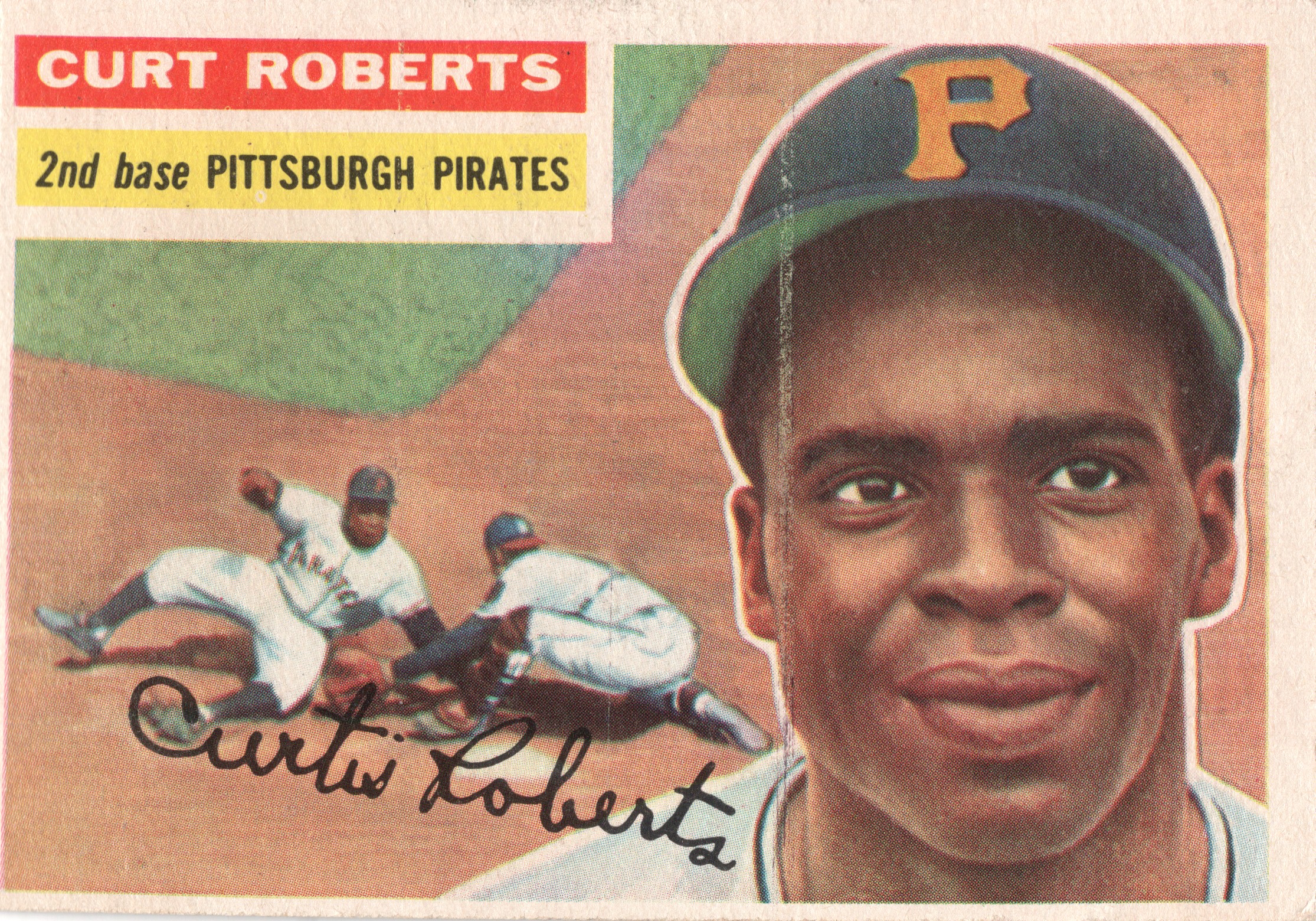
#306 Curt Roberts - Pittsburgh Pirates


Curtis Benjamin Roberts
Pittsburgh Pirates
Second Base

Bats:  Right  Throws:  Right  Height:  5'8"  Weight:  165
Born:  August 16, 1929, Pineland, TX
Signed:  Signed by the Boston Braves as an amateur free agent before 1951 season
Major League Teams:  Kansas City Monarchs 1947-48; Pittsburgh Pirates 1954-56
Died:  November 14, 1969, Oakland, CA (age 40)

Curt Roberts played for two seasons with the Kansas City Monarchs in the late 1940s before becoming the first black player in Pirates' franchise history in 1954.  With the Monarchs as a teenager, Roberts batted .275 in 65 games over the 1948 and 1948 seasons.  He earned a reputation as one of the best fielding second basemen in the league.  Originally signed by the Braves in 1951, Roberts played steadily in the minors before earning a spot on the Pirates' opening day roster in 1954.  He tripled off future Hall of Famer Robin Roberts (#180) in his first at-bat and would later double in the same game.  With general manager Branch Rickey supporting him, Roberts was the regular second baseman for the Pirates that season, batting .232 in 134 games with 18 doubles, a home run and 36 RBIs.  That would be his sole full season in the majors, as he was demoted to the minors early in the 1955 season and eventually lost his job in 1956 to Bill Mazeroski.

Roberts would continue to play professionally through the 1963 sesason in the Yankees, Dodgers and White Sox systems, finding success with the Denver Bears, then the Yankees' top farm team, in the late 1950s.  In parts of three seasons with the Pirates, Roberts batted .223 in 171 games.  His legacy has been revisited in recent years, with the Pirates recognizing his contributions to their franchise with various initiatives named for Roberts.  He's credited with paving the way for other players in the years to come, including future Hall of Famer Roberto Clemente (#33).

December 25, 2007
Building the Set

December 28, 2007 from Dad's eBay purchase - Card #336
I last shared this full story with the Foster Castleman (#271) post in late December, but I'll repeat myself, in an edited version, here.  The way my Dad and I finished the 1956 Topps set was somewhat anti-climatic but nevertheless a joyful memory.  Leading up to the Christmas of 2007, my Dad (with the help of my Mom) scoured eBay and other online baseball card stores for the remaining 29 cards we needed to complete the set.  Throughout the weeks and months leading up to the holidays, he knew we had completed the set but he kept it quiet, wanting to surprise me on Christmas morning.  I have no idea, and I'll never know, what the true last card was that he acquired to finish off the set.  And I have no record, nor was he able to tell me, how much they had paid for any of these final 29 cards.  

This Roberts card was one of the final 29.  It was one of the commons included in a memorable haul that included the cards of Pee Wee Reese (#260), Roberto Clemente (#33), Whitey Ford (#240) and a spotless checklist card for the 1st and 3rd Series.

The Card / Pirates Team Set
Roberts has cards in the 1954, 1955 and 1956 Topps sets with all three cards using the exact same photo.  The action shot would appear to show him out at home plate on a tag applied by what looks to be a Braves catcher.  The cartoons on the back of the card highlight his recent success in the minor leagues and his strong defensive skills.

1956 Season
Roberts began the season as the back-up to Johnny O'Brien (#65), but with O'Brien slumping Roberts earned more playing time.  Roberts didn't fare much better, making 17 starts at second base and batting just .177 in 31 games overall.  His last game in the majors came on June 8th when he entered a game against the Cardinals as a late inning defensive replacement.  On June 23rd, Roberts was dealt to the Athletics with Jack McMahan for Spook Jacobs (#151), but he'd never suit up in Kansas City.  With their top minor league team in Columbus, Roberts batted .320 in 87 games.

1954 Topps #242
1955 Topps #107

Other Notable Baseball Cards

First Mainstream Card:  1954 Topps #242
Topps Flagship Set Appearances (3):  1954-56
Most Recent Mainstream Card:  1994 Topps Archives 1954 #242

15 - Roberts non-parallel baseball cards in the Beckett online database as of 8/31/24.

Sources:  
Baseball Reference
Beckett Database

Monday, July 1, 2024

#297 Bob Skinner - Pittsburgh Pirates


Robert Ralph Skinner
Pittsburgh Pirates
Outfield


Bats:  Left  Throws:  Right  Height:  6'4"  Weight:  190
Born:  October 3, 1931, La Jolla, CA
Signed:  Signed by the Pittsburgh Pirates as an amateur free agent before 1951 season
Major League Teams:  Pittsburgh Pirates 1954, 1956-1963; Cincinnati Reds 1963-1964; St. Louis Cardinals 1964-1966
As a Manager:  Philadelphia Phillies 1968-1969; San Diego Padres 1977

Bob Skinner spent over 50 years in baseball as a player, manager, coach and scout.  Most of his playing career was spent with the Pirates where he was an All-Star in 1958 and for both games in 1960.  As the regular left fielder for the Pirates, Skinner had his best season in 1958 when he batted .321 with 13 home runs and 70 RBIs, finishing in the top ten in the National League in most major offensive categories and earning MVP votes.  In 1960, Skinner was second on the club with 86 RBIs, behind only Roberto Clemente (#33) for the team lead, helping the Pirates clinch the pennant and eventually win the World Series in seven games over the Yankees.  After a few seasons with the Reds, Skinner ended his playing career as a pinch-hitter and back-up outfielder for the Cardinals.  He had four pinch-hitting appearances in the 1964 World Series, going 2 for 3 as St. Louis prevailed over the Yankees.  In 1,381 career games, Skinner batted .277 with 103 home runs and 531 RBIs.

Skinner began his managerial career in 1967 with the San Diego Padres, then the top minor league affiliate for the Phillies.  He won Minor League Manager of the Year honors after leading the Padres to an 85-63 record and winning the 1967 Pacific Coast League Championship.  On June 16, 1968, Skinner was named as the new manager of the Phillies after Gene Mauch was fired.  Skinner's time as manager of the Phillies would last a little over a year before he'd resign from the position.  Skinner would coach in the majors with the Padres (1970-1973, 1977), Pirates (1974-1976, 1979-1985), Angels (1978) and Braves (1986-1988), and he earned his third World Series ring as the hitting coach for the Pirates in 1979.  He'd work in the Astros organization as a special assignment scout until 2009.  Skinner's son Joel played nine seasons in the majors with the White Sox, Yankees and Indians.  Joel Skinner briefly managed the Indians in the second half of the 2002 season.

Some text for this post originally appeared on my 1965 Topps blog.

Building the Set

December 25, 2003 from San Diego, CA (Kit Young Cards) - Card #250
My Dad/Santa brought me nine cards for our set for Christmas in 2003, with all but one of the cards coming from his dealer of choice, Kit Young Cards in San Diego.  The Brooklyn Dodgers team card (#166) was the lone non-Kit Young Cards addition, as that card came from TemDee in Turnersville, New Jersey.  It was a strange mix of commons from Kit Young Cards, with no semi-star or star card to balance out the lot.  We were admittedly in a lull collecting the set, with only 18 cards added during all of 2003 and only six cards added, as Christmas presents, in 2004.

Pictures from the Christmas of 2003 show us opening gifts at my Mom's house on December 26th, which has since become a tradition for us.  So while the official set records indicate these nine cards were added on December 25th, it was most likely a day later I opened the cards while in Millville.

The Card / Pirates Team Set
Skinner's rookie card can be found in the 1955 Topps set, and this card reuses the main head shot photo from that card.  The action shot features an excellent play at the plate, and it would look as if Skinner is out.  But thanks to the magic of the internet, I found the source photo showing the home plate umpire signaling Skinner as safe.  In a play that happened in the first inning of the Pirates-Giants game on April 20, 1954, Skinner slid under the tag of Giants' catcher Ray Katt as the on-deck batter, Jack Shepard, wearing #10, looks on.  It looks as if Topps decided to move Skinner's head in the photo used for the card.

On the back, Topps imagines playing in New Orleans as a non-stop Mardi Gras celebration, complete with a parade and marching band.

1956 Season
Still a few years away from his break-out season of 1958, Skinner spent all of 1955 in the minor leagues and made the Pirates' opening day roster in 1956.  He spent the season learning to play the outfield, and served as a utility player for the club, making starts in left field (21), first base (19) and right field (9).  In 113 games overall, Skinner batted .202 with five home runs and 29 RBIs.

Phillies Career
Skinner's managerial career with the Phillies did not go well, which was somewhat surprising at the time given his success with the Triple-A Padres.  In 1968, Skinner inherited a team from Mauch in fifth place, but only 5 1/2 games out of first place.  The 1968 Phillies finished the season with 86 losses overall and 21 games out of first place.  In 1969, Skinner continued to clash with star Dick Allen.  When Allen skipped a double header in New York on June 24th, he was suspended and missed the next 26 games.  With the Phillies front office seemingly negotiating with Allen behind Skinner's back, the manager abruptly resigned in early August.  The story from the Phillies was that Skinner resigned because the team wouldn't extend his contract beyond the 1969 season, but Skinner maintained the reason for his departure was the constant clashing with Allen.  Third base coach George Myatt managed the team for the remainder of the season.  Skinner was 92-123 overall for the Phillies, in a managerial tenure that lasted a little over one year.

1955 Topps #88
1958 Topps #94
1961 Topps #204
1969 Topps #369
1985 Topps #139

Other Notable Baseball Cards

First Mainstream Card:  1955 Topps #88
Topps Flagship Set Appearances (16):  1955-1966, 1969, 1973-1974, 1985
Most Recent Mainstream Card:  1992 Fleer ProCards #503

98 - Skinner non-parallel baseball cards in the Beckett online database as of 7/1/24.

Sources:  
1965 Topps Blog

Friday, May 26, 2023

#252 Vernon Law - Pittsburgh Pirates


Vernon Sanders Law
Pittsburgh Pirates
Pitcher

Bats:  Right  Throws:  Right  Height:  6'2"  Weight:  195
Born:  March 12, 1930, Meridian, ID
Signed:  Signed by the Pittsburgh Pirates as an amateur free agent before 1948 season
Major League Teams:  Pittsburgh Pirates 1950-1951, 1954-1967

Vern Law spent his entire 16-year big league career with the Pirates and his dominating season in 1960 led to a World Series ring and the National League Cy Young Award.  Law made his debut in 1950 and pitched for two seasons as a swingman for the Pirates before missing two entire years while serving in the military.  He earned a spot back in the Pirates' starting pitching rotation in 1954.  Law won at least 10 games in nine different seasons and his 18-9 record in 1959 was a precursor to his career year in 1960.  He was 20-9 with a 3.08 ERA and a league leading 18 complete games that season, throwing 271 2/3 innings as the Pirates won the National League pennant for the first time since 1927.  Law was the winning pitcher in Games 1 and 4 against the Yankees, and started the decisive Game 7 before being relieved in the sixth inning with the Pirates holding a 4-1 lead.  The Yankees would battle back, but Bill Mazeroski hit his walk-off home run in the bottom of the ninth to give the Pirates the Series.  Law had also started and won the second All-Star Game in 1960, pitching two scoreless innings.

While he never again enjoyed the success he found in 1960, Law continued to be a key member of the Pirates' pitching staff, winning 17 games in 1965 and earning National League Comeback Player of the Year honors.  He retired following the 1967 season with a career record of 162-147, a 3.77 ERA and 1,092 strikeouts over 2,672 innings pitched - 4th on the Pirates' all-time franchise leaderboard.  Following his playing days, Law served as the Pirates pitching coach in 1968 and 1969.  He'd go on to coach at the collegiate level, in the minor leagues and for three seasons in Japan for the Seibu Lions.  His son, Vance Law, was an All-Star in 1988 and played 11 years in the majors for the Pirates (1980-1981), White Sox (1982-1984), Expos (1985-1987), Cubs (1988-1989) and Athletics (1991).

Some text for this post originally appeared on my 1965 Topps blog.

Building the Set
Summer of 1983 or 1984 in Millville, NJ - Card #33
This was one of the Original 44, and I re-told the story of how my Dad and I started collecting this set with the Walt Dropo (#238) post, back in February.  Seven of the Original 44 came from series one, with 11 coming from series two, and this Law card is the 15th of 16 from series three.

The Card / Pirates Team Set
Law returned to Topps with this card after appearing exclusively with Bowman in 1955.  Like many of the Pirates cards before this, Law is shown wearing the helmet required by then Pirates General Manager Branch Rickey.  I found this summary from SABR explaining Rickey's introduction of the helmets in September 1952, to be worn at all times by Pirates players and coaches - at bat and in the field.  Clicking on the link below for the Pirates team set will take you to a gallery of Pirates cards found in the set so far, with a majority of the players wearing these helmets.

I never noticed the Bing Crosby cameo on the back of this card, and when the card came into our collection originally, I likely didn't know who Crosby was.  Per Law's SABR biography, Crosby was a minority owner of the Pirates when the team was courting Law during his senior year of high school in 1947.  Crosby was instrumental in convincing Law, who was in high demand, to sign with the Pirates, with the crooner going so far as to call Law's house and speak to his mother.  I wonder if Crosby has made any more cameo appearances on other baseball cards?

1956 Season
Law suffered through a rough season, pitching in 39 games and going 8-16 with a 4.32 ERA for the seventh place Pirates.  He made 32 starts, with only Bob Friend (#221) and Ron Kline (#94) making more starts, with 42 and 39 respectively.

1951 Bowman #203
1954 Topps #235
1961 Topps #400
1966 Topps #15
1985 Topps #137

Other Notable Baseball Cards

First Mainstream Card:  1951 Bowman #203
Topps Flagship Set Appearances (15):  1952, 1954, 1956-1967, 1985
Most Recent Mainstream Card:  2020 Topps Archives Fan Favorites Autographs #FFA-VL

117 - Law non-parallel baseball cards in the Beckett online database as of 5/20/23.

Sources:  
Baseball Reference
Beckett Database
SABR
The Trading Card Database

Friday, December 30, 2022

#232 "Toby" Atwell - Pittsburgh Pirates


Maurice Dailey Atwell
Pittsburgh Pirates
Catcher

Bats:  Left  Throws:  Right  Height:  5'9"  Weight:  185
Born:  March 8, 1924, Leesburg, VA
Signed:  Signed by the Brooklyn Dodgers as an amateur free agent before 1946 season
Major League Teams:  Chicago Cubs 1952-1953; Pittsburgh Pirates 1953-1956; Milwaukee Braves 1956
Died:  January 25, 2003, Purcellville, VA (age 78)

Toby Atwell spent six seasons climbing the ladder through the Dodgers' minor league system, finding success at each level and batting as high as .342 during the 1948 season.  But with Roy Campanella (#101)  starting for the Dodgers and Bruce Edwards serving as an effective back-up for the future Hall of Famer, there was no room for Atwell in Brooklyn.  In December 1951 he was traded to the Cubs, and he'd enjoy his best season in the majors during his rookie year of 1952.  Making his debut on opening day 1952 and settling in as the Cubs' regular catcher, Atwell was batting .324 by the All-Star break and he was named to the National League All-Star squad.  He'd not get into the game as it was shortened to five innings due to rain, and with Campanella again blocking his playing time.  In 107 games during the 1952 season, Atwell batted .290 with 16 doubles and 31 RBIs.

Atwell never repeated the success he found in 1952, but he did play in parts of four more big league seasons with the Cubs, Pirates and Braves.  He spent the most time in Pittsburgh, sharing catching duties with Mike Sandlock or Jack Shepard for the second division club.  Atwell had come to Pittsburgh in June 1953 in a blockbuster 10-player trade that saw Ralph Kiner leave the Pirates for the Cubs.  He played professionally through the 1958 season, retiring after a brief stint in the Orioles organization.  In 378 big league games, Atwell batted .260 with nine home runs and 110 RBIs.

Building the Set

December 25, 2003 from San Diego, CA (Kit Young Cards) - Card #245
My Dad/Santa brought me nine cards for our set for Christmas in 2003, with all but one of the cards coming from his dealer of choice, Kit Young Cards in San Diego.  The Brooklyn Dodgers team card (#166) was the lone non-Kit Young Cards addition, as that card came from TemDee in Turnersville, New Jersey.  It was a strange mix of commons from Kit Young Cards, with no semi-star or star card to balance out the lot.  We were admittedly in a lull collecting the set, with only 18 cards added during all of 2003 and only six cards added, as Christmas presents, in 2004.

Pictures from the Christmas of 2003 show us opening gifts at my Mom's house on December 26th, which has since become a tradition for us.  So while the official set records indicate these nine cards were added on December 25th, it was most likely a day later I opened the cards while in Millville.

The Card / Pirates Team Set
Atwell appeared exclusively in Bowman sets in 1954 and 1955, and this is his first Topps card since 1953.  I'm assuming he's safe at home in the action shot, given the catcher and the home plate umpire are no where to be seen.  On the back, his .289 average from the 1954 season is highlighted as is the massive trade with the Cubs that brought him to Pittsburgh, presumably via a pirate ship.

1956 Season
Atwell began the season with the Pirates as one of three catchers on the team's roster along with Danny Kravitz and Shepard.  He'd appear in just 12 games for the Pirates, batting .111 (2 for 18), before a May trade sent him to the Cardinals' organization.  He'd be with the Cardinals until July 3rd, when St. Louis traded him to the Phillies for third baseman Jim Command.  Atwell was property of the Phillies for two weeks before he was on the move again, this time sold to the Braves.

He'd appear in 15 games for the Braves, batting .167 (5 for 30) with a pair of home runs and seeing his final big league action on September 28th.

Phillies Connection
As mentioned above, Atwell spent two weeks of the 1956 season in the Phillies' system.  Baseball Reference shows he played in four games for the Miami Marlins, then the International League affiliate of the Phillies.  There's no record of him catching in any of those games, so there's no telling if he caught Satchel Paige, who appeared in 37 games for the Marlins in 1956.

1952 Topps #356
1953 Bowman Color #112
1953 Topps #23
1954 Bowman #123
1955 Bowman #164

Other Notable Baseball Cards

First Mainstream Card:  1952 Topps #356
Topps Flagship Set Appearances (3):  1952-1953, 1956
Most Recent Mainstream Card:  1991 Topps Archives 1953 #23

12 - Atwell non-parallel baseball cards in the Beckett online database as of 11/30/22.

Sources:  
Baseball Reference
Beckett Database