Showing posts with label 1951. Show all posts

Friday, August 1, 2025

#338 Jim Delsing - Detroit Tigers


James Henry Delsing
Detroit Tigers
Outfield

Bats:  Left  Throws:  Right  Height:  5'10"  Weight:  175
Born:  November 13, 1925, Rudolph, WI
Acquired:  Obtained by the Chicago White Sox from the Milwaukee Brewers (American Association) as part of a minor league working agreement, before 1946 season
Major League Teams:  Chicago White Sox 1948; New York Yankees 1949-50; St. Louis Browns 1950-52; Detroit Tigers 1952-56; Chicago White Sox 1956; Kansas City Athletics 1960
Died:  May 4, 2006, Chesterfield, MO (age 80)

Jim Delsing played professionally for 17 seasons, finding his most success as a regular center or left fielder for the Tigers in the early 1950s.  Delsing made his minor league debut in 1942, and then missing two full seasons while serving in the Army in Europe during World War II.  He spent 20 games with the White Sox in 1948 and nine games with the Yankees late in the 1949 season, filling in for an ailing Joe DiMaggio.  Delsing's first shot at regular playing time came with the Browns in 1951, when he appeared in 131 games.  He famously pinch-ran for the 3' 7" Eddie Gaedel after Gaedel walked in his lone big league plate appearance on August 19, 1951.  Traded to the Tigers in August 1952 as part of an eight-player deal, Delsing was the club's opening day center fielder in 1953.  He batted .288 with 11 home runs and 62 RBIs that season, reaching personal bests in all three categories.  Delsing moved to left field in 1954 and had another solid year with the Tigers, batting .248 with six home runs and 38 RBIs in 122 games.  He led the league in fielding percentage in 1953, among center fielders, and in 1954, among all outfielders.

Delsing lost playing time following the 1954 season, appearing as primarily a pinch-hitter in 1955 and 1956.  After three full seasons in the minor leagues, he made a brief comeback with the Athletics in 1960, batting .250 in 16 games.  In 822 major league games, Delsing batted .255 with 112 doubles, 40 home runs and 286 RBIs.

Winter 1994 - Dad inspecting the new construction
Building the Set

December 25, 1994 from San Diego, CA - Card #141
The Roy Campanella (#101) card was my "big" present from Santa for Christmas 1994.  With my Dad's help, Santa secured the Campanella card from Kit Young Cards in San Diego for what my notes say was $75.  That price seems steep, but there were six other cards from the 1956 Topps set under the Christmas tree that year from Kit Young Cards, including this Delsing card, with the other six cards costing a combined $20.  In December 1994, I would have been home from college for the winter break of my junior year.

This was the last Christmas my family and I spent in the house on 12th Street in my hometown where I grew up.  My parents were in the process of building a new house and we'd visit the construction site throughout that winter break.  I had a tough time leaving my childhood home behind and the 1994-95 timeframe brought about quite a few major changes in my life.

The Card / Tigers Team Set
Topps reused Delsing's photo from his 1955 Topps card for this card.  The cartoons on the back of the card highlight his minor league success and his career year in 1953.

1956 Season
Delsing lost his starting job with the Tigers following the 1955 season, and he'd appear in just 10 games with the club before a trade sent him back to his original team, the White Sox.  On May 15th, the Tigers traded Delsing and Fred Hatfield (#318) to Chicago for Jim Brideweser, Harry Byrd and Bob Kennedy (#38).  Used almost exclusively as a pinch-hitter or late inning defensive replacement, Delsing batted .122 in 55 games for the White Sox.

1951 Bowman #279
1952 Topps #271
1953 Topps #239
1955 Topps #192
1959 Topps #386

Other Notable Baseball Cards

First Mainstream Card:  1951 Bowman #279
Topps Flagship Set Appearances (6):  1952-56, 1959
Most Recent Mainstream Card:  1994 Topps Archives 1954 #111

20 - Delsing non-parallel baseball cards in the Beckett online database as of 6/28/25.

Sources:  
Baseball Reference
Beckett Database

Friday, April 25, 2025

#330 Jim Busby - Cleveland Indians


James Franklin Busby
Cleveland Indians
Outfield

Bats:  Right  Throws:  Right  Height:  6'1"  Weight:  175
Born:  January 8, 1927, Kenedy, TX
Signed:  Signed by the Chicago White Sox as an amateur free agent, June 7, 1948
Major League Teams:  Chicago White Sox 1950-52; Washington Nationals 1952-55; Chicago White Sox 1955; Cleveland Indians 1956-57; Baltimore Orioles 1957-58; Boston Red Sox 1959-60; Baltimore Orioles 1960-61; Houston Colt .45s 1962
Died:  July 8, 1996, Augusta, GA (age 69)

Jim Busby spent nearly three full decades in the major leagues as both a smooth-fielding center fielder and as a coach.  He spent 13 seasons as a player, and his earlier seasons were his best.  Busby was an All-Star with the White Sox in his rookie season of 1951, and he'd play a half inning in left field in the All-Star Game, replacing Ted Williams (#5).  Busby swiped a career-high 26 bases in 1951.  He'd have his best seasons as a member of the Nationals, batting .312 with career highs in doubles (28) and RBIs (82) in 1953.  Speed in the outfield helped him finish in the top 10 for putouts, fielding percentage and assists in most of the seasons throughout the 1950s.  Busby's production declined following his departure from Washington, and he spent the final eight seasons of his career playing for six different clubs, including a repeat stint with the White Sox and two different stints with the Orioles.

Busby is one of the more underrated players from the 1950s in my opinion.  In 1,352 games, he collected 1,113 hits, 162 doubles, 35 triples, 48 home runs and had 438 RBIs, while stealing 97 bases.  He was a player-coach with the Orioles in 1961 and with the inaugural Colt .45s team in 1962.  Busby's complete coaching career spanned 18 years with the Orioles (1961), Colt .45s/Astros (1962-67), Braves (1968-75), White Sox (1976) and Mariners (1977-78).


Building the Set
July 20, 1989 in Williamstown, NJ - Card #79
In the summer of 1989, I was between my freshman and sophomore years of high school, and I have nothing but pleasant memories of that time growing up in South Jersey.  There were maybe five or six baseball card stores in our area, although only a few of them were known to carry older baseball cards.  One of those stores was located in Williamstown, New Jersey, which ironically enough is where my wife and I would settle and start to raise our family some 14 years later.  I had to dig into my notes from our other set quests to find the store's name - Collector's Corner.  We had finished off our 1974 Topps set in February 1988 at Collector's Corner.   

1977 Topps #597
July 20th was a Thursday, and I guess my Dad would have been off work with a hankering for a new card for our relatively new 1956 Topps set quest.  We were also collecting the 1973 Topps set, and with our 1956 and 1973 checklists in hand, we made the half hour drive from Millville to Williamstown.  I don't know if we purchased any 1973 Topps cards that day, but we found this Busby card for $5 - not a bad deal.  As a current Williamstown resident, I'm not even sure where this store would have been located back in the day, as a lot of the ubiquitous strip malls all look pretty much the same to me.  But it was in a strip mall, I remember that much.

I'm not exactly sure why Busby was one of my Dad's favorite players, and I wish I had thought to ask him at some point.  I suspect it has something to do with the fact they both shared the same first name, and there weren't a lot of major leaguers with the first name of Jim during my Dad's years as a young baseball fan.  Busby holds a special place for me in my collecting journey, as my Dad brought home a 1959 Topps Busby card one day back in the early 1980s.  It was one of a trio of completely disconnected (and ancient) cards added to my collection after I had first discovered baseball cards, and these were the oldest cards in my collection for a few years until the Magic Shoebox entered my life, jumpstarting the journey of collecting the 1956 Topps set.

The Card / Indians Team Set
This is Busby's first Topps card since 1952, as he had been exclusive to Bowman.  It looks as if Busby is wearing a White Sox uniform in the action photo and Topps also decided to remove any infielders in the background who may have been in the vicinity of second base.  He could be wearing a White Sox or Nationals jersey in the head shot, and a Topps artist did a decent job adding the Indians logo to Busby's hat.  The back of the card highlights his speed and "great fielding ability."

On October 25, 1955, Busby was traded by the White Sox with Chico Carresquel (#230) to the Indians for Larry Toby (#250).  Topps updated the cap logos on Busby's and Carresquel's cards, but surprisingly decided to leave Doby's cap logo as is. 

1956 Season
Busby was the opening day center fielder for the Indians, and he'd start 122 games overall at the position.  In 135 total games, he batted .235 with 17 doubles, 12 home runs and 50 RBIs.  He was not able to replace Doby's output for the Indians, as had been hoped, but he did hit grand slams in back-to-back games on July 5th and 6th.

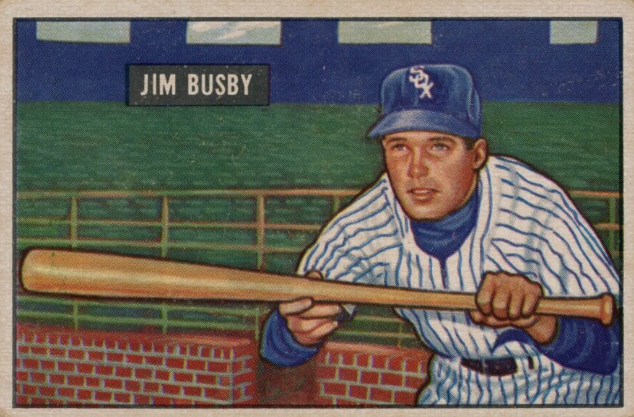
1951 Bowman #302
1952 Topps #309
1953 Bowman Color #15
1957 Topps #309
1974 Topps #634

Other Notable Baseball Cards

First Mainstream Card:  1951 Bowman #302
Topps Flagship Set Appearances (9):  1952, 1956-60, 1973-74, 1977
Most Recent Mainstream Card:  1983 Topps 1952 Reprint Series #309

55 - Busby non-parallel baseball cards in the Beckett online database as of 4/8/22.

Sources:  
Baseball Reference
Beckett Database

Friday, February 21, 2025

#321 Jim Konstanty - New York Yankees


Casimir James Konstanty
New York Yankees
Pitcher


Bats:  Right  Throws:  Right  Height:  6'1"  Weight:  202
Born:  March 2, 1917, Strykersville, NY
Acquired:  Sent from the Springfield Nationals (Eastern League) to the Cincinnati Reds in an unknown transaction before 1942 season
Major League Teams:  Cincinnati Reds 1944; Boston Braves 1946; Philadelphia Phillies 1948-54; New York Yankees 1954-56; St. Louis Cardinals 1956
Died:  June 11, 1976, Oneonta, NY (age 59)

To date, Jim Konstanty is the only National League relief pitcher to win MVP honors, a feat he accomplished as the top reliever for the Phillies' 1950 pennant-winning team, the Whiz Kids.  Konstanty pitched briefly for the Reds and Braves in the 1940s, missing the entire 1945 season while serving in the U.S. Navy.  He'd earn a September call-up from the Phillies in 1948, joining the club's bullpen for good in 1949.  His career year came in 1950 when he was 16-7 with a 2.66 ERA while leading the league with 74 relief appearances.  Konstanty threw 152 innings, using a slider and change-up to help him record a league-best 22 saves.  Even though he hadn't started a game in the majors since 1946, Phillies' manager Eddie Sawyer named Konstanty as his starting pitcher for Game 1 of the 1950 World Series against the Yankees.  Konstanty would allow a run over his eight innings of work, but was out-dueled by Vic Raschi in a 1-0 win for the Yankees.  The Phillies would be swept in the series, and not return to the postseason until 1976.

Konstanty received 18 first place votes in the league's MVP voting, with Stan Musial finishing a distant second.  He'd never again repeat the success from that 1950 season, pitching in 3 1/2 more seasons with the Phillies, parts of three seasons with the Yankees and a final 27 games with the Cardinals in 1956.  In 433 big league games, Konstanty was 66-48 with a 3.46 ERA and 76 saves.  He served as a pitching instructor in the Cardinals and Yankees systems throughout the 1960s.

Building the Set
December 25, 1993 from Deptford, NJ - Card #123
On Christmas morning 1993, I unwrapped two cards needed for our 1956 Topps set - this Konstanty card and the Ted Williams (#5) card.  Unfortunately for Konstanty, the addition of the Williams card far out shadowed the addition of his card.  I would have known who Konstanty was, given my interest in the Phillies and their history, and I can vaguely recall not knowing he had ever pitched for the Yankees.  My records show my Dad had secretly purchased this Konstanty card at a Deptford Mall baseball card show held earlier in the fall, paying just $6 for the card.

The Card / Yankees Team Set
This is Konstanty's final appearance in a Topps set during his career, and he'd pop up again in the 1961 Topps set as one of the MVP subset cards.  There's a Yankees teammate making a cameo appearance behind Konstanty, carrying what appears to be a winter coat?  The back of the card highlights his success in 1950 and since joining the Yankees' bullpen.  The final cartoon panel mentions his two important wins down the stretch for the Yankees in 1955, but Konstanty would not appear in the 1955 World Series against the Dodgers.

1956 Season
Konstanty began the season in the Yankees' bullpen, appearing in eight games and pitching to a 4.91 ERA with no record.  The Yankees released him on May 18th, and he'd sign a few weeks later, on June 4th, with the Cardinals.  He'd appear in his final 27 big league games with the Cardinals, going 1-1 with a 4.58 ERA in 27 games, and 39 1/3 innings pitched.

Phillies Career
It's always seemed like a huge oversight to me that Konstanty was never inducted onto the Phillies' Wall of Fame.  His 1950 MVP campaign alone makes him a more likely candidate than some of the recent inductees, but the Phillies probably realize they wouldn't sell many more tickets on a day featuring a pregame ceremony to honor the bespectacled pitcher from the 1950s.

The Phillies acquired Konstanty before the 1948 season as part of a minor league working agreement with the Toronto Maple Leafs, who would soon become the Phillies' Triple-A team.  He appeared in six games, all in relief, in September 1948.  Konstanty was a workhorse coming out of the bullpen for the Phillies between 1949 and the first part of the 1953 season, appearing in 53, 74, 58, 42, 48 and 33 games, in each of those seasons.  1950 was by far his career year, but he'd put up respectable numbers in each season with the Phillies thereafter.  On August 22, 1954, the Yankees selected him off waivers, ending his Phillies career.  Konstanty was 51-39 with a 3.64 ERA and 54 saves in 314 games with the Phillies.

He'd work in the Cardinals' minor league system in the early 1960s, where he's credited with teaching a young Steve Carlton how to master his slider and change-up.  That alone could be worthy of a Phillies Wall of Fame induction.

1950 Bowman #226
1951 Bowman #27
1952 Topps #108
1953 Bowman Black & White #58
1961 Topps #479

Other Notable Baseball Cards

First Mainstream Card:  1950 Bowman #226
Topps Flagship Set Appearances (3):  1952, 1956, 1961
Most Recent Mainstream Card:  1987 TCMA 1950 Philadelphia Phillies #3

47 - Konstanty non-parallel baseball cards in the Beckett online database as of 2/8/25.

Sources:  
Baseball Reference
Beckett Database

Friday, February 14, 2025

#320 Joe Adcock - Milwaukee Braves


Joseph Wilbur Adcock
Milwaukee Braves
First Base

Bats:  Right  Throws:  Right  Height:  6'4"  Weight:  210
Born:  October 30, 1927, Coushatta, LA
Signed:  Signed by the Cincinnati Reds as an amateur free agent before 1947 season
Major League Teams:  Cincinnati Reds 1950-52; Milwaukee Braves 1953-62; Cleveland Indians 1963; Los Angeles Angels 1964; California Angels 1965-66
As a Manager:  Cleveland Indians 1967
Died:  May 3, 1999, Coushatta, LA (age 71)

Blocked at first base by slugger Ted Kluszewski (#25), the Reds tried moving Joe Adcock to left field for the first three seasons of his career.  Adcock was steady at the plate during those years, but wanting to play regularly at first base, he requested and was granted a trade to the Braves.  He'd play ten seasons in Milwaukee, helping the club to National League pennants in 1957 and 1958, and the World Series title in 1958.  Adcock's best season came in 1956 when he batted .291 while reaching career highs in home runs (38) and RBIs (103).  With Henry Aaron (#31) and Eddie Mathews (#107) in the line-up, Adcock was often overlooked, but in his decade with the Braves, he clubbed 239 home runs and drove in 760 runs, hitting at least 20 home runs in six seasons.  On July 31, 1954, he hit four home runs, off four different pitchers, in one game against the Dodgers at Ebbets Field.  Adcock was an All-Star in 1960.

Dealt to the Indians following the 1962 season, Adcock played four more years in the majors.  He'd have a late career resurgence with the early Angels teams, connecting for 18 home runs in his final season in 1966.  Adcock managed the Indians for one season in 1967, with the team finishing in eighth place with a 75-87 record.  In 1,959 games, Adcock batted .277 with 1,832 hits, 336 home runs and 1,122 RBIs.  He's still in the top 100 for many fielding categories for first basemen.  In 2022, Adcock was posthumously inducted into the Braves Hall of Fame.

Building the Set
Sometime in 1998, no record of purchase - Card #174
This is the fourth and final card in our set that appeared with no record of how or when we acquired it.  Adcock joins the quartet of Joe Astroth (#106), Robin Roberts (#180) and Max Surkont (#209) as the sadly undocumented additions to our collection.  Based on checklists from the time, it looks as if the card was added at some point in 1998, as checklists from 1998 show the card as being needed, while checklists from 1999 and later show the card crossed out.

I entered the work force in the fall of 1997, and 1998 would have been my first full year as a newly hired associate at the biggest accounting firm in the world, Arthur Andersen.  (Some would say the firm was too big to ever fail.)  I would have still been working in Philadelphia at that time, at least through the summer, and likely working anywhere from 50 to 80 hours a week, as was the expectation back then.  Still, it's a little frustrating to have no idea when or how we added this Adcock card to our set, especially as it's in such great shape.

The Card / Braves Team Set
This card marks Adcock's return to Topps sets, as he had appeared exclusively in Bowman sets since 1953.  He wore #9 with the Braves, so the action shot is definitely the slugger crossing home plate.  I was actually able to find the photo from Getty Images, and this is the original caption:  "Milwaukee's Joe Adcock, who got himself into the record books by hitting four homers in yesterday's game against the Dodgers, is shown scoring from second on Johnny Logan's (#136) pop single into left field in today's game at Ebbets Field. Adcock was carried off the field on a stretcher in the fourth inning after being hit in the head by a pitched ball thrown by Clem Labine (#295)."  A quick check of Baseball Reference shows this photo would have been from the Braves-Dodgers game on August 1, 1954.  Braves' pitcher Gene Conley (#17) would plunk Duke Snider (#150) in the fourth inning, and the Braves would have the last laugh, winning the game, 14-6.

The cartoons on the back summarize Adcock missing time in 1955 with a broken arm, and highlight his four home run game agains the Dodgers, along with the home run he hit into the bleachers at the Polo Grounds.  That Polo Grounds home run was his first with the Braves, on April 29, 1953.  Topps reprinted the card in its 2002 Topps Archives set.

1956 Season
As mentioned above, this was Adcock's best season in the majors.  He played in 137 games, making 129 starts at first base, batting second in the line-up for most games.  He finished second in the league in home runs, RBIs and slugging percentage with a .597 mark.  Adcock led all first baseman with a .995 fielding percentage, the first of four times in his career he'd lead the league in that category.

1951 Bowman #323
1952 Topps #347
1958 Topps #325
1962 Topps #265
1967 Topps #563

Other Notable Baseball Cards

First Mainstream Card:  1951 Bowman #323
Topps Flagship Set Appearances (10):  1952, 1956-63, 1967
Most Recent Mainstream Card:  2007 SP Legendary Cuts #42

133 - Adcock non-parallel baseball cards in the Beckett online database as of 2/8/25.

Sources:  
Baseball Reference
Beckett Database

Friday, November 1, 2024

#312 Andy Pafko - Milwaukee Braves


Andrew Pakfo
Milwaukee Braves
Outfield

Bats:  Right  Throws:  Right  Height:  6'0"  Weight:  190
Born:  February 25, 1921, Boyceville, WI
Acquired:  Purchased by the Chicago Cubs from the Green Bay Blue Sox (Wisconsin State) for $1,000, November 1941
Major League Teams:  Chicago Cubs 1943-51; Brooklyn Dodgers 1951-52; Milwaukee Braves 1953-59
Died:  October 8, 2013, Bridgman, MI (age 92)

Andy Pafko was a veteran of 17 big league seasons, enjoying four straight All-Star seasons with the Cubs between 1947 and 1950, and playing in four different World Series with the Cubs, Dodgers and Braves.  Pafko had his best years with the Cubs and saw his first World Series action with the club in 1945.  He batted .300 and averaged 23 home runs and 82 RBIs per season during his four seasons as an All-Star.  Pafko drove in at least 100 runs in 1945 and 1948.  Dealt to Brooklyn as part of a eight-player trade in June 1951, perhaps Pafko's most memorable moments with the Dodgers were being the left fielder when the Giants' Bobby Thomson (#257) hit his "Shot Heard 'Round the World," and for earning the spot as card #1 in the iconic 1952 Topps set.

After a year and a half with the Dodgers, Pafko was traded to his home-state Braves, where he'd play the remaining seven seasons of his big league career.  A fan favorite, he helped guide the Braves to the World Series in 1957 and 1958, with his club winning over the Yankees in seven games in 1957.  Pafko batted .285 for his career, with 1,796 hits, 213 home runs and 976 RBIs.  He served as a coach for the Braves between 1960 and 1962, and briefly managed in their minor league system.  Pafko was among the many inaugural members inducted into the Chicago Cubs Hall of Fame in 2021.

January 27, 2007 - Celebrating the 63rd
Building the Set

February 7, 2007 in Voorhees, NJ - Card #294
This is one of six cards I purchased at the Echelon Mall Baseball Card show in February 2007, spending $70 total, including $7.50 on this Pafko card.  At the time, Doug was a few days away from turning two months old and we had just celebrated my Dad's 63rd birthday a few weeks earlier.

I think my wife Jenna had been out shopping on this day when she texted (or called) me to let me know there was a baseball card show being held at what used to be the Echelon Mall.  The former mall has since been converted as part of the Voorhees Town Center.

The Card / Braves Team Set
Pafko was absent from the 1955 Topps set, and this marks his return to the brand after a one year absence.  That's likely him sliding head first into home plate, as he wore #48 with the Braves and the number eight is clearly visible on the runner's back.  It looks as if the catcher is a Pirate, given the "P" on his hat and dark uniform coloring.  The cartoons on the back summarize his career highlights, including his proclivity for power, his successful 1948 season and his role helping the Dodgers win the pennant in 1952.

1956 Season
Now a veteran at 35 years old, Pafko settled into a back-up role for the Braves, appearing in 45 games and making only 21 outfield starts throughout the season.  He batted .258 with a pair of home runs and nine RBIs.

1949 Bowman #63
1951 Bowman #103
1952 Topps #1
1957 Topps #143
1959 Topps #27

Other Notable Baseball Cards

First Mainstream Card:  1948-49 Leaf #125
Topps Flagship Set Appearances (8):  1951-52, 1954, 1956-60
Most Recent Mainstream Card:  2003 Topps Heritage Real One Autographs #RO-AP

123 - Pafko non-parallel baseball cards in the Beckett online database as of 11/1/24.

Sources:  
Baseball Reference
Beckett Database