Friday, September 10, 2021

#166 Brooklyn Dodgers Team Card


Topps included full team photos in its baseball card set for the first time in 1956, having previously experimented with team cards in a limited edition 1951 stand-alone set.


Building the Set
December 25, 2003 from Turnersville, NJ (TemDee) - Card #244
How my Dad came to purchase this particular card is a bit of a mystery.  My notes show he/Santa brought me nine cards for our set for Christmas 2003, with all but this card coming from Kit Young Cards in San Diego.  TemDee was a baseball card store formerly located on the Black Horse Pike in Turnersville, New Jersey, originally behind the plaza where there's a current-day Arby's and later moving to the plaza next to White Glove Car Wash.  Sadly, it's now a Domino's Pizza.  Back in the day, it was a glorious mess in there.  

December 12, 2003 - My family at the Buena Tavern
Throughout the 1980s, 1990s and early 2000s, we'd often take a Saturday drive to TemDee and spend a good chuck of time browsing through the piles of baseball cards scattered throughout the store that mainly housed comic books, toys and other collectibles.  There were boxes upon boxes of vintage baseball cards, but most of them were fairly beat up and we'd often leave the shop with just a few packs of newer cards and maybe a couple of commons from whatever Topps set we were collecting at the time.  But we rarely, with the exception of this card apparently, made any major purchases from the store.  I have no memory of how or why this card entered our collection from TemDee or how much we paid for it.  In later years, after our oldest son Doug started showing an interest in Star Wars men, we'd visit the store in search of an action figure he didn't yet have.  The place was still a complete and total mess, but it was wonderful.

The Card / Dodgers Team Set
This card is one of the priciest team cards to be found in Topps' run of its flagship sets, given the overall popularity of the team and the overall nostalgia collectors feel today towards the Brooklyn Dodgers.  This card, featuring the 1955 World Champions, would have been particularly popular among kids of the day.  It's a same the Topps artist who colorized the photo chose to use blue for the numbers on the fronts of everyone's jerseys instead of the correct color, red.  Listed below are the players, coaches, batboy and club personnel featured on the card and the team photo was taken at some point during the 1955 season.  Frank Kellert, shown on the second row, was claimed off waivers by the Cubs on October 11, 1955.

The card was reprinted and included in the 1995 Topps Archives Brooklyn Dodgers set.

  • Front Row
  • Batboy Charlie DiGiovanna in front
  • George Shuba
  • Don Zimmer (#99)
  • Coach Joe Becker
  • Coach Jake Pitler
  • Manager Walter Alston (#8)
  • Coach Billy Herman
  • Pee Wee Reese (#260)
  • Dixie Howell
  • Sandy Amoros (#42)
  • Roy Campanella (#101)
  • 2nd Row
  • Custodian John Griffin
  • Carl Erskine (#233)
  • Sandy Koufax (#79)
  • Secretary Lee Scott
  • Roger Craig (#63)
  • Don Newcombe (#235)
  • Karl Spooner (#83)
  • Don Hoak (#335, Cubs)
  • Carl Furillo (#190)
  • Frank Kellert (#291, Cubs)
  • Trainer Doc Wendler
  • Back Row
  • Russ Meyer (#227, Cubs)
  • Jim Gilliam (#280)
  • Billy Loes (#270)
  • Clem Labine (#295)
  • Gil Hodges (#145)
  • Ed Roebuck (#58)
  • Don Bessent (#184)
  • Duke Snider (#150)
  • Johnny Podres (#173)
  • Rube Walker (#333)
  • Jackie Robinson (#30)
I found a color version of the photo with a quick internet search, shown below, and Topps opted to go with a photo without the batboy holding up the "1955" year markers.  I think it's great that club custodian John Griffin made it into the team picture, and that's Griffin on the far left on the second row in the white t-shirt.  The man in the suit is traveling secretary Lee Scott.


Flipping to the back, here are the updated categories through the 2020 season:

Most Home Runs - 279 in 2019
Most Double Plays - 198 in 1958
Most Games Won - 106 in 2019
Most Runs Scored in One Game - 24 in 1996
Additional Pennant Winning Teams - 1956, 1959, 1963, 1965, 1966, 1974, 1977, 1978, 1981, 1983, 1985, 1988, 1995, 1996, 2004, 2006, 2008, 2009, 2013, 2014, 2015, 2016, 2017, 2018, 2019, 2020
Additional Championship Teams - 1959, 1963, 1965, 1981, 1988, 2020

The Dodgers of course left Ebbets Field following the 1957 season, moving west to Los Angeles.

2021 Topps Throwback Thursday #24
1956 Season

The Dodgers repeated as National League Champions in 1956, but fell in seven games to the Yankees in the World Series.  All of the major players from the 1955 club returned and the club made only a few roster adjustments.  On December 9, 1955, Don Hoak, Russ Meyer and Walt Moryn were all traded to the Cubs with Don Elston and Randy Jackson (#223) going to Brooklyn.  Jackson took over as the team's regular third baseman as Jackie Robinson was in the midst of his final season.  Duke Snider was the team's top slugger with 43 home runs and 101 RBIs while Jim Gilliam won the Dodgers' batting title with a .300 average.  Don Newcombe went 27-7 with a 3.06 ERA on his way to winning the National League MVP Award and the Major League Cy Young Award.  Clem Labine led the bullpen with 19 saves.  In the memorable World Series, Don Larsen (#332) pitched a perfect game for the Yankees in Game 5 and the Dodgers momentarily held the Yankees off from victory when Labine pitched a 10-inning complete game shutout in Game 6.

Dodgers Cards That Never Were
The Dodgers are very well represented in the 1956 Topps set, but If I were put in charge of a fifth series, here are the Dodgers cards I'd include:
  • Don Drysdale (pitcher) - The future Hall of Famer would receive his rookie card in the 1957 Topps set.  Topps produced a "what-if" card for Drysdale this year as part of its 2021 Throwback Thursday online offering.
  • Gino Cimoli (outfield) - Cimoli also had to wait for the 1957 Topps set for his rookie card.  Among all Dodgers players in 1956, Cimoli appeared in the most games (73) without earning a card in the set.
  • Rocky Nelson (first base) - Nelson bounced around quite a bit, originally playing for the Dodgers back in 1952.  He was claimed off waivers from the Cardinals on July 30, 1956, making it into 31 games for the eventual National League Champions.
  • Sal Maglie (pitcher) - Former Giants All-Star and Dodger nemesis Maglie was sold by the Indians to the Dodgers on May 15, 1956.  He went 13-5 with a 2.89 ERA in 30 games for Brooklyn.
  • Billy Herman (coach) - Hall of Famer Herman coached for the Dodgers between 1952 and 1957.
  • Charlie DiGiovanna (batboy) - Why not?  Charlie "the Brow" DiGiovanna was a long-time batboy for the Dodgers who was widely known to have forged hundreds of player signatures on baseballs and other memorabilia throughout the 1950s at the request of the Dodgers and on behalf of star players too busy to sign.  There's a PSA article, linked here, detailing DiGiovanna's signing habits.
Sources
Baseball Reference

Friday, September 3, 2021

#165 "Red" Schoendienst - St. Louis Cardinals


Albert Fred Schoendienst
St. Louis Cardinals
Second Base


Bats:
  Both  Throws:  Right  Height:  6'0"  Weight:  170
Born:  February 2, 1923, Germantown, IL
Signed:  Signed by the St. Louis Cardinals as an amateur free agent before 1942 season
Major League Teams:  St. Louis Cardinals 1945-1956; New York Giants 1956-1957; Milwaukee Braves 1957-1960; St. Louis Cardinals 1961-1963
As a Manager:  St. Louis Cardinals 1965-1976, 1980, 1990
Hall of Fame Induction:  1989
Died:  June 6, 2018, Town and Country, MO (age 95)

Amazingly, 67 of Red Schoendienst's 76 years in baseball were spent as a member of the St. Louis Cardinals organization.  Schoendienst was a 10-time All-Star, a steady hitter and an above-average defender who led all National League second basemen in fielding percentage in six different seasons.  He enjoyed his finest seasons in the early 1950s, batting over .300 three seasons in a row and hitting a career-high .342 in 1953.  He won his first World Series ring with the Cardinals in 1946 and he won the All-Star game for his league in 1950 with a 14th inning home run.  Schoendienst departed St. Louis in a highly unpopular trade with the Giants in June 1956.  A year later, he was dealt to the Braves and he won his second World Series ring when Milwaukee defeated the Yankees in seven games in the 1957 series.  Schoendienst led the league that season with 200 hits.

After three seasons as a back-up infielder and pinch-hitter back with the Cardinals in the early 1960s, he retired as a player and began his lengthy coaching and managing career.  In 2,216 career games, Schoendienst collected 2,449 hits while batting .289.  He'd manage his Cardinals in parts of 14 different seasons, over four different decades, winning the National League pennants in 1967 and 1968.  His lifetime managerial record was 1,041-955 with a World Series title in 1967.  He served as a coach for the Cardinals (1961-1964, 1979-1995) and Athletics (1977-1978) and won two more World Series rings as a member of the Cardinals coaching staff in 1964 and 1982.  Schoendienst was inducted into the Hall of Fame in 1989, and the Cardinals retired his #2 in 1996.

Building the Set
Summer of 1983 or 1984 in Millville, NJ - Card #17
This was one of the Original 44, and I re-posted the story of how my Dad and I started collecting this set with the Ed Mathews (#107) post last July.  There are eight Hall of Famers found within the Original 44, although Schoendienst and Larry Doby (#250) hadn't yet been inducted when I first handled these cards.  The other six Hall of Famers are Ed Mathews (#107), Yogi Berra (#110), Willie Mays (#130), Early Wynn (#187), Bob Lemon (#255) and Hoyt Wilhelm (#307).

This post gives me the opportunity to tell my Mr. Mint story.  In the mid-1980s, my Dad and I became familiar with Al Rosen, Mr. Mint, as we'd see him every year at the Ocean City Baseball Card Show.  He'd sit at his table, with nothing on it but his business cards, looking somewhat bored and very smug.  Before one of these shows, a friend of my Dad's brought him a vintage, game-used Schoendienst jersey and asked my Dad to try to sell it for him at the upcoming show.  My Dad's friend was hoping to get at least $100 for the jersey, and I think his floor was maybe $50.  (These prices may not be accurate, given this is a 35-year-old story, but you get the gist.)  My Dad carried around the Schoendienst jersey, which was gorgeous and from the 1950s with two Cardinals sitting on a bat and bearing Schoendienst's #2.  His name was written on the tag sown into the jersey.

After an hour or so of walking around with the jersey, and asking dealers if they were interested in buying it, we came to the conclusion there was only one dealer present who would probably buy it from us - Mr. Mint.  We weren't fans of the guy, but my Dad didn't want to disappoint his friend, so we approached Rosen's table.  My Dad asked him if he'd be interested in buying the Schoendienst jersey and I don't think Rosen ever said hello.  There was no small talk.  Rosen looked it over begrudgingly and said, "$300" to my Dad.  My Dad agreed on the spot and Rosen tossed the jersey over his shoulder onto the table behind him.  He then opened his briefcase and counted out three crisp $100 bills into my Dad's hand and that was it.  No thank you, no conversation, no joy whatsoever.  And that was our first and last experience with Mr. Mint.  We'd see him at future shows and we'd occasionally joke about asking him if he still had the Schoendienst jersey.

As a postscript, my Dad's friend was thrilled.  My Dad made an elaborate show of handing over the proceeds, pretending as if he only received $100 but then telling a tale of exaggerated and lengthy negotiations that ultimately netted the $300 sales price.  He told his Mr. Mint story for years.

The Card / Cardinals Team Set
It looks as if Schoendienst and all of his 170 pounds have completely taken out the catcher here, safe at home with the ball trickling out of the mitt.  He returned to Topps with this card after a two-year absence and exclusive appearances in the Bowman sets.  The cartoon panels on the back nicely sum up Schoendienst's career highlights to date - his ability to hit well from both sides of the plate, his fine fielding and his heroics in the 1950 All-Star Game.  With the score tied 3-3 at Comiskey Park after 13 innings, Schoendienst connected off the Tigers' Ted Gray to give the National League a 4-3 lead.

1956 Season
Like all recent seasons before this, Schoendienst was the Cardinals' opening day second baseman.  He appeared in 40 games for the club, batting .314 before the aforementioned highly unpopular trade to the Giants on June 14th.  Schoendienst, along with Jackie Brandt, Dick Littlefield, Bill Sarni (#247), Bob Stephenson and Gordon Jones, were sent to New York for Al Dark (#148), Ray Katt, Don Liddle (#325), Whitey Lockman (#205) and cash.  Schoendienst took over at second base for Daryl Spencer (#277), appearing in 92 games for the Giants and batting .302.  His league record .993 fielding percentage was the top mark all-time for second baseman until Ryne Sandberg broke the record in 1986 with a .994 percentage.

1948 Bowman #38
1952 Topps #91
1957 Topps #154
1967 Topps #512
1990 Topps Traded #113T

Other Notable Baseball Cards

First Mainstream Card:  1948 Bowman #38
Topps Flagship Set Appearances (24):  1951-1953, 1956-1962, 1965-1976, 1988, 1990
Most Recent Mainstream Card:  2019 Topps Update Iconic Card Reprints #ICR-41

652 - Schoendienst non-parallel baseball cards in the Beckett online database as of 8/29/21.

Sources:  
Baseball Reference
Beckett Database
National Baseball Hall of Fame
SABR
The Trading Card Database

Friday, August 27, 2021

#164 Harmon Killebrew - Washington Nationals


Harmon Clayton Killebrew
Washington Nationals
Infield


Bats:  Right  Throws:  Right  Height:  6'0"  Weight:  195
Born:  June 29, 1936, Payette, ID
Signed:  Signed by the Washington Senators as an amateur free agent, June 19, 1954
Major League Teams:  Washington Senators 1954-1960; Minnesota Twins 1961-1974; Kansas City Royals 1975
Hall of Fame Induction:  1984
Died:  May 17, 2011, Scottsdale, AZ (age 74)

Harmon Killebrew was one of the most prolific sluggers of his era, and upon his retirement he was fourth on the all-time home run list and second to Babe Ruth in the American League.  Killebrew led the league six times in home runs and three times in RBIs.  He was a 13-time All-Star and received MVP votes in 11 different seasons.  He helped lead the Twins to the their first pennant in 1965, and while he hit .286 in the World Series, the Dodgers prevailed in seven games.  In 1967, he hit the longest home run ever recorded at Minnesota's Metropolitan Stadium at 520 feet.  Killebrew attained career highs in home runs (49) and RBIs (140) in 1969 and won the league's MVP honors that season.  He wrapped up his 22-year big league career with a final season with the Royals, serving as the team's designated hitter.  When the Royals visited Minnesota in early May 1975, the Twins held a pre-game ceremony to retire Killebrew's #3.  He was inducted into baseball's Hall of Fame in 1984, and was in the inaugural class of the Minnesota Twins Hall of Fame in 2000.  In 2,435 games, Killebrew accumulated 2,086 hits while batting .256.  He hit 573 career home runs to go along with 1,584 RBIs.

After retiring as a player, Killebrew served as a broadcaster for the Twins, Athletics and Angels between 1976 and 1988.  He also briefly served as a hitting instructor with the Athletics.  Nicknamed "Killer" on the field, by all accounts Killebrew was one of the kindest and most well-respected men to ever play the game.

Building the Set
January 27, 2001 from Moorestown Mall Baseball Card Show - Card #164
For Father's Day this year, we attended my youngest son's piano recital and then travelled to the Moorestown Mall (in nearby Moorestown, NJ) for a baseball card show.  I don't spend a lot of time in malls, but I thought this one looked vaguely familiar.  As it turns out, I was at the very same mall 20 years earlier with my Dad for his 57th birthday.  We paid $60 for four cards for our 1956 Topps set, including this Killebrew card that set us back $38.  Based on my checklist at the time, we got a good deal on this card as I had the Killebrew card listed as one of the more valuable cards we still needed at a range of $60 to $100.  The other three cards added were Carl Erskine (#233), Frank Malzone (#304) and Ellis Kinder (#336).

The Card / Nationals Team Set
This is one of only six cards in the set to use the "Infield" position designation.  Topps could have safely opted for "third base" as by the time this card came out, Killebrew had played in 47 games for the Senators - including 23 games at third and six games at second.  Killebrew's rookie card can be found in the 1955 Topps set, and this 1956 card uses the same main photo as his rookie card.  I'm not sure what's going on in the action shot here.  Either Killebrew is fielding a foul ball at the third base line, or a throw has gotten away from him and he's in the process of tracking it down.  The cartoon panels on the back of the card hint at what would come for Killebrew as the Senators were correctly predicting that the slugger would become a "big star."

The card was reprinted in the 2012 Topps Archives Reprints insert set, and an oversized reprint of the card was included in the 2015 Topps Cardboard Icons 5 x 7 Harmon Killebrew set.

1956 Season
Under the bonus baby rules of the day, Killebrew was required to remain on the Senators active roster for two years.  He began the season with the big club, and was used almost exclusively as a pinch-hitter in 24 games between opening day and June 21st.  When his bonus baby status expired, Killebrew was sent down to the single-A Charlotte Hornets where he'd receive regular playing time.  With the Hornets as their regular third baseman, and at just 20 years old, Killebrew played in 70 games and batted .325 with 15 home runs and 63 RBIs.  The Senators called him back up when rosters expanded in September, and for the last few weeks of the season he served as their every day third baseman.  In 44 total games with the Senators, Killebrew batted .222 with five home runs and 13 RBIs.

1955 Topps #124
1962 Topps #70
1965 Topps #400
1969 Topps #375
1975 Topps #640

Other Notable Baseball Cards

First Mainstream Card:  1955 Topps #124
Topps Flagship Set Appearances (20):  1955-1956, 1958-1975
Most Recent Mainstream Card:  2021 Topps Allen & Ginter #139

1,810 - Killebrew non-parallel baseball cards in the Beckett online database as of 8/23/21.

Sources:  
Baseball Reference
Beckett Database
National Baseball Hall of Fame
SABR
The Trading Card Database

Friday, August 20, 2021

#163 Gene Woodling - Cleveland Indians


Eugene Richard Woodling
Cleveland Indians
Outfield

Bats:  Left  Throws:  Right  Height:  5'9"  Weight:  195
Born:  August 16, 1922, Akron, OH
Signed:  Signed by the Cleveland Indians as an amateur free agent before 1940 season
Major League Teams:  Cleveland Indians 1943, 1946; Pittsburgh Pirates 1947; New York Yankees 1949-1954; Baltimore Orioles 1955; Cleveland Indians 1955-1957; Baltimore Orioles 1958-1960; Washington Senators 1961-1962; New York Mets 1962
Died:  June 2, 2001, Barberton, OH (age 78)

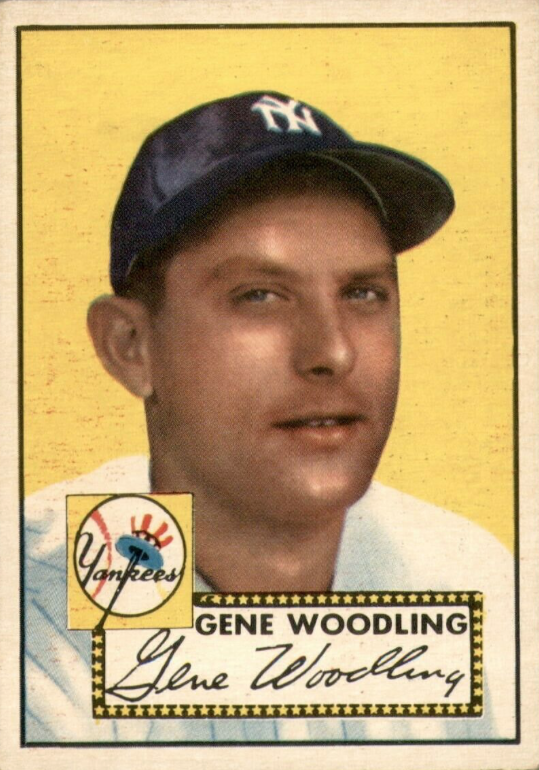
Gene Woodling was a key contributor to the Yankees dynasty that won five consecutive World Series titles between 1949 and 1953.  As the regular left fielder for those teams, he played solid defense and batted .318 (27 for 85) in the postseason although he was often overshadowed by the likes of superstars Joe DiMaggio and Mickey Mantle (#135).  Woodling was originally drafted by the Indians and missed two seasons early in his career while serving during World War II.  He'd play in the Bronx between 1949 and 1954 and was dealt to the Orioles before the start of the 1955 season in a massive 17-player trade.  Woodling continued his steady production and defense, having a career year with the Indians in 1957 when he achieved his personal career-high triple crown with a .321 average, 19 home runs and 78 RBIs.  Back with the Orioles, Woodling made his sole All-Star Game in 1959.  He wrapped up his playing career with two seasons with the Senators and a final season in 1962 with the expansion Mets.

December 25, 2006
Woodling batted .284 with 1,585 hits over 1,796 games, with 257 doubles, 147 home runs and 830 RBIs.  He had a career fielding percentage of .989 as a left fielder which is currently 18th all-time.  Woodling would later serve as a first base coach for the Orioles between 1964 and 1967, working with former teammate and current Orioles manager Hank Bauer (#177), and winning yet another World Series ring with the Orioles in 1966.

Building the Set
December 25, 2006 from Mays Landing, NJ - Card #280
I was officially given this card on Christmas Day in 2006, but my Dad had purchased it several weeks (months?) earlier at a baseball card show held at the Hamilton Mall in Mays Landing, New Jersey.

This was one of nine cards I received that Christmas from my Dad, and he spent a total of $210 on all nine cards with the Hank Aaron (#31) card being the big ticket item at $150.  Like all his purchases, he was extremely proud of this card's condition and I'm sure there was a negotiation story that went along with the acquisition.

Our first son Doug was born a few weeks before Christmas that year and we brought him home just in time for the big day.  He obviously doesn't remember much from his first Christmas, but he spent the holidays being held and loved by his parents, grandparents, aunts and uncles.  The picture shown here is from Christmas Day 2006, shortly after I had added those nine cards to our (and one day Doug's) 1956 Topps set.  One of the great joys of my life was seeing how proud my Dad was to have a grandson.

The Card / Indians Team Set
The head shot of Woodling is the same used for his 1955 Topps card, except that Topps has replaced the Orioles logo from the original photo with an Indians logo.  At first glance, I thought the beige blob behind Woodling was the disembodied hand of an infielder.  Then I realized Woodling is probably sliding into home plate and that's a discarded bat.  The cartoons on the back highlight his trade back to the Indians, his fine fielding and his World Series experience with the Yankees.

1956 Season
Woodling was the regular left fielder for the second place Indians, appearing in 101 games and batting .276 with 21 home runs and 65 RBIs.  Despite his low game total, his home run tally was still second on the team behind Vic Wertz (#300), who hit 32.  It was his second stint with the Indians as the club had acquired Woodling from the Orioles on June 15, 1955 with cash for Dave Pope (#154) and Wally Westlake (#81).

1951 Bowman #219
1952 Topps #99
1957 Topps #172
1959 Topps #170
1963 Topps #342

Other Notable Baseball Cards

First Mainstream Card:  1951 Bowman #219
Topps Flagship Set Appearances (12):  1952-1963
Most Recent Mainstream Card:  1994 Topps Archives 1954 #101

127 - Woodling non-parallel baseball cards in the Beckett online database as of 7/24/21.

Sources:  
Baseball Reference
Beckett Database
SABR
The Trading Card Database

Friday, August 13, 2021

#162 "Gus" Bell - Cincinnati Redlegs


David Russell Bell
Cincinnati Redlegs
Outfield

Bats:  Left  Throws:  Right  Height:  6'1"  Weight:  190
Born:  November 15, 1928, Louisville, KY
Signed:  Signed by the Pittsburgh Pirates as an amateur free agent before 1947 season
Major League Teams:  Pittsburgh Pirates 1950-1952; Cincinnati Reds 1953-1961; New York Mets 1962; Milwaukee Braves 1962-1964
Died:  May 7, 1995, Montgomery, OH (age 66)

Gus Bell was a four-time All-Star for the Reds and a steading hitting, fine fielding outfielder for 15 big league seasons.  He'd leave a legacy in the major leagues that continues today with his grandson David as the current manager of the Reds.  His son Buddy was a five-time All-Star primarily with the Indians and Rangers throughout the 1970s and 1980s.  Before managing the Reds, his grandson David played for 12 seasons with six different teams and another grandson, Mike, appeared briefly in the majors with the Reds in 2000.

Gus' most productive seasons came in the mid-1950s as the regular center fielder for the Reds.  He batted .290 or higher in five straight seasons between 1953 and 1957, and he drove in at least 100 runs in four seasons.  His best season was perhaps 1953 when he batted .300 with 30 home runs (a career high) and 105 RBIs.  A back-up in 1961, Bell saw his only postseason play in that year's World Series, going hitless in three pinch-hitting appearances against the Yankees.  Following the series, Bell was selected as the 8th pick by the Mets in the 1961 expansion draft.  He'd play sparingly for the Mets and Braves over the final seasons of his career, retiring following the 1964 season.  In 1,741 career games, Bell batted .281 with 1,823 hits, 206 home runs and 942 RBIs.  He was inducted into the Cincinnati Reds Hall of Fame in 1964.

Building the Set
July 30, 1994 in Ocean City, NJ - Card #130
My Dad and I bought this card at the annual Ocean City baseball card show held within the famous Music Pier during the summer between my sophomore and junior years in college.  We spent $41 on six cards for our 1956 Topps set at this show, with the most expensive card being (for some reason) Rip Repulski's (#201) card for $9.  This Bell card cost us $7.

From the flyer (right), it looks as if The Eastern Pennsylvania Sports Collectors Club (EPSCC) had abandoned its sponsorship of this baseball card show by 1994.  Honestly after they pulled out, the show was never quite the same and the quality definitely suffered.  My Dad would have grumbled at the fact that comic books were now encroaching on the floor space of his beloved baseball card show.  1994 and 1995 were strange years for the baseball card hobby as the player's strike that prematurely ended the 1994 season chased a lot of fans away from the hobby, and some of them have never come back.

Johnny Callison was back signing autographs though, and the former Phillies player was ubiquitous at these events back in the 1980s and early 1990s.

The Card / Redlegs Team Set
Bell's #25 is on display in the action shot as he makes an acrobatic catch in center field.  His son Buddy and grandson David would wear #25 whenever possible in honor of Gus.  Like many of the subjects so far in this set's second series, Bell was absent from Topps sets in 1954 and 1955, as he appeared exclusively with Bowman.  I found the highlight from the first cartoon panel on the back incredible to believe, but Bell is in fact the first Reds player to drive in over 100 runs in a season.  The final cartoon panel shows that Bell attributed his hitting success to choking up on the bat.  They just don't make baseball card cartoons like they used to!

1956 Season
Bell was at the pinnacle of his career in 1956, making his third All-Star Game and playing in 150 games for the third place Reds.  As the team's regular center fielder, he patrolled the outfield with Frank Robinson in left and Wally Post (#158) in right.  Bell batted .292 with 29 home runs and 84 RBIs, and was one of five Reds players with at least 25 home runs, joining team leader Robinson, Post, Ted Kluszewski (#25) and Ed Bailey.

1951 Bowman #40
1952 Topps #170
1957 Topps #180
1964 Topps #534
1976 Topps #66

Other Notable Baseball Cards

First Mainstream Card:  1951 Bowman #40
Topps Flagship Set Appearances (14):  1951-1953, 1956-1964, 1976, 1985
Most Recent Mainstream Card:  2001 Topps Archives #119

87 - Bell non-parallel baseball cards in the Beckett online database as of 7/24/21.

Sources:  
Baseball Reference
Beckett Database
The Trading Card Database

Friday, August 6, 2021

#161 Joe DeMaestri - Kansas City Athletics


Joseph Paul DeMaestri
Kansas City Athletics
Shortstop

Bats:  Right  Throws:  Right  Height:  6'0"  Weight:  170
Born:  December 9, 1928, San Francisco, CA
Signed:  Signed by the Boston Red Sox as an amateur free agent before 1946 season
Major League Teams:  Chicago White Sox 1951; St. Louis Browns 1952; Philadelphia Athletics 1953-1954; Kansas City Athletics 1955-1959; New York Yankees 1960-1961
Died:  August 26, 2016, San Rafael, CA (age 87)

At the start of his professional career, Joe DeMaestri bounced around with three different organizations before finding a permanent home with the Athletics, first in Philadelphia then in Kansas City, between 1953 and 1959.  With the basement-dwelling Athletics in need of an All-Star representative in 1957, DeMaestri got the nod although he didn't appear in the game.  The Athletics' regular shortstop throughout the 1950s, he led the league twice in fielding percentage for shortstops in 1957 and 1958.  In December 1959, he was dealt with Kent Hadley and Roger Maris to the Yankees for Hank Bauer (#177), Don Larsen (#332), Norm Siebern and Marv Thorneberry.  DeMaestri would play his final two big league seasons in the Bronx, earning only 11 starts but appearing in 79 games overall as a late-inning defensive replacement or as a pinch-runner.

The Yankees advanced to the World Series in both 1960 and 1961, and DeMaestri was in the dugout when the Pirates' Bill Mazeroski hit his walk-off home run off Yankees' pitcher Ralph Terry in Game 7 of the 1960 series.  He didn't appear in the postseason in 1961 when the Yankees defeated the Reds in five games.  In 1,121 career games, DeMaestri batted .236 with 49 home runs, 114 doubles and 281 RBIs.  He retired with a career .967 fielding percentage as a shortstop.

July 9, 1996 - All-Star Game at Veterans Stadium
Building the Set

August 29, 1996 in Winston-Salem, NC - Card #146
I attended college at Wake Forest University in Winston-Salem, North Carolina.  On humid days, or after a heavy rain, the air was heavy with the faint smell of tobacco.  I absolutely loved my time as a Demon Deacon and I realize how lucky I was to be able to attend such a phenomenal college.

There was a baseball card store called Season Ticket on Silas Creek Parkway I discovered half-way through my senior year, and I'd frequent the store whenever I had a little extra spending money - which honestly wasn't very often.  Given the timing of this purchase, I don't remember if my Dad was with me or not.  Save for a visit north for the 1996 All-Star Game, I spent the summer of 1996 living in Winston-Salem and this might have been a pre-start of the semester purchase that I made on my own.  I paid $10 for a lot of four cards needed for our 1956 Topps set, which included this DeMaestri card.  $10 would have bought a lot of Taco Ball back then (and it still would now) but adding four more cards to our set was worth the sacrifice.  Joining the DeMaestri card were the cards of Carlos Paula (#4), Jim Owens (#114) and Bobby Avila (#132).

I haven't been back to North Carolina in over 20 years and whenever I get around to taking my wife and my sons on a road trip to visit my old campus, I'd love to see if Season Ticket is still there.

The Card / Athletics Team Set
This is the fourth straight card of a player not to appear in the 1954 and 1955 Topps sets due to (presumably) an exclusive deal with Bowman.  DeMaestri received a 1952 Topps card and this is his first appearance in a Topps set since then.  The cartoonist for the back panels does his/her best to cover DeMaestri's career to that point, as he honestly didn't have much in the way of career highlights yet.  His steady fielding, his call-up to the White Sox in 1951 and his arrival to the Athletics are all featured.

1956 Season
The Athletics once again suffered a 100-loss season, going 52-102 to drop to the basement of the American League.  DeMaestri was the club's opening day shortstop and appeared in 133 games, making 125 starts at short.  Rookie Mike Baxes spelled DeMaestri occasionally and made 27 starts at shortstop.  DeMaestri batted .233 with 16 doubles, six home runs and 39 RBIs.

1952 Topps #286
1955 Bowman #176
1957 Topps #44
1959 Topps #64
1961 Topps #116

Other Notable Baseball Cards

First Mainstream Card:  1952 Topps #286
Topps Flagship Set Appearances (7):  1952, 1956-1961
Most Recent Mainstream Card:  2011 Topps Lineage Autographs #RA-JD

41 - DeMaestri non-parallel baseball cards in the Beckett online database as of 7/11/21.

Sources:  
Baseball Reference
Beckett Database
SABR
The Trading Card Database