Friday, February 9, 2024

#277 Daryl Spencer - New York Giants


Daryl Dean Spencer
New York Giants
Infield

Bats:  Right  Throws:  Right  Height:  6'2"  Weight:  185
Born:  July 13, 1928, Wichita, KS
Acquired:  Purchased by the New York Giants from the Pauls Valley Raiders (Sooner State League) before 1950 season
Major League Teams:  New York Giants 1952-1953, 1956-1957; San Francisco Giants 1958-1959; St. Louis Cardinals 1960-1961; Los Angeles Dodgers 1961-1963; Cincinnati Reds 1963
Died:  January 2, 2017, Wichita, KS (age 88)

Daryl Spencer spent the late 1950s and early 1960s as an everyday shortstop and second baseman for the Giants and Cardinals, and would later find success in the late 1960s during a seven season stint playing in Japan.  Spencer made his debut with the Giants in 1952 and would miss two full season (1954 and 1955) while serving in the military.  He became a regular with the Giants in 1956 and was the team's opening day shortstop on April 15, 1958, the Giants' first game in San Francisco.  His home run in the fourth inning of that game, off Dodgers' pitcher Don Drysdale, was the first home run in San Francisco Giants' history.  Spencer batted .256 that season, attaining career highs in home runs (17) and RBIs (74).  His final year as an everyday player stateside came in 1960 with the Cardinals, and over his final three seasons with the Cardinals, Dodgers and Reds he'd serve as a back-up infielder and pinch-hitter.  In 10 seasons, Spencer batted .244 with 105 home runs and 428 RBIs.

Spencer signed with the Hankyu Braves for the 1964 season, and he'd go on to be a star in Japan.  He connected for 36 home runs and 94 RBIs in 1964, topping that with 38 home runs in 1965 while batting .311.  Retired in 1969 and 1970, Spencer returned to Japan for two more seasons in 1971 and 1972 as a player-coach.  In 731 games for the Braves, he batted .275 with 152 home runs and 391 RBIs.

Building the Set
Summer of 1983 or 1984 in Millville, NJ - Card #38
This was one of the Original 44, and I re-told the story of how my Dad and I started collecting this set with the Walker Cooper (#273) post last month.  Seven of the Original 44 came from series one, with 11 coming from series two, and 16 from series three.   This is the fourth of ten cards to come from the final series four.

The Card / Giants Team Set
This is Spencer's first Topps card, and his rookie card can be found in the 1954 Bowman set.  The photo used here looks suspiciously similar to the photo used on his Bowman rookie card.  That's Roy Campanella (#101) making a cameo appearance for the play the plate, as the future Hall of Fame catcher wore #39 during his career with the Dodgers.  The photo above was used at MLB.com at the top of Spencer's obituary in 2017, and the caption for the photo notes the play took place in 1953.  Unless Spencer had a habit of losing his hat whenever he slid into home plate when Campanella was catching, this photo is likely from the same play featured on Spencer's 1956 Topps card.

The cartoons on the back of the card explain Spencer's two-year absence from baseball, highlight his high batting average with the Minneapolis Millers in 1952, and demonstrate his ability to play all three infield positions.  He's one of six players in the set to have "Infield" as the listed position, along with teammate Bobby Hofman (#28), Freddie Marsh (#23), Harmon Killebrew (#164), Jerry Coleman (#316) and Rocky Bridges (#324).

1956 Season
Spencer returned from the Army in 1956, having missed all of the 1954 and 1955 seasons.  He was the Giants' opening day second baseman and switched to third base and eventually shortstop following the acquisition of Red Schoendienst (#165) on June 14th.  Spencer appeared in 146 games overall, batting .221 with 14 home runs and 42 RBIs, as the Giants finished in sixth place in the National League.

1954 Bowman #185
1957 Topps #49
1959 Topps #443
1961 Topps #357
1963 Topps #502

Other Notable Baseball Cards

First Mainstream Card:  1954 Bowman #185
Topps Flagship Set Appearances (8):  1956-1963
Most Recent Mainstream Card:  2013 BBM Legendary Foreigners #4

52 - Spencer non-parallel baseball cards in the Beckett online database as of 1/29/24.

Sources:  
Baseball Reference
Beckett Database

Friday, February 2, 2024

#276 George Zuverink - Baltimore Orioles


George Zuverink
Baltimore Orioles
Pitcher

Bats:  Right  Throws:  Right  Height:  6'4"  Weight:  195
Born:  August 20, 1924, Holland, MI
Signed:  Signed by the St. Louis Cardinals as an amateur free agent before 1946 season
Major League Teams:  Cleveland Indians 1951-1952; Cincinnati Reds 1954; Detroit Tigers 1954-1955; Baltimore Orioles 1955-1959
Died:  September 8, 2014, Tempe, AZ (age 90)

George Zuverink spent the first eight seasons of his professional baseball career within the Cardinals, Indians, Reds and Tigers organizations before finally finding a home in the Orioles bullpen in 1955.  A side-arming sinker ball pitcher, Zuverink emerged as one of the game's top relievers in 1956, leading the league with 62 appearances and 16 saves.  He'd have an even better year in 1957, again leading the league with 56 appearances and pitching to an impressive 2.48 ERA in 112 2/3 innings pitched.  A series of arm injuries derailed Zuverink's career, and after 45 appearances in 1958 out of the Orioles' bullpen, he was limited to just six games in 1959 before a demotion to the minors.  Zuverink would attempt a comeback in 1960, but his big league career was over.

In 265 big league games, Zuverink was 32-36 with a 3.54 ERA and 40 saves.

Building the Set
December 28, 2007 from Dad's eBay purchase - Card #334
I last shared this full story with the Foster Castleman (#271) post, but I'll repeat myself, in an edited version, here.  The way my Dad and I finished the 1956 Topps set was somewhat anti-climatic but nevertheless a joyful memory.  Leading up to the Christmas of 2007, my Dad (with the help of my Mom) scoured eBay and other online baseball card stores for the remaining 29 cards we needed to complete the set.  Throughout the weeks and months leading up to the holidays, he knew we had completed the set but he kept it quiet, wanting to surprise me on Christmas morning.  I have no idea, and I'll never know, what the true last card was that he acquired to finish off the set.  And I have no record, nor was he able to tell me, how much they had paid for any of these final 29 cards.  This Zuverink card was one of the final 29.  It was one of the commons included in a memorable haul that included the cards of Pee Wee Reese (#260), Roberto Clemente (#33), Whitey Ford (#240) and a spotless checklist card for the 1st and 3rd Series.

The Card / Orioles Team Set
Despite having pitched in the league since 1951, this is only the third of Zuverink's mainstream baseball card appearances, to go along with his cards in the 1952 Topps and 1955 Bowman sets.  The back of the card highlights his minor league success, his strong fielding skills and his control.  It would seem as if Zuverink's control slipped somewhat as his career went on, as he owns 203 career walks to 223 career strikeouts.

1956 Season
The Orioles claimed Zuverink off waivers from the Tigers on July 8, 1955, and the 1956 season was the first full season the pitcher spent in Baltimore.  Installed as the top reliever out of the Orioles' bullpen, Zuverink pitched 97 1/3 innings over his league-leading 62 appearances and converted 16 of 21 save opportunities.  As told by his SABR biography, Zuverink was honored by the Maryland Firemen Association as the "Firemen's Favorite Fireman," between games of a double header on June 3rd.

1952 Topps #199
1955 Bowman #92
1957 Topps #11
1958 Topps #6
1959 Topps #219

Other Notable Baseball Cards

First Mainstream Card:  1952 Topps #199
Topps Flagship Set Appearances (5):  1952, 1956-1959
Most Recent Mainstream Card:  2011 Topps Lineage Autographs #RA-GZ

23 - Zuverink non-parallel baseball cards in the Beckett online database as of 1/29/24.

Sources:  
Baseball Reference
Beckett Database

Friday, January 26, 2024

#275 Jim Greengrass - Philadelphia Phillies


James Raymond Greengrass
Philadelphia Phillies
Outfield


Bats:  Right  Throws:  Right  Height:  6'1"  Weight:  200
Born:  October 24, 1927, Addison, NY
Signed:  Signed by the New York Yankees as an amateur free agent before 1944 season
Major League Teams:  Cincinnati Reds 1952-1955; Philadelphia Phillies 1955-1956
Died:  September 9, 2019, Chatsworth, GA (age 91)

Jim Greengrass spent nine years toiling in the Yankees' minor league system, interrupted by two years of military service during World War II, before a trade to the Reds gave him a shot at the majors.  As the regular left fielder for the Reds in 1953, Greengrass batted .285 with a career-high 100 RBIs and he finished in sixth place in the Rookie of the Year voting.  He repeated his success in 1954, batting .280 with 27 home runs and 95 RBIs as one of Cincinnati's big three sluggers along with first baseman Ted Kluszewski (#25) and Gus Bell (#162).  Greengrass' production fell off sharply in the succeeding years due to his struggles with phlebitis, a disease causing vein inflammation.

From the 1956 Phillies Yearbook
Dealt to the Phillies at the start of the 1955 season, Greengrass would appear in 94 games in 1955 and a final 86 games in 1956 before his big league career prematurely ended.  He'd play five more seasons in the minor league systems of the Phillies, Athletics and White Sox before retiring in 1961.  In 504 major league games, Greengrass batted .269 with 69 home runs and 282 RBIs.

Building the Set
August 13, 1989 in Bridgeton, NJ - Card #81
We went nuts at the Bridgeton Baseball Card Show in August 1989, buying 12 different cards for our 1956 Topps set, all at $1.50 a piece.  That's an impressive haul for $18!

I have no other information on the location of this show, other than it was held in the nearby city of Bridgeton, New Jersey.  What I do have however is the checklist I brought with us to the show - first included with the Sandy Amoros (#42) post, way back in April 2019.  I believe this is the second full checklist we carried around, having retired the prior version I created in 1988 and posted with the William Harridge (#1) card.

Just looking at this checklist brings back fond memories of finding the cards, deciding to make a purchase, negotiating a price and then finding a flat surface so that we could cross off the newest additions.

The Card / 
Phillies Team Set
Three of the last four cards in the set have been Phillies cards.  I think this is one of the best action shots in the set, and Greengrass' name is a fantastically fitting name for a baseball player, especially an outfielder.  Does anyone know where he is?  I spent way too much time Googling photos of old baseball ballparks, hoping to identify the location and the advertiser, but I came up empty.  I had hoped the search would be fairly easy, as I suspected the photo was taken at either Ebbets Field in Brooklyn or Crosley Field in Cincinnati.  No luck.  

Googling "maica stea" did lead me to artist Vincent Scilla's website and painting shown here.  Topps removed Greengrass' uniform number, which was likely the #23 he wore while playing for the Reds.

The cartoons on the back cover his minor league beginnings with the Yankees, and his successful years with the Reds in 1952 and 1953.  Greengrass signed reproductions of this card for inclusion in the 2005 Topps Heritage Real One Autographs insert set.

1956 Season / Phillies Career
On April 30, 1955, the Reds traded Greengrass, Glen Gorbous (#174) and Andy Seminick (#296) to the Phillies in exchange for Smoky Burgess (#192), Stan Palys and Steve Ridzik.  Catchers Seminick and Burgess had originally been traded for each other back in 1951.  Greengrass would serve as the most used right fielder in 1955, appearing in 94 games overall while batting .272 with 12 home runs and 37 RBIs.  As the cartoon on the back points out, Greengrass homered on May 1, 1955, his first game with the club, connecting off Cubs' pitcher Hy Cohen.  Greengrass was the Phillies' opening day right fielder in 1956, sharing outfield space with Del Ennis (#220) in left and Richie Ashburn (#120) in center.  He'd lose playing time to Elmer Valo (#3) as the season wore on, with Greengrass ultimately playing in 86 games.  His average slipped to .205 and he had just five home runs.

On April 28, 1957, the Phillies sold his contract to the Sacramento Solons in the Pacific Coast League, essentially ending his big league career.  In two seasons with the Phillies, Greengrass played in 180 games, batting .245 with 17 home runs and 62 RBIs.

1953 Topps #209
1954 Bowman #28
1954 Topps #22
1955 Bowman #49

Other Notable Baseball Cards

First Mainstream Card:  1953 Topps #209
Topps Flagship Set Appearances (3):  1953-1954, 1956
Most Recent Mainstream Card:  2005 Topps Heritage Real One Autographs #ROA-JG

18 - Greengrass non-parallel baseball cards in the Beckett online database as of 12/22/23.

Sources:  
Baseball Reference
Beckett Database

Friday, January 19, 2024

#274 Frank Baumholtz - Philadelphia Phillies


Frank Conrad Baumholtz
Philadelphia Phillies
Outfield


Bats:  Left  Throws:  Left  Height:  5'10"  Weight:  175
Born:  October 7, 1918, Midvale, OH
Signed:  Signed by the Cincinnati Reds as an amateur free agent before 1941 season
Major League Teams:  Cincinnati Reds 1947-1949; Chicago Cubs 1949, 1951-1955; Philadelphia Phillies 1956-1957
Died:  December 14, 1997, Winter Springs, FL (age 79)

Before starting his 10-season big league career, Frank Baumholtz played professional basketball for two seasons between 1945 and 1947.  In his first major league season with the Reds in 1947, he led the league with 711 plate appearances and finished fifth in the Rookie of the Year voting.  He moved to the Cubs in 1949 and had an incredible year in 1950 with the Cubs' top farm team in Los Angeles.  Baumholtz batted .379 for the Los Angeles Angels, collecting 254 hits in his last minor league action before joining the majors permanently in 1951.  His best year with the Cubs came in 1952 when he batted .325 with a career-high 50 RBIs as the team's everyday right fielder.  He lost playing time that season after a pitch from Warren Spahn (#10) broke his hand.  Baumholtz would enjoy one last solid season in the majors in 1953, batting .306 after moving over to center field with the Cubs.

From the 1956 Phillies Yearbook
His final three seasons with the Cubs and Phillies were spent mostly in a pinch-hitting role.  In 1,019 career games, Baumholtz batted .290 with 1,010 hits, 25 home runs and 272 RBIs.  He was inducted into the Ohio University Athletics Hall of Fame in 1965, where Baumholtz had starred as a basketball player.  In 1995, the university retired his #54 basketball jersey.

Building the Set
October 1, 1987 in Bridgeton, NJ - Card #51
My notes indicate we bought this card at Hummel's in Bridgeton, New Jersey a few days before my 14th birthday.  We acquired three Phillies card that day - manager Mayo Smith (#60), Murry Dickson (#211) and this Baumholtz card and I don't know how much we paid for the trio.  My memories of Hummel's are hazy at best, but I seem to recall it was a large building with a sprawling liquor store on the first floor and a baseball card shop on the second floor.  With baseball card stores booming in the mid to late 1980s, we'd often take a ride to one of the four or five local card shops we were lucky enough to have near us.  October 1st was a Thursday, so it's strange to me that we would have made the 20 minute or so drive to Hummel's on a week night after work and school.  My approaching birthday might have contributed to the motivation for the trip.

The Card / Phillies Team Set
This is Baumholtz's final appearance in a Topps flagship set, and Topps re-used the same photo from his 1954 and 1955 Topps cards, replacing his Cubs hat with a Phillies hat.  The action shot is from Baumholtz's days with the Cubs as well, as he wore #7 in Chicago and #16 in Philadelphia.  The first two cartoon panels on the back highlight his basketball career and his successful 1952 season.  Topps says "he just missed" the batting championship, but Stan Musial pretty much ran away with the batting title with his .336 average.  The final panel shows Baumholtz arriving in Philadelphia decked in full Quaker garb.

1956 Season / Phillies Career
On December 9, 1955, the Phillies purchased Baumholtz from the Cubs.  He continued mainly as a pinch-hitter with the Phillies in 1956, starting only 12 games all season, all in right field.  He batted .270 for the season, and every one of his 27 hits were singles.  He returned to the Phillies in 1957, now 38 years old, and made two pinch-hitting appearances before calling it a career.  The Phillies released him on June 17, 1957.

1949 Bowman #21
1952 Topps #225
1954 Topps #60
1955 Topps #172

Other Notable Baseball Cards

First Mainstream Card:  1949 Bowman #21
Topps Flagship Set Appearances (4):  1952, 1954-1956
Most Recent Mainstream Card:  1994 Topps Archives 1954 #60

21 - Baumholtz non-parallel baseball cards in the Beckett online database as of 12/22/23.

Sources:  
Baseball Reference
Beckett Database

Friday, January 12, 2024

#273 Walker Cooper - St. Louis Cardinals


William Walker Cooper
St. Louis Cardinals
Catcher

Bats:  Right  Throws:  Right  Height:  6'3"  Weight:  210
Born:  January 8, 1915, Atherton, MO
Signed:  Signed by the St. Louis Cardinals as an amateur free agent before 1935 season
Major League Teams:  St. Louis Cardinals 1940-1945; New York Giants 1946-1949; Cincinnati Reds 1949-1950; Boston Braves 1950-1952; Milwaukee Braves 1953; Pittsburgh Pirates 1954; Chicago Cubs 1954-1955; St. Louis Cardinals 1956-1957
Died:  April 11, 1991, Scottsdale, AZ (age 76)

Until composing this post, I had no idea Walker Cooper was a veteran of 18 major league seasons, an eight-time All-Star and a two-time World Champion with the Cardinals in the early 1940s.  Cooper was behind the plate for the Cardinals' World Series wins in 1942 and 1944, batting .300 overall in 16 World Series games, including the 1943 series in which the Cardinals lost to the Yankees.  In that 1943 season, Cooper batted .318 with 81 RBIs, finishing as runner-up to teammate Stan Musial for National League MVP honors.  He was the starting catcher for the National League All-Stars in six of the nine All-Star Games played in the 1940s.  Cooper missed most of the 1945 season while serving in the U.S. Navy during World War II, and was sold to the Giants in 1946 following a salary dispute.  With the Giants in 1947, he reached career highs in both home runs (35) and RBIs (122).

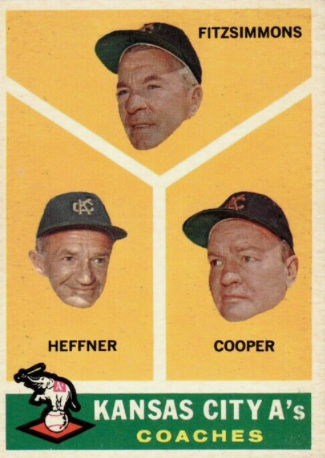
Cooper would play for six different teams, all in the National League, and would finish his big league career as a back-up catcher and pinch-hitter for the Cardinals in 1956 and 1957.  One of the strongest players in the game, Cooper also earned respect for his defense and ability to call a great game behind the plate.  In 1,473 games played, Cooper batted .285 with 1,341 hits, 173 home runs and 812 RBIs.  At the time of his retirement, he was among the top five all-time National League catchers in average, slugging percentage, home runs and RBIs.  Cooper managed in the minor leagues for three seasons and was a coach for the Kansas City Athletics in 1960.

Building the Set
Summer of 1983 or 1984 in Millville, NJ - Card #37
This Cooper card was one of the Original 44 and the last time I told the full story of the Original 44 was almost a year ago within the Walt Dropo (#238) post, so I'll repeat it again here.

June 1983 - Ocean City Baseball Card Show
Technically speaking, my Dad and I actually began collecting the set in the summer of 1987, but this card (along with the other Original 44) first entered my collection three or four years before that.

I think it was either the summer of 1983 or 1984 when a shoebox of vintage baseball cards, football cards and a few non-sports cards arrived into my world.  The box contained about a hundred cards dating between 1950 and 1956, and for the most part, they were all in excellent shape.  A friend of the family was in the process of cleaning up and moving into her new house when she found the old shoebox and she wondered if the only kid she knew who collected baseball cards (me) would be interested in looking through it – maybe even taking the box off her hands.

She dropped the box off to my parents and asked them to have me look through the box and take what I was interested in. Turns out, I was interested in everything.  Up to that point, the oldest cards in my collection were cards from the early '70s I had obtained through trades or cards that my Dad had picked up for me at yard sales or small baseball card shows.  (My Dad had given me a few dog-earred and rough Topps cards – Juan Pizzaro and Jim Busby – a few years prior, and I completely forget how or why he had purchased these cards for me.)

My parents asked me to pick out a few cards from the box, and then we’d return the rest to the family friend.  Problem was, I wanted them all.  I really wanted them all.  I diligently and meticulously went through one of my price guides and determined the “value” of the treasure chest. I probably used my Sport Americana Baseball Card Price Guide No. 4, edited by Dr. James Beckett, and I had no way to value the football or non-sports cards.  My memory is fuzzy, and I can't find the original tally, but I think I came up with the box being worth somewhere in the neighborhood of $300 to $400, which I knew my parents definitely did not have in their discretionary spending budget.  But they could tell how much I wanted those cards, as I lovingly studied each and every one and handled each as if it were some long-lost artifact.

I don’t know the exact details, but I believe my Dad went back to the friend and told her we’d take the whole box, but only if she let him give her some money for it.  I believe she was genuinely shocked that the box of old cardboard pictures had some value, and that someone was willing to give her cash for it.  My Dad shared the list I had created showing the “book value” of the cards and he mentioned how it was going to be close to impossible to get me to pick and choose which ones I wanted.  When all was said and done, the family friend, who had absolutely no intention of making money on this endeavor, walked away with (I think) something in the neighborhood of $100 for the whole lot.

Within the spoils were 44 cards from the 1956 Topps set – by far the most cards from any one set.  I studied them, I sorted them, and I pretty much memorized every detail of those 44 cards.  

And so a few years later, in the summer of 1987 while on a family vacation, I was giddy with excitement when we came across a few ’56 Topps cards in the Walker Gallery on the main drag in Cooperstown, New York.  My Dad and I studied the cards for sale and he casually asked me the question, “Why don’t we try to put together the whole set?” We bought four cards that day for $9.25.  Those cards, along with the 44 from the magic shoebox, became the basis for our 1956 Topps set.

The Card / Cardinals Team Set
This marks Cooper's first mainstream baseball card in a few years, as he had last appeared in the 1953 Bowman Black & White set.  It would seem as if the runner is safe in the action shot?  The three cartoon panels on the back cover all the right highlights, including his return to the Cardinals for the 1956 season, his reputation as a slugger and his fantastic 1947 season with the Giants.

1956 Season
In his penultimate season, and at the age of 41, Cooper re-signed with his original team, the Cardinals, to serve as the back-up catchers Bill Sarni (#247) and Hal Smith (#283).  Cooper started only 12 games all season, appearing in 40 games overall, mostly as a pinch-hitter.  He batted .265 with a pair of home runs and 14 RBIs.

1943 M.P. & Co. (R302-1)
1948 Bowman #9
1952 Topps #294
1957 Topps #380
1960 Topps #462

Other Notable Baseball Cards

First Mainstream Card:  1943 M.P. & Co. (R302-1)
Topps Flagship Set Appearances (4):  1952, 1956-1957, 1960
Most Recent Mainstream Card:  1992 Conlon Collection TSN #633

48 - Cooper non-parallel baseball cards in the Beckett online database as of 12/21/23.

Sources:  
Baseball Reference
Beckett Database

Friday, January 5, 2024

#272 Danny O'Connell - Milwaukee Braves

With this post, I'm officially entering the ninth year for this blog, which is almost the half-way point to the length of time it took my Dad and me to collect the whole set. If I keep up the current pace of a weekly post, every Friday, I should have this blog completed by early 2025. Real life and other projects tend to get in the way from time to time, but I'm enjoying the journey of going back through each of these cards and I appreciate you following along. Happy New Year!
 

Daniel Francis O'Connell
Milwaukee Braves
Second Base

Bats:  Right  Throws:  Right  Height:  5'11"  Weight:  168
Born:  January 21, 1929, Paterson, NJ
Signed:  Signed by the Brooklyn Dodgers as an amateur free agent before 1946 season
Major League Teams:  Pittsburgh Pirates 1950, 1953; Milwaukee Braves 1954-1957; New York Giants 1957; San Francisco Giants 1958-1959; Washington Senators 1961-1962
Died:  October 2, 1969, Clifton, NJ (age 40)

Originally signed by the Dodgers, Danny O'Connell played for four seasons in Brooklyn's minor league system before being dealt to the Pirates in October 1949.  He had a successful rookie campaign in 1950, batting .292 with eight home runs and 32 RBIs, and finishing third in the league's Rookie of the Year voting.  O'Connell would miss two full seasons while serving in the U.S. Army during the Korean War, and when he returned he had one of his best years in the majors.  He batted .294 with a career-high 55 RBIs in 1953 for the Pirates, earning year-end MVP votes.  O'Connell was the everyday second baseman for the Braves between 1954 and 1956, and he'd finish in the top five in fielding percentage among National League second baseman five years in a row between 1954 and 1958.

On June 15, 1957, O'Connell, Ray Crone (#76) and Bobby Thomson (#257) were dealt to the New York Giants in exchange for Red Schoendienst (#165).  While Thomson would make his own history a few years later with the Giants, O'Connell is in the team's record books for scoring the first run by a major league team playing on the West Coast.  In the third inning of the inaugural game between the Los Angeles Dodgers and the San Francisco Giants at Seals Stadium on April 15, 1958, O'Connell drew a walk off Dodgers' pitcher Don Drysdale and scored the first run of the game on a Jim Davenport sacrifice fly.  He'd play two seasons with the expansion Senators before retiring, leading the team in hits with 128 in 1961 and leading the league in sacrifice bunts that season with 15.  O'Connell batted .260 for his career with 1,049 hits.

Building the Set
October 3, 1999 in Raleigh, NC - Card #187
We bought this card on October 3rd at the Raleigh Sports Card Show, and it ended up being part of a birthday present to me from my Dad.  I was still living in Raleigh in late 1999, and my parents made the trip south to visit me for my birthday.  We bought 8 cards that day (that I knew about) paying $5 for six of the cards, and only $2 for the Grady Hatton (#26) and this O'Connell card.  Unbeknownst to me, my Dad also purchased the Sandy Koufax card (#79) but he squirreled that one away until Christmas morning 1999.

From the back of a checklist from this time period, my notes show we were simultaneously collecting the 1972 Topps set in 1999.

The Card / Braves Team Set
This marks O'Connell's first Topps appearance since 1953.  He wore #4 during his time with the Braves, so that might be him sliding into third base in the action photo . . . or is the runner sliding back to first base?  I'm going with that being O'Connell sliding into third base safely as Dodgers' third baseman Don Hoak (#335) takes the throw.  Hoak wore #43 with Brooklyn during the 1954 and 1955 seasons.  The cartoons on the back highlight O'Connell's infield versatility, his success while with the Pirates and his clutch hitting against the Giants in 1955.

1956 Season
In his last full season with the Braves, O'Connell was again the team's regular second baseman with Johnny Logan (#136) as his double play partner at shortstop.  O'Connell played in 139 games, batting .239 out of the Braves' lead-off spot for most of the season.

1951 Bowman #93
1953 Topps #107
1957 Topps #271
1959 Topps #87
1962 Topps #411

Other Notable Baseball Cards

First Mainstream Card:  1951 Bowman #93
Topps Flagship Set Appearances (8):  1953, 1956-1962
Most Recent Mainstream Card:  1991 Topps Archives 1953 #107

46 - O'Connell non-parallel baseball cards in the Beckett online database as of 12/17/23.

Sources:  
Baseball Reference
Beckett Database
SABR
The Trading Card Database

Previous Card / Next Card
Set Order: #271 Foster Castleman - New York Giants / #273 Walker Cooper - St. Louis Cardinals