Friday, February 25, 2022

#191 Frank Lary - Detroit Tigers


Frank Strong Lary
Detroit Tigers
Pitcher

Bats:  Right  Throws:  Right  Height:  5'11"  Weight:  175
Born:  April 10, 1930, Northport, AL
Signed:  Signed by the Detroit Tigers as an amateur free agent before 1950 season
Major League Teams:  Detroit Tigers 1954-1964; New York Mets 1964; Milwaukee Braves 1964; New York Mets 1965; Chicago White Sox 1965
Died:  December 14, 2017, Northport, AL (age 87)

Frank Lary enjoyed a decade of success with the Tigers, winning 20 games twice and earning three All-Star Game berths in 1960 and 1961.  That latter season was probably his best as he went 23-9 with a 3.24 ERA while leading the league with 22 complete games.  He won a Gold Glove for his fielding efforts while finishing third in A.L. Cy Young voting and seventh in A.L. MVP voting.  Lary can claim three fantastic baseball nicknames with "Taters," "Mule" and the "Yankee Killer."  The Yankee Killer nickname bestowed upon him as he went 27-10 against the powerhouse Yankees between 1955 and 1961.  Lary led the league three times in innings pitched and three times in complete games, but his heavy workload with the Tigers led to shoulder problems later in his career.  Atop the Tigers' pitching rotation between 1957 and 1963, Lary and Jim Bunning did everything they could to pitch Detroit into the World Series, but they never made it.  The closest they came was 1961 when the Tigers finished eight games behind the Yankees, despite winning 101 games.  Lary was sold to the Mets in May 1964, beginning a year and a half on the move with the Mets, the Braves, back to the Mets and finally with the White Sox.

Lary appeared in 350 big league games and a had a 128-116 record to go along with a 3.49 ERA.  He struck out 1,099 over 2,162 1/3 innings pitched.  His 21 career shutouts are currently 232nd on the all-time leaders list.  Lary briefly served as a minor league roving pitching coach for the Mets before retiring from the game.

Some text for this post originally appeared on my 1965 Topps blog.

Building the Set
December 28, 2007 from Dad's eBay purchase - Card #324
I first shared this story with the Roberto Clemente (#33) post, but I'll repeat myself, in an edited version, here.  The way my Dad and I finished the 1956 Topps set was somewhat anti-climatic but nevertheless a joyful memory.  Leading up to the Christmas of 2007, my Dad (with the help of my Mom) scoured eBay and other online baseball card stores for the remaining 29 cards we needed to complete the set.  Throughout the weeks and months leading up to the holidays, he knew we had completed the set but he kept it quiet, wanting to surprise me on Christmas morning.  I have no idea, and I'll never know, what the true last card was that he acquired to finish off the set.  And I have no record, nor was he able to tell me, how much they had paid for any of these final 29 cards.  Absolutely pristine with four sharp corners, this Lary card was one of the final 29.

The Card / Tigers Team Set
This is Lary's first Topps card, and his rookie card can be found in the 1955 Bowman set.  The action shot appears to be a play at third base, with Lary hugging the bag while seemingly kicking the third baseman in the crotch.  I thought the defender was a member of the Red Sox, but Sam Mele wore #7 in 1955 and didn't play any third base.  My next guess was this could be an Indians player, and sure enough Cleveland third baseman Al Rosen (#35) wore #7 between 1948 and 1956.  Lary made it on base twice against the Indians in 1955, on July 4th and again on September 17th with Rosen at third base in both those games.  In the July 4th game, Lary singled to left in the bottom of the 11th, but didn't advance.  In the September 17th game, Lary singled again, advanced to second on a Harvey Kuenn (#155) bunt and was thrown out trying to score on an Al Kaline (#20) single.  The scoring for the putout is 4-2-5, with Rosen applying the tag on Lary.  So there you have it - the action photo ended the top of the fifth inning on September 17, 1955 in a game the Tigers would ultimately win against the Indians, 3-1.

1956 Season
This was to be Lary's first 20-win season, as he went 21-13 with a 3.15 ERA for the fifth place Tigers as the ace of their pitching staff.  Kaline had a monster season for Detroit, but Lary was arguably the team's MVP as his 6.7 WAR was slightly higher than Kaline's 6.6.  Five of his 21 wins came against the Yankees, cementing his "Yankee Killer" nickname.

1955 Bowman #154
1957 Topps #168
1961 Topps #243
1962 Topps #474
1965 Topps #127

Other Notable Baseball Cards
First Mainstream Card:  1955 Bowman #154
Topps Flagship Set Appearances (9):  1956-1965
Most Recent Mainstream Card:  2014 Topps Heritage Real One Autographs #ROA-FL

57 - Lary non-parallel baseball cards in the Beckett online database as of 2/4/22.

Sources:  
1965 Topps Blog

Friday, February 18, 2022

#190 Carl Furillo - Brooklyn Dodgers


Carl Anthony Furillo
Brooklyn Dodgers
Outfield

Bats:  Right  Throws:  Right  Height:  6'0"  Weight:  190
Born:  March 8, 1922, Stony Creek Mills, PA
Acquired:  Obtained by the Brooklyn Dodgers from Reading (Interstate) as part of a minor league working agreement before 1941 season
Major League Teams:  Brooklyn Dodgers 1946-1957; Los Angeles Dodgers 1958-1960
Died:  January 21, 1989, Stony Creek Mills, PA (age 66)

Spending his entire career within the Dodgers' organization, Carl Furillo cemented his place as one of the more popular members of the Dodgers dynasty of the 1950s.  Furillo, nicknamed "The Reading Rifle" and "Skoonj," after one of his favorite Italian dishes, scungilli, came up with the Dodgers in 1946.  He'd spend the next 13 seasons as the club's regular center or right fielder, playing in seven World Series with the club between 1947 and 1959.  Furillo drove in at least 90 runs in six different seasons, driving in 106 in both 1949 and 1950.  He was a two-time All-Star in 1952 and 1953, and Furillo won the National League batting title in 1953 with a .344 average.  His best season came in 1955 as the Dodgers would win their only World Series Championship while in Brooklyn.  Furillo batted .314 that season with a career-high 26 home runs and 95 RBIs.  He batted  .296 (8 for 27) in the 1955 World Series and had a .266 overall batting average in 40 World Series games.  Furillo would win a second World Series ring with the Dodgers in 1959, contributing a key two-run pinch-hit single in Game 3.

Furillo possessed an above-average throwing arm and he led all National League right fielders in assists three times.  His 115 career assists from right field are currently 41st all-time.  Upon his retirement, Furillo's games played in right field (1,408) were fifth all-time in the National League.  In 1,806 games, he collected 1,910 hits while batting .299 with 192 home runs and 1,058 RBIs.  Featured as one of the former Dodgers' players tracked down by author Roger Kahn in his book, The Boys of Summer, Furillo was found in 1972 while installing elevators at the World Trade Center.

Building the Set
December 28, 2007 from Dad's eBay purchase - Card #323
I first shared this story with the Roberto Clemente (#33) post, but I'll repeat myself, in an edited version, here.  The way my Dad and I finished the 1956 Topps set was somewhat anti-climatic but nevertheless a joyful memory.  Leading up to the Christmas of 2007, my Dad (with the help of my Mom) scoured eBay and other online baseball card stores for the remaining 29 cards we needed to complete the set.  Throughout the weeks and months leading up to the holidays, he knew we had completed the set but he kept it quiet, wanting to surprise me on Christmas morning.  I have no idea, and I'll never know, what the true last card was that he acquired to finish off the set.  And I have no record, nor was he able to tell me, how much they had paid for any of these final 29 cards.  Off-center, but well-loved, This Furillo card was one of the final 29.


The Card / Dodgers Team Set
Signed exclusively to Bowman, this is Furillo's first Topps card despite his ten seasons in the majors to this point.  He appears in each Bowman set issued between 1949 and 1955.  I was able to find the original photo used for Furillo's main head shot with a quick Getty Images search, and I found the source of the action shot as well.  The action shot seems to be from Game 2 of the 1953 World Series, played on October 1, 1953.  That's Yogi Berra (#110) making yet another cameo on another player's card in the 1956 Topps set, and Furillo is safe at the plate on a two-run, fourth inning double from Billy Cox.  Gil Hodges (#145) had scored before Furillo, and the Dodgers held a temporary 2-1 lead.  The Yankees would go on to win Game 2, 4-2, and they'd also win the Series in six games.

The cartoon panels on back highlight his stellar 1955 season, as well as his eight hits in the 1955 World Series.  His strong throwing arm is featured in the final cartoon panel.  Topps has reprinted this card a few times, first in the 1995 Topps Archives Brooklyn Dodgers set and again in the 2001 Topps Archives set.

1956 Season
As a member of the newly crowned World Champions, Furillo enjoyed another solid season in 1956.  He appeared in 149 games overall, making 138 starts in right field and sharing the outfield most often with Sandy Amoros (#42) in left and Duke Snider (#150) in center.  The Dodgers again reached the World Series, but fell in seven games to the Yankees.  Furillo batted .289 for the season with 21 home runs and 83 RBIs, finishing 21st in the league's MVP voting.

1949 Bowman #70
1953 Bowman Color #78
1955 Bowman #169
1957 Topps #45
1960 Topps #408

Other Notable Baseball Cards

First Mainstream Card:  1949 Bowman #70
Topps Flagship Set Appearances (5):  1956-1960
Most Recent Mainstream Card:  2018 Panini Diamond Kings #16

187 - Furillo non-parallel baseball cards in the Beckett online database as of 2/4/22.

Sources:  
Baseball Reference
Beckett Database
SABR
The Trading Card Database

Friday, February 11, 2022

#189 Ned Garver - Detroit Tigers


Ned Franklin Garver
Detroit Tigers
Pitcher

Bats:  Right  Throws:  Right  Height:  5'10"  Weight:  180
Born:  December 25, 1925, Ney, OH
Signed:  Signed by the St. Louis Browns as an amateur free agent before 1944 season
Major League Teams:  St. Louis Browns 1948-1952; Detroit Tigers 1952-1956; Kansas City Athletics 1957-1960; Los Angeles Angels 1961
Died:  February 26, 2017, Bryan, OH (age 91)

Ned Garver relied on his craftiness as a pitcher to play in 14 big league seasons, mostly with the Browns, Tigers and Athletics.  Garver was one of the few bright spots for the Browns teams of the early 1950s, and although he lost 17 games in 1949 and 18 games in 1950, his other pitching statistics were otherwise decent and he crossed the 200 inning plateau in both seasons.  In 1951, he led the American League with 24 complete games and was a 20-game winner, becoming only the second player in the 20th Century to win 20 games for a team that lost at least 100 games.  (Irv Young did it for the Boston Beaneaters in 1905.)  Garver started the All-Star Game in 1951, facing off against the Phillies' Robin Roberts (#180), lasting three innings and allowing a run on one hit.

In August 1952, he was part of an eight-player trade that sent him to the Tigers, the team he had rooted for growing up in Ohio.  After recovering from a back injury, Garver returned as an innings-eater and was one of the top pitchers for the re-building Tigers in 1954 and 1955.  Traded to the Athletics following the 1956 season, Garver would cross the 200-innings pitched mark two more times.  In total, he threw at least 200 innings or more in seven seasons, while pitching 198 innings in two additional seasons.  While never pitching for a first division team, Garver enjoyed a relatively successful career and he's one of the more underrated pitchers from his era.  In 402 games, including 330 starts, Garver was 129-157 with a 3.73 ERA and 881 strikeouts over 2,477 1/3 innings pitched.  He threw 153 career complete games, including 18 shutouts.

December 24, 2007 - Dad and Doug
Building the Set

December 28, 2007 from Dad's eBay purchase - Card #322
I first shared this story with the Roberto Clemente (#33) post, but I'll repeat myself, in an edited version, here.  The way my Dad and I finished the 1956 Topps set was somewhat anti-climatic but nevertheless a joyful memory.  Leading up to the Christmas of 2007, my Dad (with the help of my Mom) scoured eBay and other online baseball card stores for the remaining 29 cards we needed to complete the set.  Throughout the weeks and months leading up to the holidays, he knew we had completed the set but he kept it quiet, wanting to surprise me on Christmas morning.  I have no idea, and I'll never know, what the true last card was that he acquired to finish off the set.  And I have no record, nor was he able to tell me, how much they had paid for any of these final 29 cards.  This Garver card was one of the final 29.

The Card / Tigers Team Set
I've always appreciated the talent some baseball fans have of being able to immediately identify a stadium from yesteryear by a billboard sign or a small section of outfield fence or a glimpse of some bleachers.  I've never had that skill, and other than being able to tell immediately if a picture was taken at Philadelphia's Veterans Stadium, the locations of old baseball card photos remains a mystery to me.  That being said, I can at least recognize Garver's "action" shot was taken in Yankee Stadium, given the famous facade present in the background.  The Tigers visited Yankee Stadium four times in 1955, in May, June, August and September.  I'd guess this picture is from either the May or June trips.

The head shot is different from the photo used for Garver's 1954 Topps card, and he was exclusively with Bowman in 1955.  The cartoons on the back highlight his personal accomplishments, all while pitching for a few fairly bad teams.

1956 Season
This season was to be the turning point in Garver's career.  He pitched a complete game against the Indians in Cleveland on April 20th, and while throwing batting practice the following week in Kansas City, Garver felt something pop in his pitching arm.  The injury, which some sources attribute to a pinched vertebra, limited him to just five more games for the rest of the season.  Garver finished with an 0-2 record and a 4.08 ERA in 17 2/3 innings pitched.  On December 5th, Garver, Wayne Belardi, Gene Host, Virgil Trucks (#117) and cash were traded to the Athletics for Jack Crimian (#319), Jim Finigan (#22), Bill Harrington and Eddie Robinson (#302).

1949 Bowman #15
1952 Topps #212
1954 Topps #44
1959 Topps #245
1961 Topps #331

Other Notable Baseball Cards

First Mainstream Card:  1949 Bowman #15
Topps Flagship Set Appearances (10):  1951-1954, 1956-1961
Most Recent Mainstream Card:  2011 Topps Lineage Autographs #RA-NG

54 - Garver non-parallel baseball cards in the Beckett online database as of 2/4/22.

Sources:  
Baseball Reference
Beckett Database
SABR
The Trading Card Database

Friday, February 4, 2022

#188 Chicago White Sox Team Card


Topps included full team photos in its baseball card set for the first time in 1956, having previously experimented with team cards in a limited edition 1951 stand-alone set.

Building the Set
December 28, 2007 from Dad's eBay purchase - Card #321
I first shared this story with the Roberto Clemente (#33) post, but I'll repeat myself, in an edited version, here.  The way my Dad and I finished the 1956 Topps set was somewhat anti-climatic but nevertheless a joyful memory.  Leading up to the Christmas of 2007, my Dad (with the help of my Mom) scoured eBay and other online baseball card stores for the remaining 29 cards we needed to complete the set.  Throughout the weeks and months leading up to the holidays, he knew we had completed the set but he kept it quiet, wanting to surprise me on Christmas morning.  I have no idea, and I'll never know, what the true last card was that he acquired to finish off the set.  And I have no record, nor was he able to tell me, how much they had paid for any of these final 29 cards.  This was one of three team cards included within that final lot of 29 cards, along with the Nationals team card (#146) and the upcoming Tigers team card (#213).

The Card / White Sox Team Set
There are quite a few people on this card, and this looks to be one of the more crowded team cards in the set.  Listed below are the players, coaches, batboy and club personnel featured on the card.  The photo was taken late in the 1955 season as Ron Northey was acquired from the Giants on August 26th and he's standing on the back row here.  Al Papai was purchased from Oklahoma City in the Texas League on September 1st, and he's seated in the front row.

  • Front Row
  • Morrie Martin
  • Ed White
  • Al Papai
  • Dixie Howell (#149)
  • Harry Byrd
  • Sandy Consuegra (#265)
  • Batboy Joe Bozich
  • Jim Brideweser
  • Buddy Peterson
  • Minnie Minoso (#125)
  • Sammy Esposito
  • Bob Kennedy (#38)
  • Trainer Ed Froelich
  • 2nd Row
  • Virgil Trucks (#117, Tigers)
  • Les Moss
  • Bobby Adams (#287, Orioles)
  • Chico Carrasquel (#230, Indians)
  • Coach Del Wilber
  • Coach Don Gutteridge
  • Manager Marty Marion
  • Coach George Myatt
  • Coach Ray Berres
  • Jim Rivera (#70)
  • Billy Pierce (#160)
  • George Kell (#195)
  • Back Row
  • Home Club Equipment Mg. E. Colledge
  • Joe Heinsen (batting practice catcher)
  • Ron Northey
  • Bob Keegan (#54)
  • Jim Busby (#330, Indians)
  • Bob Powell (#144)
  • Earl Battey
  • Connie Johnson (#326)
  • Ron Jackson (#186)
  • Dick Donovan (#18)
  • Jack Harshman (#29)
  • Bob Nieman (#267)
  • Nellie Fox (#118)
  • Sherm Lollar (#243)
  • Walt Dropo (#238)
  • Visiting Clubhouse Mg. A. Colledge
I found a copy of the original team photo for sale in an eBay auction and this gives a better view of the Comiskey Park bleachers behind the team, as well as a mysterious person standing directly behind the team in the stands.  It looks as if the person is holding something?  In any event, the dimensions of Comiskey Park were consistent to both corners (352 feet) and center field (425).  Given the 365 foot sign behind the team, this photo was taken either against the right or left field wall.


The back of the card omits any mention of the 1919 Black Sox, but it does reference the White Sox' two World Championship titles from 1917 and 1906.  The White Sox would return to the World Series again in 1959, but they wouldn't win another title until 2005.  Pitchers Ed Walsh (1904-1916), Clark Griffith (1901-1902) and Ed Cicotte (1912-1920) are referenced, with Cicotte one of the eight players banned from the game for life after the 1919 scandal.  Here are the updated statistical categories through the 2021 season, and Topps didn't update this card for the 29 runs scored in a game against the Athletics on April 23, 1955:

Most Hits - 1,615 in 2000
Most Home Runs - 242 in 2004
Most Double Plays - 190 in 2000
Most Games Won - 106 in 2019
Most Runs Scored in One Game - 29 in 1955
Additional Pennant Winning Teams - 1959, 1983, 1993, 2000, 2005, 2008, 2021
Additional Championship Teams - 2005

The White Sox played their final game in old Comiskey Park in 1990, moving into new Comiskey Park in 1991.  Selling the ballpark's naming rights changed the name of the new park to U.S. Cellular Field (2003-2016) and then Guaranteed Rate Field (2017-Present).

1956 Season

The White Sox earned a third place finish in 1956, with a record of 85-69.  It was their fifth year in a row finishing in third place.  They'd finish in second place in 1957 and 1958, before finally clinching a first place finish and the American League pennant in 1959.  In 1956, left fielder Minnie Minoso (#125) and center fielder Larry Doby (#250) paced the offense.  Minoso led the team with a .316 average while Doby led with 24 home runs and 102 RBIs.  Billy Pierce (#160) was the ace of the pitching staff, going 20-9 with a 3.32 ERA.  The bullpen was a weak spot and two of the team's top relievers were Paul LaPalme and Ellis Kinder (#336).

White Sox Cards That Never Were
There are a few regulars from the 1956 White Sox line-up in the set, but on other teams, including third baseman Fred Hatfield (#318) with the Tigers and starting pitcher Jim Wilson (#171) with the Orioles.  If I were put in charge of a fifth series for the set, here are the White Sox cards I'd include:
  • Marty Marion (manager) - Marty Marion was the 1944 National League MVP and an eight-time All-Star.  He managed the White Sox between 1954 and 1956.
  • Sammy Esposito (utility) - Sammy Esposito appeared in 81 games for the White Sox in 1956, and his rookie card would appear in the 1957 Topps set.
  • Les Moss (catcher) - Back-up catcher Les Moss appeared in 32 games in 1955 and 56 games in 1956.  He'd have to wait for the 1957 Topps set for his first mainstream White Sox card.
  • Paul LaPalme (pitcher) - Selected off waivers from the Reds in June, LaPalme would make 29 relief appearances for the White Sox and he'd appear on his final Topps flagship card in the 1957 set.
  • Bubba Phillips (outfield) - Similar to Esposito, Moss and LaPalme, reserve outfield Bubba Phillips would have to wait for the 1957 Topps set for his first mainstream White Sox card.
  • George Myatt (coach) - It's a stretch, but coach George Myatt would get a card.  Myatt was only with the White Sox in 1955 and 1956, but he served as a coach in majors between 1950 and 1972 with six different organizations.  He briefly managed the Phillies in 1968 and 1969.
Sources
Baseball Reference

Friday, January 28, 2022

#187 Early Wynn - Cleveland Indians


Early Wynn
Cleveland Indians
Pitcher


Bats:  Both  Throws:  Right  Height:  6'0"  Weight:  190
Born:  January 6, 1920, Hartford, AL
Signed:  Signed by the Washington Senators as an amateur free agent before 1937 season
Major League Teams:  Washington Senators 1939, 1941-1944, 1946-1948; Cleveland Indians 1949-1957; Chicago White Sox 1958-1962; Cleveland Indians 1963
Hall of Fame Induction:  1972
Died:  April 4, 1999, Venice, FL (age 79)

One of the game's toughest competitors, Early Wynn used a blazing fastball and his willingness to pitch inside to batters, more than occasionally hitting them, to craft a Hall of Fame career.  Wynn began his career with the Senators and enjoyed an 18-win season in 1943 when he first crossed the 200-inning plateau and led the league with 33 games started.  He made his first All-Star team in 1947, but his career really took off after a December 1948 trade sent him to the Indians.  With Cleveland, Wynn was part of one of the strongest starting pitching rotations in the game's history, joining Bob Feller (#200), Mike Garcia (#210) and Bob Lemon (#255).  Wynn was a 20-game winner in four seasons with the Indians, winning an ERA title in 1950 and helping the club reach the World Series in 1954.  His best seasons came in 1955 and 1956.  Wynn was 20-9 in 1956 with a 2.72 ERA in 35 starts.  A blockbuster trade that saw Minnie Minoso (#125) head to the Indians sent Wynn to the White Sox for the 1958 season.

With the White Sox, Wynn won the Cy Young Award in 1959, going 22-10 with a 3.17 ERA and leading the league with 255 2/3 innings pitched.  He'd again reach the World Series, but the White Sox would fall to the Dodgers in six games.  Wynn would pitch through the 1963 season, signing with the Indians that June in an attempt to win his 300th career game.  He finally reached the milestone on July 13th and was released following the season.  Wynn was a nine-time All-Star.  He retired with a career record of 300-244 over 691 games pitched with an ERA of 3.54.  His 4,564 innings pitched are currently 22nd all-time, his strikeout total of 2,334 is 54th all-time, and he's ranked 21st all time in shutouts with 49.  He'd later serve as the pitching coach for the Indians (1964-1966) and Twins (1967-1969) and was inducted into the Hall of Fame in 1972.

Building the Set
Summer of 1983 or 1984 in Millville, NJ - Card #8
This Wynn card was one of the Original 44 and the last time I told the full story of the Original 44 was over a year ago within the Ed Mathews (#107) post, so I'll repeat it again here.  This is one of eight Hall of Famers from the Original 44 and the next Hall of Famer coming up is Larry Doby (#250).

June 1983 - Ocean City Baseball Card Show
Technically speaking, my Dad and I actually began collecting the set in the summer of 1987, but this card (along with the other Original 44) first entered my collection three or four years before that.

I think it was either the summer of 1983 or 1984 when a shoebox of vintage baseball cards, football cards and a few non-sports cards arrived into my world.  The box contained about a hundred cards dating between 1950 and 1956, and for the most part, they were all in excellent shape.  A friend of the family was in the process of cleaning up and moving into her new house when she found the old shoebox and she wondered if the only kid she knew who collected baseball cards (me) would be interested in looking through it – maybe even taking the box off her hands.

She dropped the box off to my parents and asked them to have me look through the box and take what I was interested in. Turns out, I was interested in everything.  Up to that point, the oldest cards in my collection were cards from the early '70s I had obtained through trades or cards that my Dad had picked up for me at yard sales or small baseball card shows.  (My Dad had given me a few dog-earred and rough Topps cards – Juan Pizzaro and Jim Busby – a few years prior, and I completely forget how or why he had purchased these cards for me.)

My parents asked me to pick out a few cards from the box, and then we’d return the rest to the family friend.  Problem was, I wanted them all.  I really wanted them all.  I diligently and meticulously went through one of my price guides and determined the “value” of the treasure chest. I probably used my Sport Americana Baseball Card Price Guide No. 4, edited by Dr. James Beckett, and I had no way to value the football or non-sports cards.  My memory is fuzzy, and I can't find the original tally, but I think I came up with the box being worth somewhere in the neighborhood of $300 to $400, which I knew my parents definitely did not have in their discretionary spending budget.  But they could tell how much I wanted those cards, as I lovingly studied each and every one and handled each as if it were some long-lost artifact.

I don’t know the exact details, but I believe my Dad went back to the friend and told her we’d take the whole box, but only if she let him give her some money for it.  I believe she was genuinely shocked that the box of old cardboard pictures had some value, and that someone was willing to give her cash for it.  My Dad shared the list I had created showing the “book value” of the cards and he mentioned how it was going to be close to impossible to get me to pick and choose which ones I wanted.  When all was said and done, the family friend, who had absolutely no intention of making money on this endeavor, walked away with (I think) something in the neighborhood of $100 for the whole lot.

Within the spoils were 44 cards from the 1956 Topps set – by far the most cards from any one set.  I studied them, I sorted them, and I pretty much memorized every detail of those 44 cards.  

And so a few years later, in the summer of 1987 while on a family vacation, I was giddy with excitement when we came across a few ’56 Topps cards in the Walker Gallery on the main drag in Cooperstown, New York.  My Dad and I studied the cards for sale and he casually asked me the question, “Why don’t we try to put together the whole set?” We bought four cards that day for $9.25.  Those cards, along with the 44 from the magic shoebox, became the basis for our 1956 Topps set.

The Card / Indians Team Set
This card is badly off center, but I don't mind that much, given its sentimental value.  Wynn returned to Topps sets with this card after a two-year absence and exclusive appearances in Bowman sets.  His facsimile autograph includes his nickname, "Gus."  The middle cartoon panel on the back of the card highlights Wynn's pitch repertoire, which included his aforementioned fastball and a knuckleball.  The left panel highlights Wynn's 200th career victory attained during the 1955 season.  At the time, the only other active 200-game winner was teammate Feller, who had 266.

1956 Season
As mentioned above, this was probably Wynn's career year as he tallied a 7.8 WAR, tops in the league.  Wynn, Lemon and Herb Score (#140) were all 20-game winners for the second place Indians.  Wynn pitched a scoreless ninth inning in the 1956 All-Star Game, retiring Henry Aaron (#31), Ken Boyer (#14) and Willie Mays (#130) in order and striking out Mays to boot.

1949 Bowman #110
1951 Bowman #78
1953 Topps #61
1959 Topps #260
1962 Topps #385

Other Notable Baseball Cards

First Mainstream Card:  1949 Bowman #110
Topps Flagship Set Appearances (10):  1951-1953, 1956-1962
Most Recent Mainstream Card:  2021 Panini Mosaic #27

390 - Wynn non-parallel baseball cards in the Beckett online database as of 1/15/22.

Sources:  
Baseball Reference
Beckett Database
National Baseball Hall of Fame
SABR
The Trading Card Database

Friday, January 21, 2022

#186 Ron Jackson - Chicago White Sox


Ronald Harold Jackson
Chicago White Sox
First Base

Bats:  Right  Throws:  Right  Height:  6'7"  Weight:  225
Born:  October 22, 1933, Kalamazoo, MI
Signed:  Signed by the Chicago White Sox as an amateur free agent, June 15, 1954
Major League Teams:  Chicago White Sox 1954-1959; Boston Red Sox 1960
Died:  July 6, 2008, Kalamazoo, MI (age 74)

A bonus baby signed during the 1954 season, the rules of the day compelled the White Sox to keep Ron Jackson on their big league roster for two seasons.  He played sparingly with the White Sox between 1954 and 1957, and Jackson found greater success in the minor leagues.  He enjoyed a career year in 1957 with the Triple-A Indianapolis Indians, where he was an All-Star and batted .310 with 21 home runs and 102 RBIs.  Jackson's performance that season led to a full year in the majors with the White Sox in 1958.  He did see stretches of regular playing time as the White Sox starting first baseman, appearing in 61 games overall and batting .233 with seven home runs and 21 RBIs.  That was to be the last regular action in the majors Jackson would see, as he'd appear in 10 games for the pennant-winning White Sox in 1959 and 10 games for the Red Sox in 1960 following an offseason deal that sent him to Boston.

In May 1960, Jackson was dealt to the Braves for former teammate Ray Boone (#6).  He'd play in the minors for two more seasons before retiring.  Jackson had a .245 average over 196 big league games, with 17 home runs and 52 RBIs.

Building the Set
December 28, 2007 from Dad's eBay purchase - Card #320
The way my Dad and I finished the 1956 Topps set was somewhat anti-climatic but nevertheless a joyful memory.  Leading up to the Christmas of 2007, my Dad (with the help of my Mom) scoured eBay and other online baseball card stores for the remaining 29 cards we needed to complete the set.  Throughout the weeks and months leading up to the holidays, he knew we had completed the set but he kept it quiet, wanting to surprise me on Christmas morning.  I have no idea, and I'll never know, what the true last card was that he acquired to finish off the set.  And I have no record, nor was he able to tell me, how much they had paid for any of these final 29 cards.

December 24, 2007 - Dad with his first grandson
Our son Doug had just turned one, and on Christmas morning 2007, we were anxiously awaiting the arrival of our families to our house to celebrate the day.  I've had a few rough Christmases, but this was one of the worst as my Dad ended up in the hospital that day and it was the beginning of his health struggles that would continue until he passed away in late 2011.  He was discharged from the hospital three days later, and it was only then we celebrated Christmas together, on December 28th, and I opened the package containing the last of the cards needed for our 1956 Topps set.

Dad was understandably distraught that Christmas, but not solely because of his own health issues.  Because of his unselfish nature, he was worried that he had ruined Christmas for everyone since we had spent the holidays in a hospital.  He was also upset that his surprise package containing those last 29 baseball cards sat in the back seat of his car for three days until he recovered enough to come home.  I was just happy to have him out of the hospital, but I do remember feeling confused and somewhat hopeless as we weren't quite sure yet what was wrong with him.

I don't have any pictures from December 28th, which is unusual for me.  I'm assuming I was just happy that Dad was out of the hospital and taking pictures never crossed my mind.

The Card / White Sox Team Set
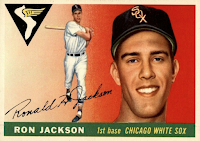
What do you suppose is happening in that action photo?  My best guess is that a ball got loose in the infield and Jackson is scooping it up while checking on a base runner.  Jackson's head shot is the same used for his rookie card, found in the 1955 Topps set.  Jackson's 6'7" height is played up in a few cartoons on the back of the card as is his successful basketball record at Western Michigan University.

1956 Season
Jackson appeared in 22 games for the White Sox in May and September, batting .214 and making 15 starts at first base.  Most of his season was spent with the Vancouver Mounties in the Pacific Coast League, managed by Lefty O'Doul.  Jackson batted .304 for the Mounties as their regular first baseman, with a team-leading nine home runs and 49 RBIs.

1955 Topps #66
1958 Topps #26
1959 Topps #73
1960 Topps #426

Other Notable Baseball Cards

First Mainstream Card:  1955 Topps #66
Topps Flagship Set Appearances (5):  1955-1956, 1958-1960
Most Recent Mainstream Card:  1960 Topps #426

14 - Jackson non-parallel baseball cards in the Beckett online database as of 1/14/22.

Sources:  
Baseball Reference
Beckett Database
SABR
The Trading Card Database