Friday, April 25, 2025

#330 Jim Busby - Cleveland Indians


James Franklin Busby
Cleveland Indians
Outfield

Bats:  Right  Throws:  Right  Height:  6'1"  Weight:  175
Born:  January 8, 1927, Kenedy, TX
Signed:  Signed by the Chicago White Sox as an amateur free agent, June 7, 1948
Major League Teams:  Chicago White Sox 1950-52; Washington Nationals 1952-55; Chicago White Sox 1955; Cleveland Indians 1956-57; Baltimore Orioles 1957-58; Boston Red Sox 1959-60; Baltimore Orioles 1960-61; Houston Colt .45s 1962
Died:  July 8, 1996, Augusta, GA (age 69)

Jim Busby spent nearly three full decades in the major leagues as both a smooth-fielding center fielder and as a coach.  He spent 13 seasons as a player, and his earlier seasons were his best.  Busby was an All-Star with the White Sox in his rookie season of 1951, and he'd play a half inning in left field in the All-Star Game, replacing Ted Williams (#5).  Busby swiped a career-high 26 bases in 1951.  He'd have his best seasons as a member of the Nationals, batting .312 with career highs in doubles (28) and RBIs (82) in 1953.  Speed in the outfield helped him finish in the top 10 for putouts, fielding percentage and assists in most of the seasons throughout the 1950s.  Busby's production declined following his departure from Washington, and he spent the final eight seasons of his career playing for six different clubs, including a repeat stint with the White Sox and two different stints with the Orioles.

Busby is one of the more underrated players from the 1950s in my opinion.  In 1,352 games, he collected 1,113 hits, 162 doubles, 35 triples, 48 home runs and had 438 RBIs, while stealing 97 bases.  He was a player-coach with the Orioles in 1961 and with the inaugural Colt .45s team in 1962.  Busby's complete coaching career spanned 18 years with the Orioles (1961), Colt .45s/Astros (1962-67), Braves (1968-75), White Sox (1976) and Mariners (1977-78).


Building the Set
July 20, 1989 in Williamstown, NJ - Card #79
In the summer of 1989, I was between my freshman and sophomore years of high school, and I have nothing but pleasant memories of that time growing up in South Jersey.  There were maybe five or six baseball card stores in our area, although only a few of them were known to carry older baseball cards.  One of those stores was located in Williamstown, New Jersey, which ironically enough is where my wife and I would settle and start to raise our family some 14 years later.  I had to dig into my notes from our other set quests to find the store's name - Collector's Corner.  We had finished off our 1974 Topps set in February 1988 at Collector's Corner.   

1977 Topps #597
July 20th was a Thursday, and I guess my Dad would have been off work with a hankering for a new card for our relatively new 1956 Topps set quest.  We were also collecting the 1973 Topps set, and with our 1956 and 1973 checklists in hand, we made the half hour drive from Millville to Williamstown.  I don't know if we purchased any 1973 Topps cards that day, but we found this Busby card for $5 - not a bad deal.  As a current Williamstown resident, I'm not even sure where this store would have been located back in the day, as a lot of the ubiquitous strip malls all look pretty much the same to me.  But it was in a strip mall, I remember that much.

I'm not exactly sure why Busby was one of my Dad's favorite players, and I wish I had thought to ask him at some point.  I suspect it has something to do with the fact they both shared the same first name, and there weren't a lot of major leaguers with the first name of Jim during my Dad's years as a young baseball fan.  Busby holds a special place for me in my collecting journey, as my Dad brought home a 1959 Topps Busby card one day back in the early 1980s.  It was one of a trio of completely disconnected (and ancient) cards added to my collection after I had first discovered baseball cards, and these were the oldest cards in my collection for a few years until the Magic Shoebox entered my life, jumpstarting the journey of collecting the 1956 Topps set.

The Card / Indians Team Set
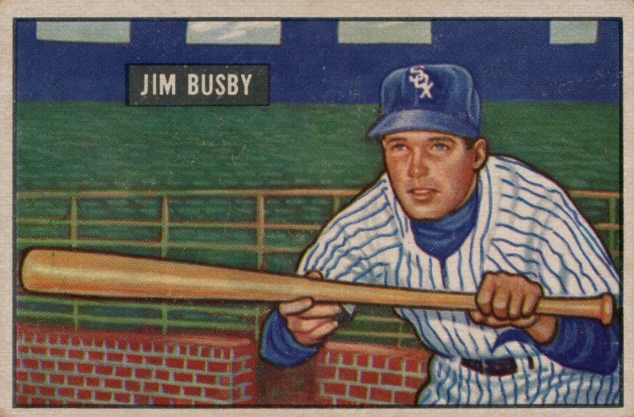
This is Busby's first Topps card since 1952, as he had been exclusive to Bowman.  It looks as if Busby is wearing a White Sox uniform in the action photo and Topps also decided to remove any infielders in the background who may have been in the vicinity of second base.  He could be wearing a White Sox or Nationals jersey in the head shot, and a Topps artist did a decent job adding the Indians logo to Busby's hat.  The back of the card highlights his speed and "great fielding ability."

On October 25, 1955, Busby was traded by the White Sox with Chico Carresquel (#230) to the Indians for Larry Toby (#250).  Topps updated the cap logos on Busby's and Carresquel's cards, but surprisingly decided to leave Doby's cap logo as is. 

1956 Season
Busby was the opening day center fielder for the Indians, and he'd start 122 games overall at the position.  In 135 total games, he batted .235 with 17 doubles, 12 home runs and 50 RBIs.  He was not able to replace Doby's output for the Indians, as had been hoped, but he did hit grand slams in back-to-back games on July 5th and 6th.

1951 Bowman #302
1952 Topps #309
1953 Bowman Color #15
1957 Topps #309
1974 Topps #634

Other Notable Baseball Cards

First Mainstream Card:  1951 Bowman #302
Topps Flagship Set Appearances (9):  1952, 1956-60, 1973-74, 1977
Most Recent Mainstream Card:  1983 Topps 1952 Reprint Series #309

55 - Busby non-parallel baseball cards in the Beckett online database as of 4/8/22.

Sources:  
Baseball Reference
Beckett Database

Friday, April 18, 2025

#329 Lou Berberet - Washington Nationals


Louis Joseph Berberet
Washington Nationals
Catcher

Bats:  Left  Throws:  Right  Height:  5'11"  Weight:  200
Born:  November 20, 1929, Long Beach, CA
Signed:  Signed by the New York Yankees as an amateur free agent before 1950 season
Major League Teams:  New York Yankees 1954-55; Washington Nationals 1956; Washington Senators 1957-58; Boston Red Sox 1958; Detroit Tigers 1959-60
Died:  April 6, 2004, Las Vegas, NV (age 74)

A steady defensive catcher with a strong arm for throwing out would-be base stealers, Lou Berberet played in parts of seven big league seasons, with most of his success coming in Washington.  Berberet earned September call-ups in 1954 and 1955 with the Yankees, appearing in a combined seven games over the two seasons.  A seven-player deal with the Nationals before the 1956 season gave Berberet a good home and more regular playing time.  He was the opening day catcher for Washington in 1956, ultimately making 54 starts behind the plate in a three-way platoon with fellow catchers Clint Courtney (#159) and Ed FitzGerald (#198).  He'd have another successful campaign in 1957, playing in 99 games while batting .261 and connecting for seven home runs and 36 RBIs.  Berberet led all catchers with a 1.000 fielding percentage in 1957.  He was dealt to the Red Sox on May 1, 1958 for infielder Ken Aspromonte, and after a season in Boston he was dealt to Detroit that December.

Berberet was the most frequently used catcher for Jimmy Dykes' Tigers team in 1959, appearing in 100 games overall, and reaching career highs in home runs (13) and RBIs (44).  His last action in the majors came in 1960 and he was the most frequently used catcher for the Tigers in his final season.  Berberet led the American League in caught stealing percentage in both 1956 and 1959.  In 448 games, he collected 281 hits, batted .230 and swatted 31 home runs with 153 RBIs.

November 22, 2007 - Thanksgiving Day
Building the Set

October 31, 2007 from Dad's eBay purchases - Card #313
Our first son Doug was born in December 2006, and this happy event led directly to my Dad visiting us on a more regular basis.  Dad was living by himself at this point in Mays Landing, New Jersey and he detested the 40 minute ride north to our house.  Among all the very positive memories I have of my Dad, one of my few negative memories is the fact that he absolutely seemed to loathe driving and that loathing increased exponentially if there was traffic or if it were dark.  But he made the trips anyway, sometimes staying no more than an hour, because he was so incredibly anxious and excited to spend time with his grandson. 

By the time his second grandson (Ben) was born in April 2010, my Dad's health had begun failing and whatever visits we had were pre-arranged or consisted of us visiting him.  Which is why these visits during Doug's infancy and first few years are so special to me.  My Dad would show up, ecstatic to see Doug, there would be some small talk and we'd complain about the Phillies, and then he'd leave.  But on his way out, he'd always say he'd see us again in a few days and I'd look forward to these visits.

This background is needed to better explain how this Berberet card came into our set.  In 2007, My Dad's days mostly consisted of an occasional round of golf, calls and visits to his kids - my sister and me, watching cable news, an afternoon nap and scouring eBay. Most (but not all) of his eBay purchases benefitted me in the form of 1956 Topps cards we needed for our set.  He'd show up at our house for a visit with Doug and nonchalantly hand me one of his recent purchases.  He handed me this Berberet card on Thanksgiving Day, as he was visiting with the rest of our family to enjoy Doug's first Thanksgiving.

Throughout 2007, I suspect he had a backlog of purchased 1956 Topps cards piled up on his desk at his house, and he'd grab one or two to deliver to me as he was heading out the door to make the 40 minute drive to visit Doug.  Not to ruin the ending for this blog, but this is how we finished the 1956 Topps set.  Not with one last glorious purchase at a baseball card show, but with my Dad systematically and methodically checking off cards from our checklist through eBay purchases.

Together with my Mom, he'd deliver the last 29 cards we needed to complete the set as a Christmas present to me that year.

The Card / Nationals Team Set
This is Berberet's rookie card, and like the Bob Wiesler (#327) card right before this one, the catcher is likely wearing all Yankees gear in both photos.  The cartoon panels on the back celebrate his arrival in Washington, his minor league success and his strong defensive skills.

This is the last Nationals' card in the set, and not including the team card, there are 18 players featured in the Nationals team set.  Of interest to probably only a few of us, Topps spelled out Nationals on 10 cards, and abbreviated the team name to Nate on eight cards, including Berberet's.

1956 Season
On February 8th, the Yankees dealt Berberet, Herb Plews, Dick Tettelbach, Wiesler and player to be named later Whitey Herzog to the Nationals for Bobby Kline and Mickey McDermott (#340).  As noted above, Berberet and two other catchers shared catching duties for the club throughout the season, with Courtney's offensive numbers a little better than Berberet's.

1957 Topps #329
1958 Topps #383
1959 Topps #96
1960 Topps #6

Other Notable Baseball Cards

First Mainstream Card:  1956 Topps #329
Topps Flagship Set Appearances (5):  1956-60
Most Recent Mainstream Card:  1961 Post #43

16 - Berberet non-parallel baseball cards in the Beckett online database as of 4/8/25.

Sources:  
Baseball Reference
Beckett Database

Friday, April 11, 2025

#328 Preston Ward - Pittsburgh Pirates


Preston Meyer Ward
Pittsburgh Pirates
First Base

Bats:  Left  Throws:  Right  Height:  6'4"  Weight:  190
Born:  July 24, 1927, Columbia, MD
Signed:  Signed by the Brooklyn Dodgers as an amateur free agent before 1944 season
Major League Teams:  Brooklyn Dodgers 1948; Chicago Cubs 1950, 1953; Pittsburgh Pirates 1953-56; Cleveland Indians 1956-58; Kansas City Athletics 1958-59
Died:  June 2, 2013, Las Vegas, NV (age 85)

Originally signed by the Dodgers before the 1944 season, Preston Ward made his professional debut with the Class D Zanesville Dodgers as a 16-year-old.  After a solid season with the Pueblo Dodgers of the Western League in 1947, Ward earned the job as the opening day first baseman for the big league Dodgers in 1948.  He'd lose playing time, and eventually his job, when Gil Hodges (#145) moved from behind the plate to first base for Brooklyn.  Ward was sold to the Cubs following the 1949 season and after playing in a utility role for Chicago in 1950, he'd miss the next two seasons while serving in the military during the Korean War.  With the Pirates in 1954, Ward collected a career-best 48 RBIs as a back-up first baseman and right fielder.  

He'd appear in a career-high 129 games in 1958, splitting time with the Indians and Ahtletics, and batting .284 with 10 home runs and 45 RBIs.  Ward hit three home runs in a game against the Orioles on September 9, 1958, and he'd retire from baseball following the 1959 season.  In 744 big league games, Ward batted .253 with 522 hits, 50 home runs and 262 RBIs.

Building the Set
August 13, 1989 in Bridgeton, NJ - Card #90
We went nuts at the Bridgeton Baseball Card Show in August 1989, buying 12 different cards for our 1956 Topps set, all at $1.50 a piece.  That's an impressive haul for $18!


I have no other information on the location of this show, other than it was held in the nearby city of Bridgeton, New Jersey.  What I do have however is the checklist I brought with us to the show.  I believe this is the second full checklist we carried around, having retired the prior version I created in 1988 and posted with the William Harridge (#1) card.

Just looking at this checklist brings back fond memories of finding the cards, deciding to make a purchase, negotiating a price and then finding a flat surface so that we could cross off the newest additions.

The Card / Pirates Team Set
Topps repeated the same photo found on Ward's 1955 Topps card for this card.  The cartoon panels on the back nicely summarize Ward's career, explaining his start with the Dodgers then his move to the Cubs and finally his super utility role with the Pirates.  By the time collectors were finding this card in packs of 1956 Topps, Ward was already playing in Cleveland - see below.

1956 Season
Ward began the season in a reserve role, getting starts at third base and in right field for the Pirates, and batting .333 in 16 games.  On May 15th, he was traded, straight-up, to the Indians for catcher Hank Foiles.  Ward would settle into a back-up role with the Indians, appearing in 87 games overall, and getting starts in left field, right field and at first base.  He batted .253 with six home runs and 21 RBIs for the Indians, in one of his best seasons in the majors.   

1950 Bowman #231
1953 Topps #173
1954 Topps #72
1957 Topps #226
1959 Topps #176

Other Notable Baseball Cards

First Mainstream Card:  1950 Bowman #231
Topps Flagship Set Appearances (7):  1953-59
Most Recent Mainstream Card:  1994 Topps Archives 1954 #72

27 - Ward non-parallel baseball cards in the Beckett online database as of 4/5/25.

Sources:  
Baseball Reference
Beckett Database

Friday, April 4, 2025

#327 Bob Wiesler - Washington Nationals


Robert George Wiesler
Washington Nationals
Pitcher

Bats:  Both  Throws:  Left  Height:  6'3"  Weight:  188
Born:  August 13, 1930, St. Louis, MO
Signed:  Signed by the New York Yankees as an amateur free agent before 1949 season
Major League Teams:  New York Yankees 1951, 1954-55; Washington Nationals 1956; Washington Senators 1957-58
Died:  August 10, 2014, Florissant, MO (age 83)

On the strength of several strong minor league seasons, Bob Wiesler was promoted to the Yankees in August 1951, pitching in his first four big league ballgames.  He'd miss all of the 1952 season while serving in the U.S. Army during the Korean War, and then spend the 1953 season back in the minors.  Wiesler pitched sparingly with the Yankees in 1954 and 1955, and a trade to the Nationals in early 1956 finally gave him a shot at regular appearances in the majors.  He'd see the most major league action of his career that season, going 3-12 with a 6.44 ERA in 37 games overall, and 21 starts.  Wiesler threw a career-high 123 innings, striking out 49 but walking an alarming 112. 

He'd spend a few more seasons bouncing between the minor leagues and Washington, pitching in his final major league game on May 10, 1958.  Wiesler spent the next three seasons attempting to mount a comeback, spending time in the Yankees, Angels and Twins minor league systems.  In 70 games in the majors, Wiesler was 7-19 with a 5.74 ERA, 113 strikeouts and 218 walks in 241 1/3 innings pitched.

1957 Topps #126
Building the Set
December 28, 2007 from Dad's eBay purchase - Card #341
This is the second to last card added to our complete 1956 Topps set.  I recently shared this full story with the Rocky Bridges (#324) post earlier this month, but I'll repeat myself, in an edited version, here.  The way my Dad and I finished the 1956 Topps set was somewhat anti-climatic but nevertheless a joyful memory.  Leading up to the Christmas of 2007, my Dad (with the help of my Mom) scoured eBay and other online baseball card stores for the remaining 29 cards we needed to complete the set.  Throughout the weeks and months leading up to the holidays, he knew we had completed the set but he kept it quiet, wanting to surprise me on Christmas morning.  I have no idea, and I'll never know, what the true last card was that he acquired to finish off the set.  And I have no record, nor was he able to tell me, how much they had paid for any of these final 29 cards.  

This Wiesler card was one of the final 29.  It was one of the commons included in a memorable haul that included the cards of Pee Wee Reese (#260), Roberto Clemente (#33), Whitey Ford (#240) and a spotless checklist card for the 1st and 3rd Series.

The Card / Nationals Team Set
Wiesler is wearing a Yankees uniform here, and Topps did an admirable job transferring him over to his new team's uniform.  The Yankee pinstripes can still be seen when you look at the card up close, and the Nationals only wore pinstripes in 1955 at home.  The cartoon panels on the back highlight his minor league success, his blazing fastball and his arrival at Griffith Stadium, the Nationals' home ballpark, for the 1956 season.  This is his rookie card.

1956 Season
On February 8th, Wiesler, Lou Berberet (#329), Herb Plews, Dick Tettelbach and player to be named later Whitey Herzog were dealt to the Nationals from the Yankees for Bobby Kline and Mickey McDermott (#340).  Wiesler and his former Yankee teammates went from the zenith of the American League to the nadir, with the Nationals losing 95 games and finishing in seventh place that season.  Wiesler slotted into the pitching rotation behind Chuck Stobbs (#68), Camilio Pascual (#98) and Dean Stone (#87), and he threw three complete games.

Other Notable Baseball Cards

First Mainstream Card:  1956 Topps #327
Topps Flagship Set Appearances (2):  1956-57
Most Recent Mainstream Card:  2006 Topps Heritage Real One Autographs #ROA-BW

5 - Wiesler non-parallel baseball cards in the Beckett online database as of 3/31/25.

Sources:  
Baseball Reference
Beckett Database

Friday, March 28, 2025

#326 Connie Johnson - Chicago White Sox


Clifford Johnson
Chicago White Sox
Pitcher

Bats:  Right  Throws:  Right  Height:  6'4"  Weight:  200
Born:  December 27, 1922, Stone Mountain, GA
Acquired:  Purchased by the Chicago White Sox from the St. Hyacinthe Saints (Canadian Provincial League) for $6,500, August 31, 1951
Major League Teams:  Toledo/Indianapolis Crawfords 1940; Kansas City Monarchs 1941-42, 1946-48; Chicago White Sox 1953, 1955-56; Baltimore Orioles 1956-58
Died:  November 28, 2004, Kansas City, MO (age 81)

Connie Johnson spent 17 seasons pitching professionally throughout North America, with his career beginning as an impressive 17-year-old with the minor league Atlanta Black Crackers and the Toledo/Indianapolis Crawfords.  Johnson was named to the East-West All-Star Game as a member of the Crawfords in 1940, the youngest player to earn that distinction.  With Hall of Famers Satchel Paige and Hilton Smith, Johnson helped lead the Kansas City Monarchs to back-to-back pennants in 1941 and 1942, before missing three full seasons while in military service during World War II.  He'd return to baseball in 1946, pitching three more seasons with the Monarchs.  Johnson made his American League debut with the White Sox in 1953, and his best seasons in that league came in 1956 and 1957 with the White Sox and Orioles.

Johnson was a combined 9-11 with a 3.44 ERA in 31 games in 1956, throwing nine complete games and a pair of shutouts.  He was 14-11 in 1957 with the Orioles, with a 3.20 ERA and a career-high 177 strikeouts.  Johnson would spend parts of two seasons with the Orioles' top farm team in Vancouver and he'd finish his career after pitching three games with the Pericos de Puebla in the Mexican League in 1961.  During most of his offseasons, Johnson continued to pitch in the Panamanian and Cuban Leagues.  In the American League, Johnson was 60-50 in 176 games, including 127 starts.  He threw 51 complete games, nine shutouts and struck out 676 in 974 2/3 innings.

December 25, 2007
Building the Set

December 28, 2007 from Dad's eBay purchase - Card #340
I recently shared this full story with the Rocky Bridges (#324) post earlier this month, but I'll repeat myself, in an edited version, here.  The way my Dad and I finished the 1956 Topps set was somewhat anti-climatic but nevertheless a joyful memory.  Leading up to the Christmas of 2007, my Dad (with the help of my Mom) scoured eBay and other online baseball card stores for the remaining 29 cards we needed to complete the set.  Throughout the weeks and months leading up to the holidays, he knew we had completed the set but he kept it quiet, wanting to surprise me on Christmas morning.  I have no idea, and I'll never know, what the true last card was that he acquired to finish off the set.  And I have no record, nor was he able to tell me, how much they had paid for any of these final 29 cards.  

This Johnson card was one of the final 29.  It was one of the commons included in a memorable haul that included the cards of Pee Wee Reese (#260), Roberto Clemente (#33), Whitey Ford (#240) and a spotless checklist card for the 1st and 3rd Series.

The Card / White Sox Team Set
Despite having already pitched professionally for 15 years, this is Johnson's rookie card.  The cartoon panels on the back of the card highlight his promotion to the White Sox in 1955, his success in the Canadian Provincial League and his consistently low ERA.  This is the final White Sox card in the 1956 Topps set.

1956 Season
Johnson began the season with the White Sox, and control problems led to an early season slump.  In five games with the White Sox, including a pair of starts, he was 0-1 with a 3.65 ERA, six strikeouts and seven walks in 12 1/3 innings pitched.  On May 21st, he was dealt with Mike Fornieles, George Kell (#195) and Bob Neiman (#267) to the Orioles for Dave Philley (#222) and Jim Wilson (#171).  Johnson turned his season around in Baltimore, going 9-10 with a 3.43 ERA in 26 games, all but one of those games as a starting pitcher.  He regained his control, striking out 130 and walking 62 in 183 2/3 innings pitched.  He threw a six-hit, 11 strikeout shutout against the Nationals on August 14th. 

1957 Topps #43
1958 Topps #266
1959 Topps #21

Other Notable Baseball Cards

First Mainstream Card:  1956 Topps #326
Topps Flagship Set Appearances (4):  1956-59
Most Recent Mainstream Card:  1959 Topps #21

14 - Johnson non-parallel baseball cards in the Beckett online database as of 3/21/25.

Sources:  
Baseball Reference
Beckett Database

Friday, March 21, 2025

#325 Don Liddle - New York Giants


Donald Eugene Liddle
New York Giants
Pitcher

Bats:  Left  Throws:  Left  Height:  5'10"  Weight:  165
Born:  May 15, 1925, Mount Carmel, IL
Signed:  Signed by the Boston Braves as an amateur free agent before 1946 season
Major League Teams:  Milwaukee Braves 1953; New York Giants 1954-56; St. Louis Cardinals 1956
Died:  June 5, 2000, Mount Carmel, IL (age 75)

Don Liddle pitched in four big league seasons, appearing in 117 games, but he was on the mound for one of the most historic moments in baseball history.  Originally signed by the Braves, Liddle was a swingman for the club in his rookie season of 1953, pitching to a 7-6 record and a 3.08 ERA in 31 games and 15 starts.  He was part of a blockbuster six-player deal with the Giants before the start of the 1954 season, and he'd have his best season that year with New York.  Liddle was 9-4 with a 3.06 ERA during the regular season, and when the Giants won the National League pennant, he'd make two memorable appearances in the World Series against the Indians.  Liddle was called upon in the eighth inning of Game 1 to face Vic Wertz (#300) with game tied 2-2.  Wertz launched a ball to deep center, artfully and memorably tracked down by Willie Mays (#130) with an overhead, back-to-the-field catch.  Liddle would start and win the decisive Game 4 agains the Indians, giving the Giants the World Championship.

He'd only pitch two more seasons int he majors, and was traded to Cardinals mid-way through the 1956 season.  Liddle was 28-18 lifetime, with a 3.75 ERA and one memorable pitch thrown during the 1954 World Series.

Building the Set
December 2, 2000 from Raleigh, NC - Card #222
I went nuts and bought 16 cards for our 1956 Topps set on this day at the Sports Card & NASCAR Collectibles Show in Raleigh.  My records show the 16 cards set me back $55 which I would have considered to be a small fortune back then.  I hadn't yet moved back north yet, so I was still living in Raleigh at this time planning for my eventual escape.  I would have provided my Dad with an updated checklist following this show as he was back in New Jersey.

The Card / Giants Team Set
Liddle appears in two Topps flagship sets, with both of his cards using the same photo.  He returned to Topps in 1956 after only appearing in the Bowman set in 1955.  I'm not sure about Topps' assertion on the back that Liddle "is one of the best control pitchers in baseball."  He walked a ton of batters and finished his career with 203 walks, compared to 198 strikeouts.  I was also puzzled by how the cartoonist represented the Cardinals in the final cartoon panel.  The Braves and Pirates are represented by the stereotypes of the day, but the "Cards" are represented by a guy in a top hat holding a deck of cards?

1956 Season
Liddle started the season in the Giants' bullpen and had his first start on May 16th, a complete game victory over the Cubs.  On June 14th, Liddle, Al Dark (#148), Ray Katt, Whitey Lockman (#205) and cash were traded to the Cardinals for Jackie Brandt, Dick Littlefield, Bill Sarni (#247) and Red Schoendienst (#165), along with two players to be named later.  Liddle struggled with the Cardinals.  In 14 games, including a pair of starts, he was 1-2 with an 8.39 ERA in 24 2/3 innings pitched.  His final big league appearance came against the Dodgers on September 19th in a 17-2 blow-out loss.  Liddle allowed a home run to Don Demeter and an RBI-double to Randy Jackson (#223) before striking out Bob Aspromonte in his last appearance on a big league mound.

1953 Johnston Cookies
Milwaukee Braves #9
1954 Topps #225
 
1955 Bowman #146
 

Other Notable Baseball Cards

First Mainstream Card:  1954 Topps #225
Topps Flagship Set Appearances (2):  1954, 1956
Most Recent Mainstream Card:  1994 Topps Archives 1954 #225

15 - Liddle non-parallel baseball cards in the Beckett online database as of 3/15/25.

Sources:  
Baseball Reference
Beckett Database

Friday, March 14, 2025

#324 "Rocky" Bridges - Cincinnati Redlegs


Everett Lamar Bridges
Cincinnati Redlegs
Infield

Bats:  Right  Throws:  Right  Height:  5'8"  Weight:  170
Born:  August 7, 1927, Refugio, TX
Signed:  Signed by the Brooklyn Dodgers as an amateur free agent before 1947 season
Major League Teams:  Brooklyn Dodgers 1951-52; Cincinnati Redlegs 1953-57; Washington Senators 1957-58; Detroit Tigers 1959-60; Cleveland Indians 1960; St. Louis Cardinals 1960; Los Angeles Angels 1961
Died:  January 28, 2015, Coeur d'Alene, ID (age 87)

The popular and at times comedic Rocky Bridges played in parts of 11 major league seasons with seven different teams.  Drafted by the Dodgers, there was no hope of Bridges cracking the middle infield for the club as it was already covered by Pee Wee Reese (#260) and Jackie Robinson (#30).  He was dealt to the Redlegs as part of big, four-team trade in February 1953.  Bridges was Cincinnati's everyday second baseman in 1953, but he'd go back to a bench role with the club for the next three seasons.  Claimed off waivers by the Senators in May 1957, Bridges would have the best span of his career between 1957 and 1959.  He was an All-Star in 1958, finishing the season with a .263 average and a career-best five home runs.  Bridges was on the move frequently in the final two years of his career, playing for four different teams.  In 919 games, he collected 562 hits and batted .247 with 16 home runs and 187 RBIs.

At the end of his career, Bridges was quoted as saying, "I've had more numbers on my back than a bingo board."  He'd coach with the Angels (1962-63, 1968-71) and Giants (1985), and when he wasn't coaching at the major league level, he was a minor league manager in the Angels, Giants, Padres and Pirates organizations through the 1989 season.

Building the Set
December 28, 2007 from Dad's eBay purchases - Card #339
The way my Dad and I finished the 1956 Topps set was somewhat anti-climatic but nevertheless a joyful memory.  Leading up to the Christmas of 2007, my Dad (with the help of my Mom) scoured eBay and other online baseball card stores for the remaining 29 cards we needed to complete the set.  Throughout the weeks and months leading up to the holidays, he knew we had completed the set but he kept it quiet, wanting to surprise me on Christmas morning.  I have no idea, and I'll never know, what the true last card was that he acquired to finish off the set.  And I have no record, nor was he able to tell me, how much they had paid for any of these final 29 cards.

December 24, 2007 - Doug and Dad
Our son Doug had just turned one, and on Christmas morning 2007, we were anxiously awaiting the arrival of our families to our house to celebrate the day.  I've had a few rough Christmases, but this was one of the worst as my Dad ended up in the hospital that day and it was the beginning of his health struggles that would continue until he passed away in late 2011.  He was discharged from the hospital three days later, and it was only then we celebrated Christmas together, on December 28th, and I opened the package containing the last of the cards needed for our 1956 Topps set.

Dad was understandably distraught that Christmas, but not solely because of his own health issues.  Because of his unselfish nature, he was worried that he had ruined Christmas for everyone since we had spent the holidays in a hospital.  He was also upset that his surprise package containing those last 29 baseball cards sat in the back seat of his car for three days until he recovered enough to come home.  I was just happy to have him out of the hospital, but I do remember feeling confused and somewhat hopeless as we weren't quite sure yet what was wrong with him.

I don't have any pictures from December 28th, which is unusual for me.  I'm assuming I was just happy that Dad was out of the hospital and taking pictures never crossed my mind.  Among the "big" cards in that final haul were the cards of Roberto Clemente (#33), Monte Irvin (#194), Whitey Ford (#240), Pee Wee Reese (#260) and the Checklist covering Series 1 and 3.

The Card / Redlegs Team Set
The Great American Baseball Card Flipping, Trading and Bubble Gum Book said Bridges "looked like a ballplayer. In fact, he may have looked more like a ballplayer than any other ballplayer who ever lived."  

That's quite an action shot on the card of Bridges mid-air, about to dive into second base.  This card marks Bridges' return to Topps after being exclusive to Bowman between 1953 and 1955.  He's wearing a Dodgers' road jersey here, colored red, as the Redlegs' uniforms did not have any piping around the color and the Dodgers' did.

1956 Season
In 71 games with the Redlegs, Bridges batted .211 (4 for 19) with nary an extra-base hit and not a single RBI.  Manager Birdie Tebbetts didn't pencil Bridges' name into the starting line-up once all season.  His contribution to the team was as a defensive replacement at each infield position, but most frequently filling in for third baseman Ray Jablonski (#86).  Bridges only pinch-hit twice all year, and was used as a pinch-runner 21 times.  It's amazing Topps included him in this set, as those numbers would definitely see him omitted from the 2025 Topps set. 

1952 Topps #239
1957 Topps #294
1958 Topps #274
1959 Topps #318
1961 Topps #508

Other Notable Baseball Cards

First Mainstream Card:  1952 Topps #239
Topps Flagship Set Appearances (7):  1952, 1956-61
Most Recent Mainstream Card:  2010 Topps Heritage Real One Autographs #ROA-RB

63 - Bridges non-parallel baseball cards in the Beckett online database as of 3/7/25.

Sources:  
Baseball Reference
Beckett Database